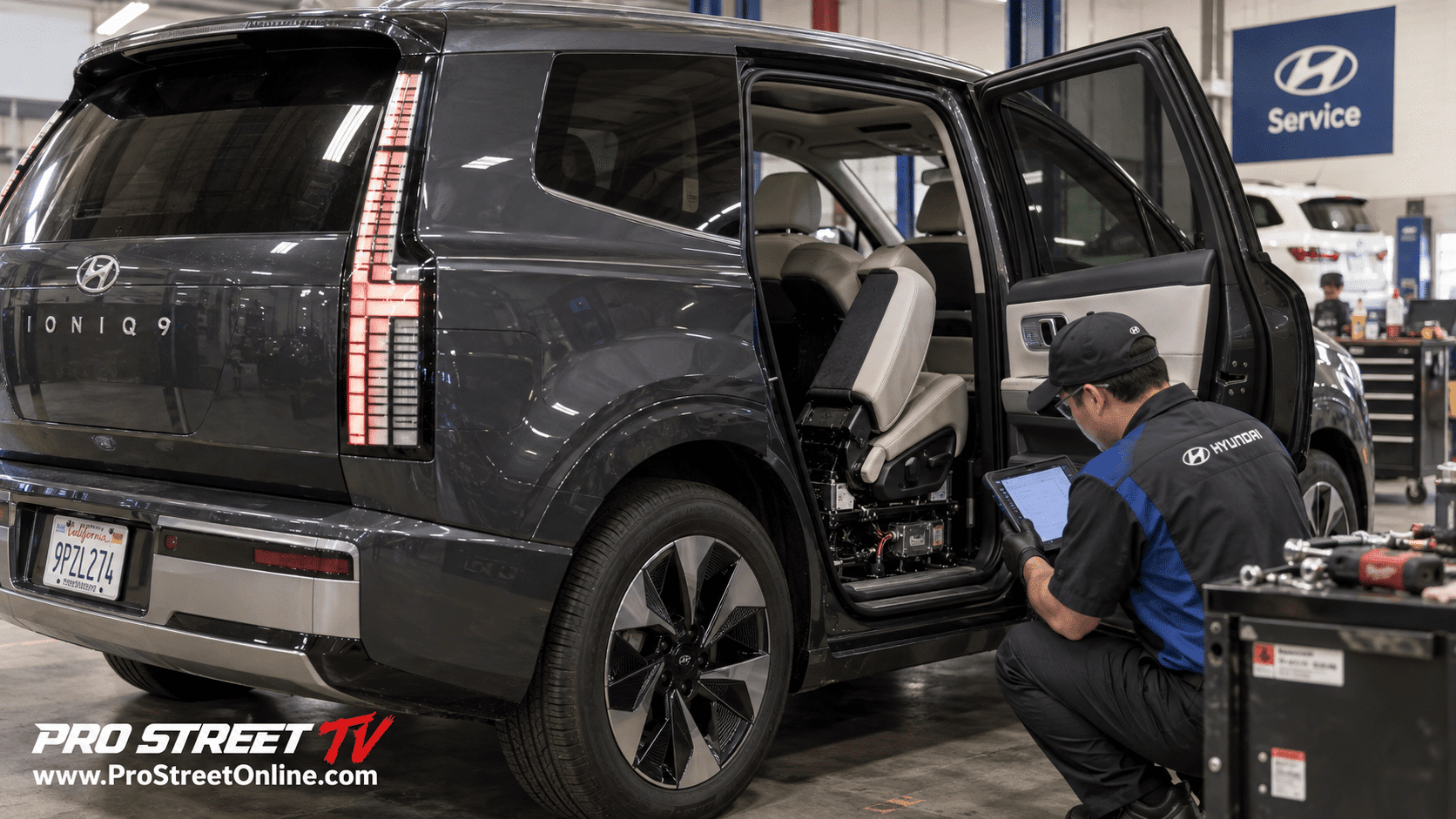
A button on the door panel folds the whole second row flat in seconds, a trick families lean on at every curbside pickup.
It feels like magic in a showroom.
Inside one popular three row electric SUV, that same motion just got a federal warning label.
Government filings describe seats that do not always know when they have found a person.
They keep moving anyway.
How a seat is supposed to know you are there, and why some did not
Power folding seats rely on a built in force sensor that watches how much resistance the motor feels as it moves. When the resistance spikes, the logic is supposed to read that as a hand, a knee, or a small body in the way, then stop or reverse the seat before real pressure builds.
That detection lives entirely in software, not in a simple mechanical switch, so it depends on the controller correctly judging ordinary resistance against resistance caused by a person. Hyundai’s own filing says the second row seat assemblies in certain Ioniq 9 trims may not respond to contact with an occupant or object as intended during fold and stow, according to the recall report filed with safety regulators.
So instead of the seat recognizing a stuck sleeve or a leg and easing off, the mechanism just keeps going. That is the entire mechanism behind the recall, a misread force signal that sometimes gets the resistance reading wrong at the exact moment a person is in the way.
Inside the cabin where the feature was supposed to shine
The Ioniq 9 is Hyundai’s largest and most expensive electric SUV, built around three rows and marketed heavily on cargo flexibility for families. The power fold second row is one of the signature convenience features on its higher trims, letting a driver clear space for strollers or luggage without climbing into the cabin.
Which is exactly why the defect lands where it does. Vehicles in this segment are often marketed for their spaciousness and peace of mind for parents, so this recall carries extra weight.
A feature sold as one touch convenience becomes a moment parents now have to watch closely. The recalled population covers three specific trims, all built around the same automatic fold hardware.
The affected vehicles are certain Ioniq 9 SUVs in the Limited, Calligraphy, and Calligraphy Design trim packages. Lower trims without the automatic power fold hardware are not part of the campaign.
What regulators found and how big the recall actually is
Hyundai is recalling 5,360 of its 2026 Ioniq 9 SUVs in the United States over the seat defect. The automaker estimates that every single recalled vehicle has the fault, meaning this was not a rare glitch limited to a handful of cars but a condition built into every unit with the affected hardware.
The problem surfaced through a short but pointed investigation. A three month inquiry followed five consumer complaints, during which Hyundai received two reports of minor injuries.
Those numbers are small next to total sales, but regulators treat seat entrapment risk as serious regardless of complaint volume. Engineers eventually pinned the cause down to how the seat system reads force during movement.
By early September, both the automaker and regulators agreed a recall was warranted based on force measurements taken during second row power folding and stow operations. That detail matters because it shows the defect was confirmed with physical testing, not just guesswork from complaint letters.
Where this fits a wider pattern, and where it does not
This is not Hyundai’s first brush with powered rear seats this year. Earlier in the year, a related but separate issue touched a different nameplate entirely.
In March, Hyundai filed a separate campaign covering 61,093 Palisade Limited and Calligraphy models, gas and hybrid, whose second and third row power seats could also fail to detect an occupant during folding. That earlier case carried higher stakes.
It echoed an issue that led to a recall and stop sale order on the Palisade last year after a fatality. The Ioniq 9 recall is smaller in scale and, so far, tied only to minor injury reports, not a death, an important distinction even though the underlying mechanism looks similar.
Other automakers have hit versions of the same problem too. Earlier this year, a Detroit automaker recalled over 14,000 Vistiq electric SUVs because their third row seats could trap children, a reminder that power folding seats across the industry share the same basic vulnerability once the convenience feature depends on software judgment calls rather than a hard mechanical stop.
What owners can do right now and what changes next
Until the fix lands, the instructions are plain. Hyundai says owners of potentially affected vehicles should exercise caution when operating the second row power folding functions.
Families with young children are specifically urged to keep them clear of the rear seating area whenever the fold button is pressed. The remedy itself is simple by recall standards.
Dealers will inspect the vehicles and install updated seat controller software free of charge, and much of that fix can reach cars without a shop visit at all. Because Hyundai can push it over the air, many owners may never need a service visit.
Which is the quieter upside buried in this story. The same software layer that let a force sensor misread a person’s weight is the layer that lets Hyundai rewrite the logic remotely and roll it out across thousands of cars within weeks, a repair speed no mechanical recall could ever match.
For families with an Ioniq 9 in the Limited or Calligraphy trims, the sensible move is to check the VIN, confirm the update has installed, and keep an eye on the second row until it does. That habit mirrors how owners of other newly electrified vehicles are learning to track software fixes the way they once tracked oil changes, a shift already visible in how automakers handle everything from hands free driving features to new battery platforms arriving across the EV lineup.
