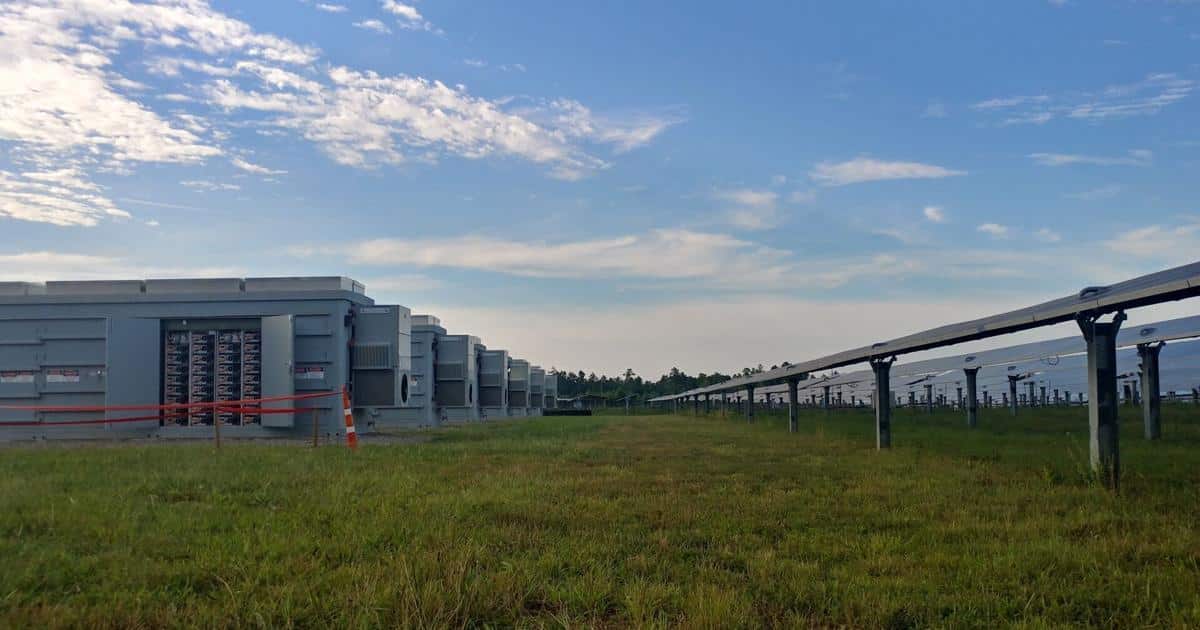
A gravel lot outside Columbus has gone from empty field to steel skeleton in a matter of months.
Crews are bolting together rows of container sized battery units on a fifteen acre site in Licking County.
By next year those boxes will be able to hold more electricity than almost any other battery in a thirteen state region.
The scale is hard to picture from the road.
So what actually makes one battery big enough to carry that title, and how does it work once the power starts flowing?
How a battery this size actually stores and releases power
At its core, the project called Flint Grid is a collection of thousands of lithium cells packed into standardized containers, each wired into a shared electrical system. The developer, Eolian, says the battery energy storage system will be able to deliver 200 megawatts of power for more than five hours in Jersey Township, Licking County, which is what gives it its unusual size. That duration matters as much as the raw power figure.
A short burst battery can cover a brief spike in demand. Five hours of steady output is different, letting the facility carry a neighborhood or an industrial customer through an entire evening demand peak.
Charging happens when electricity is cheap, often overnight or during sunny midday hours when solar power floods the grid. The stored energy then gets released later, acting as a buffer between when power is cheap to make and when it is needed most. None of that is new in concept, but doing it at this scale in a region that barely built batteries until recently is.
The site taking shape outside a fast growing data center corridor
The location is not an accident. The Flint Grid battery energy storage system (BESS) project is located next to New Albany data center and industrial load, an area where electricity demand has climbed sharply as new facilities come online, straining local substations and transmission lines that were never designed for this kind of growth.
Because that corridor pulls so much power, the grid operator needs flexible backup capacity nearby rather than relying entirely on distant power plants. A battery placed close to the load can respond in seconds.
The developer announced in a press release that Flint Grid, a 200MW, 5+hour duration grid-scale battery energy storage system in Jersey Township, Licking County, Ohio, has started construction. Crews are now assembling container units and wiring them into surrounding infrastructure, work expected to continue into next year.
What makes this specific project a genuine first for the region
The record claims here are concrete and stack on top of each other. Eolian says Flint Grid will be the largest battery energy storage project in Ohio and across PJM, the regional grid operator serving 13 states and Washington, DC. Beyond sheer size, the project also cleared a regulatory first, as the first grid-scale battery project permitted by the Ohio Power Siting Board, a process the state had never applied to a standalone battery before.
It broke new ground financially too. Eolian says Flint Grid is the first large-scale battery project to qualify for PJM’s capacity market.
It was also the largest single battery to clear the grid operator’s 2027-28 capacity auction, accounting for more than half of the new battery capacity selected for that delivery year. That detail explains why one project carries so much weight, since clearing a capacity auction means planners are now counting on this battery during stress periods, a role traditionally reserved for power plants.
Why PJM has lagged so far behind other grids on batteries
PJM had just over 400 MW of utility-scale batteries online in the third quarter of 2025, compared with about 17.9 GW in ERCOT and 15.8 GW in CAISO.
That gap did not happen by chance. For years, interconnection backlogs and a slow permitting process made it difficult for battery developers to get projects approved and connected inside the PJM footprint, a pattern echoing the kind of queue backlog pressure that has slowed storage projects nationwide.
Even so, the pipeline behind Flint Grid suggests the region is catching up fast. Developers have proposed nearly 200 battery storage projects in PJM representing tens of gigawatts of capacity, according to the grid operator’s interconnection queues.
What the Ohio project signals for the grid going forward
None of this means batteries have suddenly solved the region’s power squeeze. A single 200 megawatt project, however record setting, is still a small fraction of the thousands of megawatts regional planners say will eventually be needed.
Even so, Flint Grid functions as a proof point. It shows a region long considered slow on storage can site, permit and finance a project large enough to matter inside a competitive power market, mirroring the same instinct behind programs that reward automated charging schedules to smooth out peak hours elsewhere on the grid.
For the data centers and factories crowding into central Ohio, the upshot is simple. A battery on fifteen acres outside Columbus is set to carry real grid responsibility starting next year, a weight this part of the country rarely asked a battery to bear.
