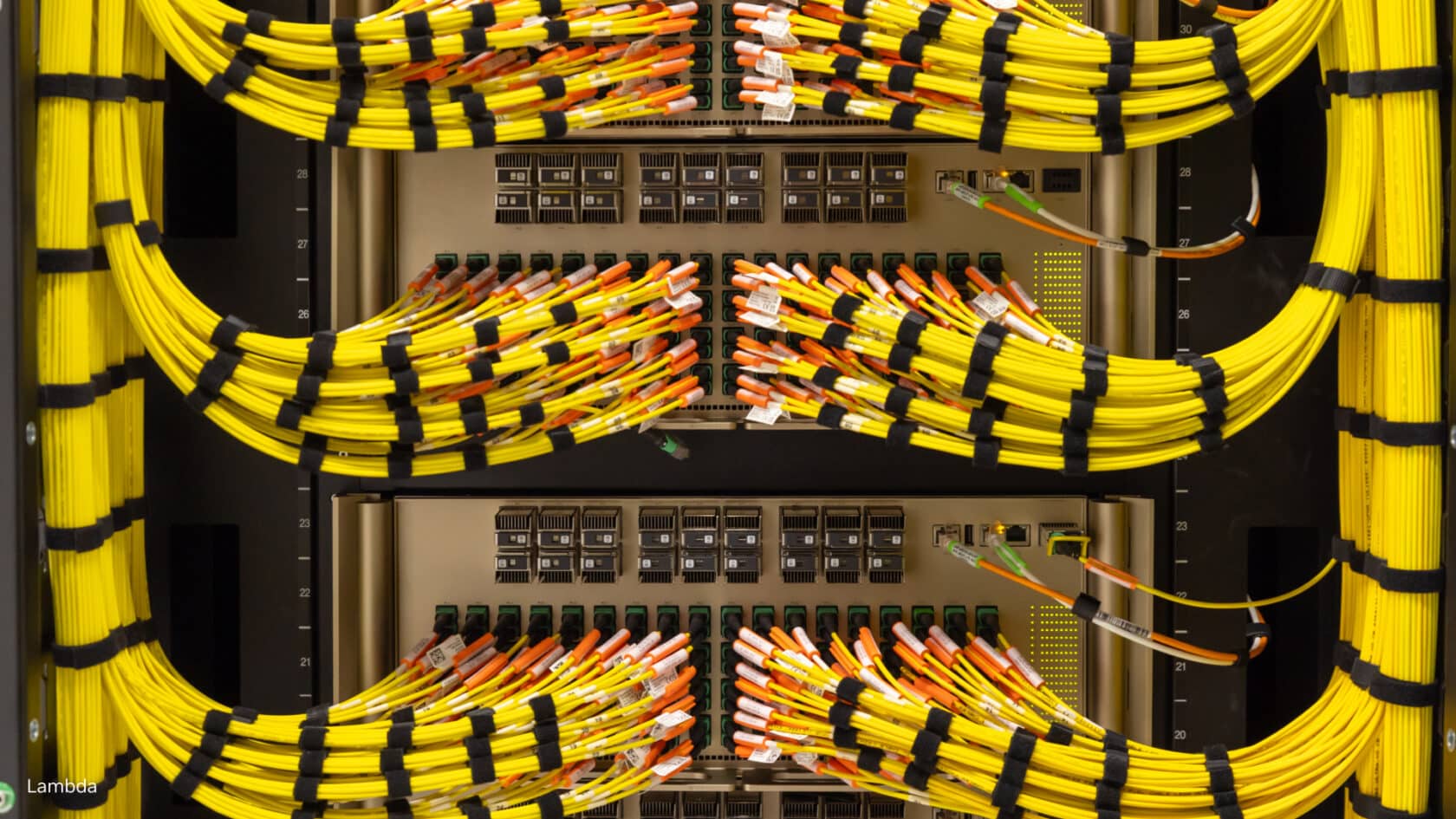
Lambda has deployed NVIDIA Photonics co-packaged optics switches across a cluster of more than 10,000 NVIDIA Blackwell Ultra GPUs at its Quebec data center campus, in what the companies describe as the world’s first large-scale deployment of the technology running production AI workloads.
The announcement came November 16 at the SC26 supercomputing conference in Chicago.
What the deployment connects
To train an AI model, thousands of GPUs have to work together, requiring a network that’s fast, efficient and resilient, and Lambda is tackling the network piece of the puzzle with NVIDIA Photonics co-packaged optics (CPO) switches, using the switches to connect NVIDIA GB300 NVL72 racks with more than 10,000 GPUs, delivering lower power, higher resiliency and longer mean time between interruptions (MTBI) to an AI factory at scale, according to NVIDIA’s official blog post.
The Quebec deployment uses NVIDIA Photonics switches, each with 144 ports running at 800Gb/s.
The Quebec campus operates with 142 MW of secured, nearly 100% renewable energy capacity, enables free cooling up to 80% of the year, and is guaranteed to a PUE of 1.2, with no process water consumption associated with server cooling, Lambda said in its own announcement carried over Business Wire.
Replacing pluggable transceivers
Co-packaged optics integrates the components that convert electrical signals into light directly onto the switch package next to the processing chip, rather than housing them in separate pluggable modules at the front panel.
As AI clusters grow, networking infrastructure becomes increasingly critical to connecting thousands of GPUs efficiently. Unlike conventional pluggable optics, which convert electrical signals to light at the switch’s front panel, CPO places optical engines alongside the switch ASIC, shortening the electrical path from inches to millimeters.
This reduces signal loss, eliminates the need for retimer chips, and increases network resiliency. In benchmarks across rack, scalable unit and pod configurations, Lambda found CPO maintained identical throughput and more stable signal integrity than conventional pluggable optics, while delivering lower latency at every scale, with the gap growing from 3.8% at rack scale to 10.1% at pod scale. NVIDIA says its photonics switches deliver up to 15x higher reliability, so Lambda’s customers get more productive GPU hours from their investment, according to Gilad Shainer, Senior Vice President Networking at NVIDIA.
Lambda also reported a cooler-running system in practice: more stable signal integrity and a median optics temperature of 36°C, compared with 51°C for the pluggable configuration.
What Lambda’s executive said
Dave Ward, president of cloud services at Lambda, framed the shift as a networking response to the scale of modern AI training clusters.
“Networking has to keep pace with the demands of increasingly large AI clusters. Bringing co-packaged optics into a deployment of this scale is an important step toward building the efficient and resilient infrastructure needed to support the next generation of AI,” Ward said.
The milestone builds on groundwork Lambda laid earlier this year. Following its early adoption of NVIDIA CPO networking, first announced in November 2025, Lambda benchmarked the technology against conventional optics, demonstrating lower latency and improved signal stability at scale, according to HPCwire’s coverage of the announcement.
Why networking has become a bottleneck
As AI training runs scale past tens of thousands of GPUs, the network linking those chips together has become as important to overall performance as the processors themselves, since in a large training job, one interrupted link can stall thousands of GPUs.
Companies managing fleets at this scale increasingly rely on fine-grained monitoring tools, an area where NVIDIA recently launched its Minerva platform to track sprawling GPU deployments, and optimized model training pipelines, an area where tools like Google’s Gemini models for coding have also drawn industry attention for infrastructure efficiency.
NVIDIA has said it plans to extend co-packaged optics across both its Quantum-X InfiniBand and Spectrum-X Ethernet switch lines, positioning the technology as a building block for data centers aiming to connect well beyond a million GPUs as AI workloads continue to grow.
