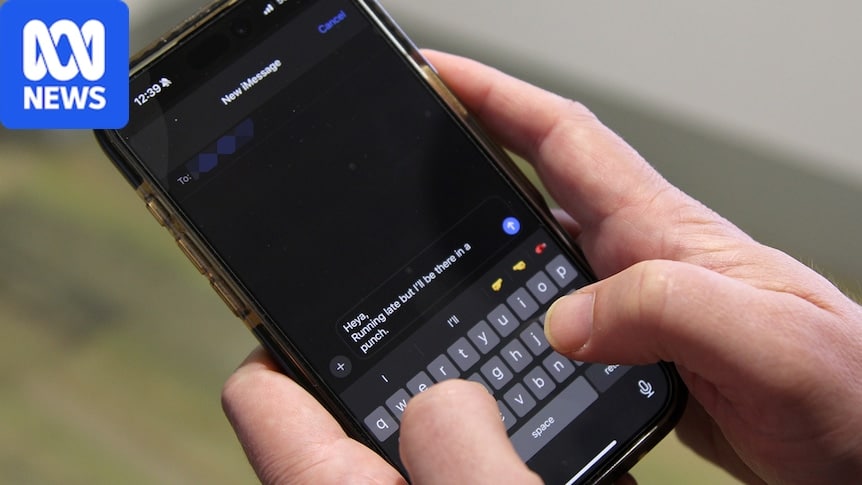
A thumb hovers over a glass keyboard before a single letter lands.
Three faint words already float above the keys, waiting to be chosen.
Nobody asked for them, yet almost nobody deletes them either.
Billions of these tiny choices happen every day on phones across the country.
So what is actually deciding which word gets offered first, and why does it matter what people pick?
How the keyboard decides what you meant to say
Every modern phone keyboard runs a small language prediction engine that works in two directions at once. Autocorrect looks backward, fed by the keys just pressed, while predictive texting looks forward, fed by completed words to guess the most likely next word or phrase. That split is the entire trick behind the suggestion bar.
Because touchscreens are imprecise, the system never assumes a tap hit the letter it was aimed at. The keyboard looks at the surrounding letters and tries to work out whether the user meant to hit the letter they did, or whether they were actually aiming to hit an adjacent key, depending on how close they were to the edge of the key. A clumsy thumb still lands on a real word almost every time.
Behind that sits a massive frequency database built from ordinary writing, what linguists call a corpus. Every suggestion is really a probability ranking pulled from that corpus, not a dictionary lookup, and it narrows fast to fit you specifically.
When you consistently reject certain proposals, the algorithm quietly reduces the odds of repeating them. The keyboard is constantly rewriting its own guess about who you are.
Three words, one habit, repeated billions of times a day
Picture the ordinary moment this plays out. A commuter taps out a reply at a red light, eyes flicking between the road and the screen, and the suggestion bar is already filled before the brain finishes the sentence.
That bar is not neutral furniture. It is a live leaderboard of candidate words, reranked after every keystroke, and the top slot usually wins because it sits closest to the thumb.
So the texter is not really composing from a blank page anymore. They are picking from a short, pre-filtered menu, the way a diner chooses from a printed list instead of inventing a dish.
That shift from writing to selecting happens fast, and it happens constantly. People who would never read a style guide get nudged toward the same safe, common phrasings every time they reach for a word, not unlike how a thumbs-up reply can carry more weight than anyone intended.
What researchers actually measured when they tested it
The clearest test of this effect came from a Harvard-affiliated writing experiment that put the suggestion bar under controlled conditions rather than everyday guesswork. In a study titled Predictive Text Encourages Predictable Writing, researchers conducted a within-subjects study with 109 participants who wrote a total of 1,308 image captions while varying characteristics of the predictive suggestions.
Before they typed a single word in one condition, the app suggested labels such as “woman,” “man,” or “person” along the top of the keyboard , forcing every writer to react to a menu rather than start from nothing.
The result held up across the sample. When predictive suggestions are enabled, participants could catch more typos, but their writing also became more succinct and predictable. Fewer spelling errors arrived bundled with flatter, more interchangeable sentences.
The researchers summed up the core finding plainly: “Thus, predictive text led to more predictable writing.” The individual flavor in people’s word choices had effectively been predicted away.
Where the effect gets complicated and stops being simple
None of this means every phone user types like a robot now. The homogenizing pull is statistical, showing up across large groups of writers rather than guaranteeing any single text will sound generic.
Context pushes back constantly. Slang, inside jokes, and regional phrasing survive, because when someone regularly types jargon or informal expressions, the algorithm gradually folds those terms in and suggests them more readily. The system adapts to the user almost as often as the user adapts to it.
Even so, the newest layer of prediction goes further than old T9 phones ever could. An emerging application of neural language models is smart software keyboards that provide next-word prediction, with apps like SwiftKey advertising the use of neural networks for predictions , the same broad family of technology, built at a much smaller scale, behind today’s largest chatbots.
That raises an open question: whether a generation that writes mostly through suggestion bars develops a narrower working vocabulary than one that typed on blank keypads. A similar generational split already shows up in how differently younger phone users treat a missed call.
What it means for anyone who taps a keyboard today
The practical takeaway is not to panic about a flattened vocabulary. It is to notice the choice already being made for you dozens of times a day.
Because the system rewards speed, most people will keep accepting the top suggestion without a second thought. That is a reasonable tradeoff for a grocery list or a one-line reply, and convenience earned its place in the pocket for good reason.
Yet the same mechanics that smooth out a rushed text also smooth out the sentences people care about getting right, like a message to a close friend or a group built on shared enthusiasm. A pause before tapping the suggestion costs almost nothing.
What stays open is how far more powerful language models will push that pull as they learn from ever larger piles of human writing. For now, the bar above the keyboard remains a constant quiet offer to let someone else finish the thought.
