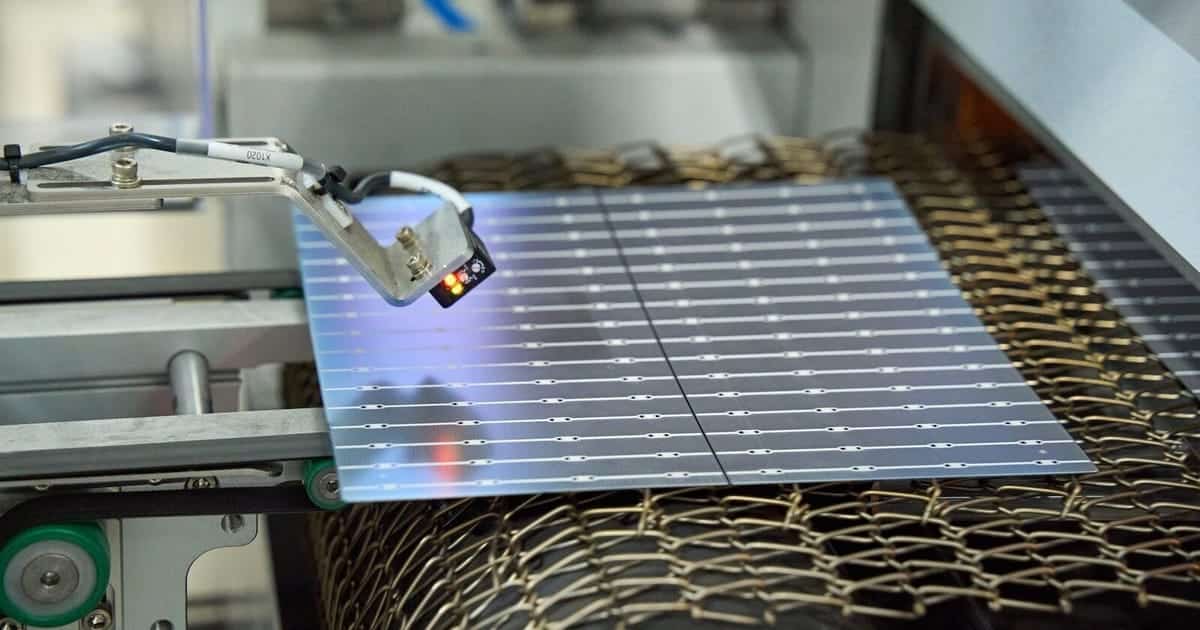
A block of silicon the size of a coffee can rolls off an American production line.
It is destined for a solar panel bolted to a roof in Ohio or a field in Texas.
But that block, called an ingot, often does not go straight to the next machine down the hall.
Instead it gets packed into a shipping container and crosses an ocean.
It gets sliced into wafers thinner than a fingernail, then sails back to finish the job.
So why does a finished American ingot need a trip abroad at all?
What the factory floor actually looks like today
A solar panel does not get built in one motion. It moves through five distinct physical stages, and each stage demands different machinery: raw polysilicon gets melted and pulled into a solid ingot, that ingot gets sliced into wafers, each wafer gets processed into a working cell, and only then do cells get wired together into a finished module.
The United States has plenty of capacity at both ends of that chain. Polysilicon refining and final module assembly attracted the earliest investment, because they are the most familiar stages to scale with existing furnace and automation designs.
So the wafer stage, sitting in the middle, became the stage nobody built fast enough. Slicing an ingot into wafers without cracking it or wasting the silicon requires wire saws and polishing lines that are expensive, precise and slow to install.
That gap is why a finished American ingot often has nowhere domestic to go. Industry trackers describe the result bluntly: with wafer capacity this constrained, a US-produced polysilicon ingot often must be shipped abroad to be sliced into wafers, then returned to the country for processing into a cell , according to PV Tech’s supply chain analysis.
Why a finished American ingot takes a trip abroad before it becomes a cell
Picture the chain stretched out as real buildings. A polysilicon refinery in the Pacific Northwest turns quartz rock into ultra pure silicon chunks. Those chunks travel to a furnace that melts and regrows them into a cylindrical ingot, a process that looks closer to crystal growing than to cutting metal.
From there, the ingot should move next door to a wafering line. Instead, for most of the industry, it moves to a port.
Domestic wafering capacity, not domestic polysilicon or cell capacity, is the tightest bottleneck in the chain, and it is the stage that has attracted the least investment relative to the gap it needs to close , per PV Tech’s analysis.
Meanwhile the back end of the chain looks almost the opposite. Assembly lines that snap finished cells into glass and aluminum frames have multiplied across Georgia, Ohio and Texas, racing ahead of the materials needed to feed them, a pattern this desk has tracked where a wire saw shaves silicon wafers inside the few plants that do exist.
That imbalance did not happen by accident. Billions in incentives rewarded finished panels first, because panels are what utilities and homeowners actually buy, so the stages invisible to a buyer got built last and smallest.
The numbers that show just how lopsided the chain has become
Industry figures compiled by PV Tech Research put real numbers on the imbalance. US wafer capacity is just 5GW, against production of 3.2GW, which currently covers less than 63% of the crystalline-only cell segment it feeds , one stage downstream.
That 5 gigawatts also barely touches the polysilicon sitting above it in the chain. Wafer capacity utilises only 20% of the polysilicon capacity sitting above it that American refineries are already equipped to produce.
Compare that to the finish line. The Solar Energy Industries Association (SEIA) estimates that as of early 2026, US solar module manufacturing capacity increased 50% annually to 65GW , more than ten times the wafer stage supposed to feed it, a mismatch confirmed separately by reporting that active capacity from Hanwha Qcells and Corning provides only 5.3 GW, leaving the rest of the market dependent on imports .
So nearly every cell going into an American made module still began life as an imported wafer. Two companies account for almost the entire domestic ingot and wafer supply, which means a single equipment delay at either one ripples through the whole national assembly line.
Where the gap is already starting to close, and where it is not
Federal policy has started treating that round trip as a problem worth fixing rather than an industry quirk. A proclamation signed this past summer imposes new trade measures on the stages in between, and the Secretary recommended that these two remedies be accompanied by an onshoring program to encourage companies to build new United States polysilicon, ingot, wafer, and cell production facilities, according to the White House proclamation.
Even so, new wafer lines take years to plan, permit and ramp. Norway’s NorSun had planned a 5-GW ingot and wafer factory near Tulsa, Oklahoma, but the project has run into serious trouble, with the company’s website going dark and its plans for the site now in doubt.
Other vertically integrated projects in Georgia are only now moving cell production into full operation, so the physical slicing capacity on the ground still lags the policy intended to reward it. Qcells on Tuesday said it started manufacturing solar cells at its factory in Cartersville, Georgia, a major step toward having a fully domestic solar supply chain , with full production expected in Q3 2026 for ingots, wafers and solar cells with 3.3GW annual nameplate capacity each . A furnace that grows ingots can run within months of breaking ground, but a wafering line that slices them thin enough without wasting a third of the silicon to dust takes considerably longer to tune and certify.
Why this middle stage matters more than it looks
This gap matters well beyond factory balance sheets. Every ingot that leaves the country and comes back adds shipping time and cost to a product that is supposed to prove it was built in America from the ground up.
That traceability question is becoming its own hurdle. Developers trying to prove a panel never touched restricted foreign supply chains find that import dependency at the cell and wafer stages will remain challenging to guarantee for several more years, no matter how domestic the final assembly looks, since producers remain heavily dependent on imports of upstream components such as wafers, ingots and polysilicon.
Still, the direction is set even if the pace is not. Refineries, furnace lines and a wave of new wafer investment are aimed squarely at the one stage that has quietly decided how domestic an American solar panel really is, a lesson already playing out in battery supply chains tracked in EIA battery storage forecasts. Closing a gap measured in gigawatts never happens overnight, but for the first time the middle of the chain is getting the attention the two ends have had for years.
