A pickup truck rolled past a hand painted mile counter on its dashboard, and the number kept climbing long after everyone expected it to stop.
Drivers swapped seats in one hour shifts.
The speedometer barely nudged past walking pace.
Engineers outside Detroit watched a battery gauge refuse to hit zero.
By the time the truck finally went dark, it had rewritten what an electric pickup is supposed to do.
So how did a stock truck travel more than twice its rated distance on one charge?
The driving trick that made the extra miles possible
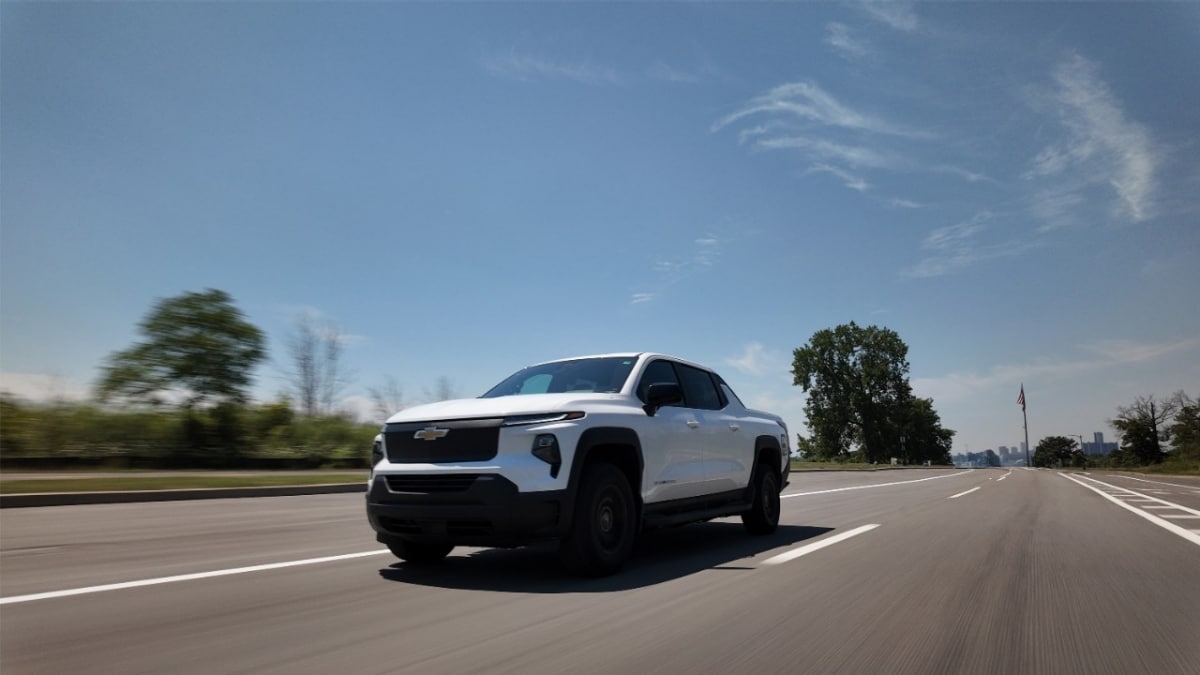
The mechanism was not a secret battery or a hidden fuel tank bolted under the bed. It was speed held to a crawl, paired with a production Silverado EV that nobody touched under the hood. The test used a stock Silverado EV, with no hardware or software modifications, proving the capability of the production model. Test drivers were asked to change their habits along with making a series of setting adjustments, including maintaining an average speed of 20-25mph, minimise hard braking and acceleration, and turning off climate control. The trip computer confirmed the totals: 1059.2 miles traveled, averaging 4.9 miles/kWh, roughly doubling the EPA rating.
That consumption figure is the whole story. Electric motors lose far less energy to air resistance at a crawl than at highway speed, so cutting speed in half can nearly double the miles a pack delivers.
Official filings confirm the pace that made it work. The team found the Silverado EV’s most efficient cruising speed to be 20-25 mph. That is a realistic pace for neighborhood or city driving in southeast Michigan, and at that speed the truck was putting nearly all of its battery power into forward motion rather than other systems.
Crucially, nothing mechanical changed. The truck’s hardware and software were unmodified, meaning anyone with a Silverado EV could theoretically achieve the same range, with enough determination. Any owner could, in theory, chase the same number.
Inside the record attempt near Detroit
The setting was unglamorous on purpose. A group of 40 employees drove a production Silverado EV WT, the cheapest, lightest trim, on public roads surrounding the company’s Milford Proving Ground, as well as Detroit’s Belle Isle, over seven days to set the record. There was no closed track and no wind tunnel, just the same stretch of pavement circled for days.
What they were driving mattered as much as how. The truck was a Silverado EV Work Truck with the Max Range pack, which stores 205.0 kilowatt-hours thanks to its massive battery pack , one of the largest packs sold in any full-size electric pickup on the market today.
Even so, nobody expected triple digit growth over the sticker number. Initial estimates ranged from 800 to 1,000 miles, setting a high bar for the team. The truck kept rolling well past the last of those, which is when the team on site finally allowed themselves to celebrate.
Once it stopped, the crew marked the moment with a flourish. The Silverado EV that set the record was recharged and powered up a 3D printer that printed a trophy to honor the team’s accomplishment , a playful coda to a grinding endurance test.
Where the number comes from and who confirmed it
The figure is not a marketing round number. GM says it set a new EV range record with a 2026 Chevrolet Silverado EV Max Range Work Truck, EPA-estimated for up to 493 miles, going 1,059.2 miles on a full charge during a range test executed by the GM engineering team. The automaker published the full account of the run, including photos of the trip odometer at the finish.
That detail matters because this was not an anonymous claim. The run beat an existing benchmark set only weeks earlier, when the previous record, held by the Lucid Air at 749 miles, stood for less than a month before the Silverado EV broke it. The Lucid Air is a luxury sedan rather than a pickup, so the two vehicles were competing for the same overall EV range title rather than a truck-specific one.
The base truck used is not exotic. Multiple outlets that tracked the attempt put the Work Truck’s starting price around $55,000, placing the record holder well inside mainstream full size truck pricing.
Independent outlets that tracked the attempt reached the same total, describing 1059.2 miles (1704.6km) on a single charge during a range test by GM engineers. That consistency across separate reports is part of what makes the figure credible rather than promotional noise, though GM’s own account frames it as a company-run test rather than an independently officiated contest.
The catch every driver should understand
None of this means a typical commute now stretches to four figures. The test leaned on conditions almost no real trip replicates. This feat does not mean every Silverado EV buyer can expect to drive 1,000 miles per charge. In real-world highway driving, at speeds closer to 70 mph with passengers, cargo, and air conditioning, expect the Silverado EV to deliver range close to its official 493-mile spec.
That gap is the honest limit of the exercise. Hypermiling trades time for distance, and most owners will not spend seven days covering ground a highway trip handles in sixteen hours.
Towing erases even more of the cushion. A loaded bed or hitch can cut an electric truck’s range sharply, similar to other full size electric pickups on the market today.
Cold weather adds another variable the test avoided entirely. Drivers chasing maximum efficiency numbers in summer, as this test was run, will not see the same math once heating systems and dense winter air pull against a pack’s stored energy.
What the record actually signals for buyers
Even with those caveats, the attempt reset expectations for how much headroom a modern pack carries beyond its window sticker. That gap between rated and demonstrated range is now part of the sales pitch for electric trucks chasing skeptical buyers.
Shoppers comparing electric SUVs priced near the mainstream are weighing worst case range alongside sticker range, and stunts like this one give them real numbers to anchor against.
It also lands as used electric trucks move unevenly through wholesale auction lots nationwide, where buyers increasingly ask about real world battery performance before bidding.
For now the 1,059.2 mile mark stands as the longest distance GM has documented for a production electric vehicle on a single charge in a company-run test. Whether a rival beats it again this year remains open, and nobody in Detroit is betting it stands for long.
