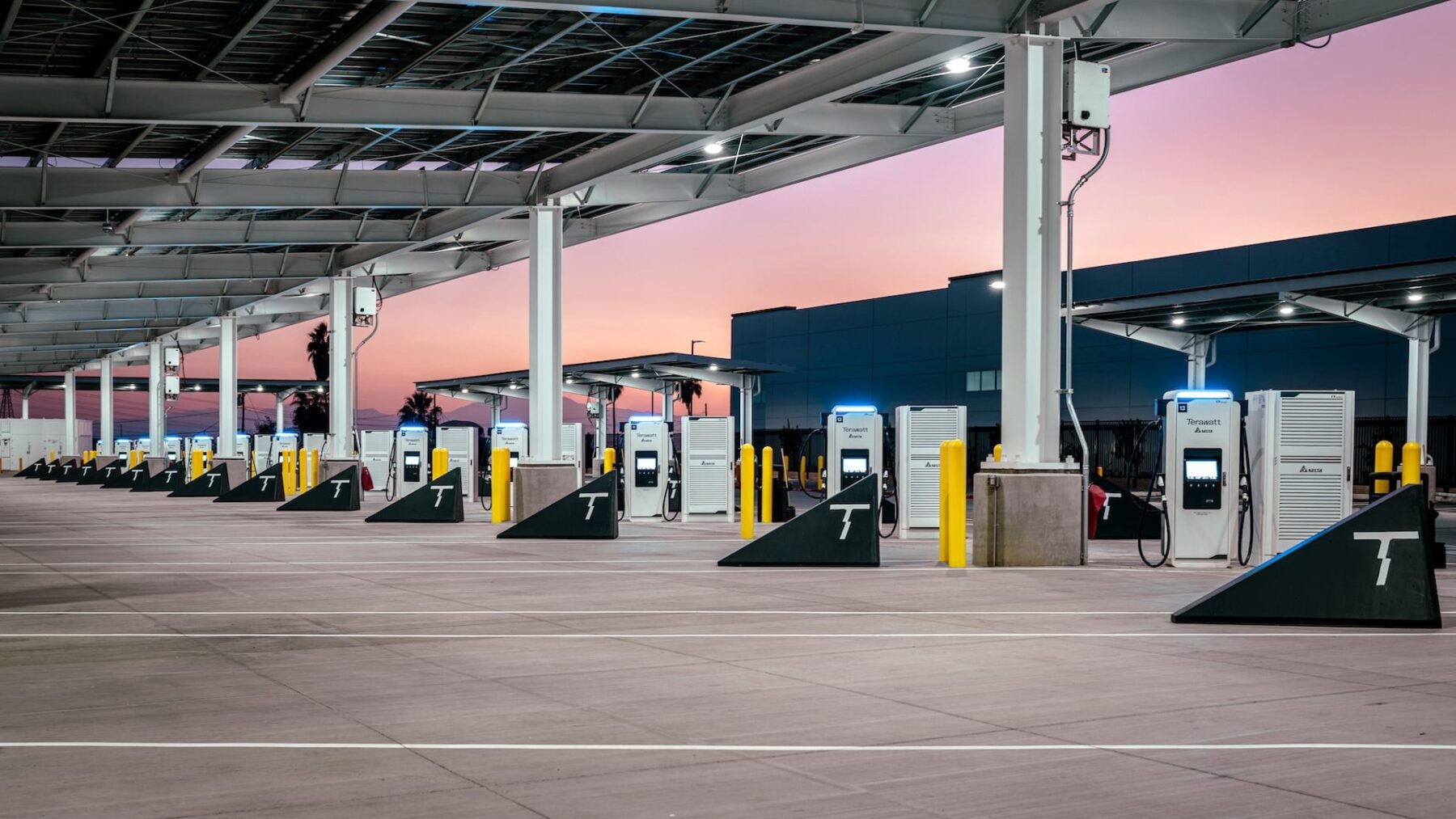
A diesel yard outside Fresno used to go quiet by midnight, its trucks idle until dawn.
Now the same lot hums through the night with chargers pulling serious power.
Seven heavy duty dispensers line one wall, fifteen smaller ones line another.
A tractor trailer backs in every few minutes trailing a cable thick as a fire hose.
None of that power should technically exist yet, at least not on paper.
So how did a depot built for a high power connection get running on a fraction of that?
How a fraction of the power keeps a full depot running
The trick is not more wire, it is smarter timing. Traditional utility planning sizes a connection for the worst case moment, the instant every charger on a lot might theoretically run at once, then builds steel and copper to survive that peak forever.
Fresno’s depot flips that math. Software watches how many trucks are plugged in, how much the surrounding grid has to spare at that hour, and how urgently each vehicle needs a full charge before its next run. It then throttles each charger in real time so the site never asks for more than the wire can deliver.
That is the heart of what Pacific Gas & Electric supported through its Flex Connect program, allowing the depot to begin operations before permanent grid upgrades are completed, letting a site draw most of its rated capacity most of the year without building the full fixed upgrade first. Trucks rarely all arrive empty at once, so the software can safely promise more than the static wire allows.
The payoff shows up as speed. Instead of waiting on transformers, substations and permitting, the operator simply started charging trucks on infrastructure that already existed.
Inside the yard where the math gets tested every night
The facility sits along the Highway 99 corridor in Fresno, a route thick with long haul trucking between Northern and Southern California. It is built around seven MCS megawatt chargers, enabling charging “dwell times” of 30 minutes or less, comparable to diesel refueling times, and also includes 15 single-cord 240kW CCS chargers.
That mix matters because freight does not move on a single schedule. A drayage truck shuttling containers from a nearby port needs a fast top off and a quick return to the road, while a regional hauler parked overnight can trickle charge slowly without straining anything.
So the site blends both rhythms under one roof, letting the flexible connection absorb short bursts while slower stalls fill the gaps. It is also WattEV’s seventh depot in California, and the first of four planned Northern California sites linking the Ports of Oakland and Stockton with Central Valley freight hubs.
The numbers behind the shortcut, and where they came from
While approximately 1 MW of firm capacity is currently available, Flex Connect enables access to up to 3.6 MW during most hours of the year by leveraging flexible load management.
Under a conventional interconnection process, that gap would have meant waiting for a planned capacity upgrade, with a permanent power upgrade still expected in mid-2028, with this approach enabling the site to come online roughly two years before the grid upgrade that would normally have gated it. Instead, the flexible arrangement unlocked access to nearly the full rated power during most hours of the year, and the depot opened on June 30, 2026 rather than on the utility’s original timeline.
That shift echoes a broader pattern utilities are testing nationwide, where fleet charging depots add grid load faster than conventional wire upgrades can keep pace. It also follows the same logic already showing up in how drivers pay for power, where fast chargers charge sharply more at peak hours, a pricing signal meant to do with dollars what flexible interconnection does with software. The utility’s own account of the service, published when it launched the Flex Connect offering, describes the same tradeoff of speed for flexibility that now defines the Fresno site.
Where the shortcut runs into its own limits
None of this means the wire itself becomes optional forever. Flexible capacity works because trucks do not all arrive depleted at once, but a depot scaling toward dozens of simultaneous fast charging sessions could eventually outgrow what clever scheduling alone can deliver.
PG&E itself frames Flex Connect as a bridge, not a substitute for the fixed upgrade still working its way through the queue. Normally, big new connections can take one to three years to get full power capacity approved. Under Flex Connect, PG&E lets customers connect in months instead, in exchange for agreeing to have their power use scaled back automatically during rare periods when the local grid is stretched thin. The flexible connection buys years, not an indefinite exemption from heavier infrastructure.
Yet the broader industry pressure has not eased, since grid connection limits remain one of the most significant bottlenecks facing heavy duty charging buildout nationally. That is why flexible interconnection tools are spreading beyond trucking, with current and prospective customers mostly in the electric vehicle charging business, but the pipeline also includes smaller data centers, advanced manufacturing facilities and battery energy storage facilities, with most active and potential Flex Connect sites ranging from 2 MW to 5 MW, though some data center and manufacturing prospects push 10 MW.
What it means for the next depot waiting in line
For an industry accustomed to multi year interconnection queues, two years saved on a single site is a meaningful marker rather than a footnote. It suggests at least some of the bottleneck slowing heavy duty electrification is not physical scarcity but how conservatively utilities have been sizing connections against worst case assumptions.
Instead of waiting years for a transformer, an operator willing to let software manage its load can sometimes get moving on infrastructure that already exists. Which reframes the challenge as one of coordination and trust between fleets and utilities, not just raw construction.
Whether this approach scales to the dozens of depots freight will eventually need remains an open question, one regulators elsewhere are watching closely. Pacific Gas and Electric has said it continues publishing field data from live Flex Connect sites, aiming to build the case for expanding the program and persuading state regulators to make it a standard interconnection option rather than a pilot. For now, the Fresno site stands as proof that a fraction of the wire, managed well, can carry far more truck traffic than the old rulebook assumed.
