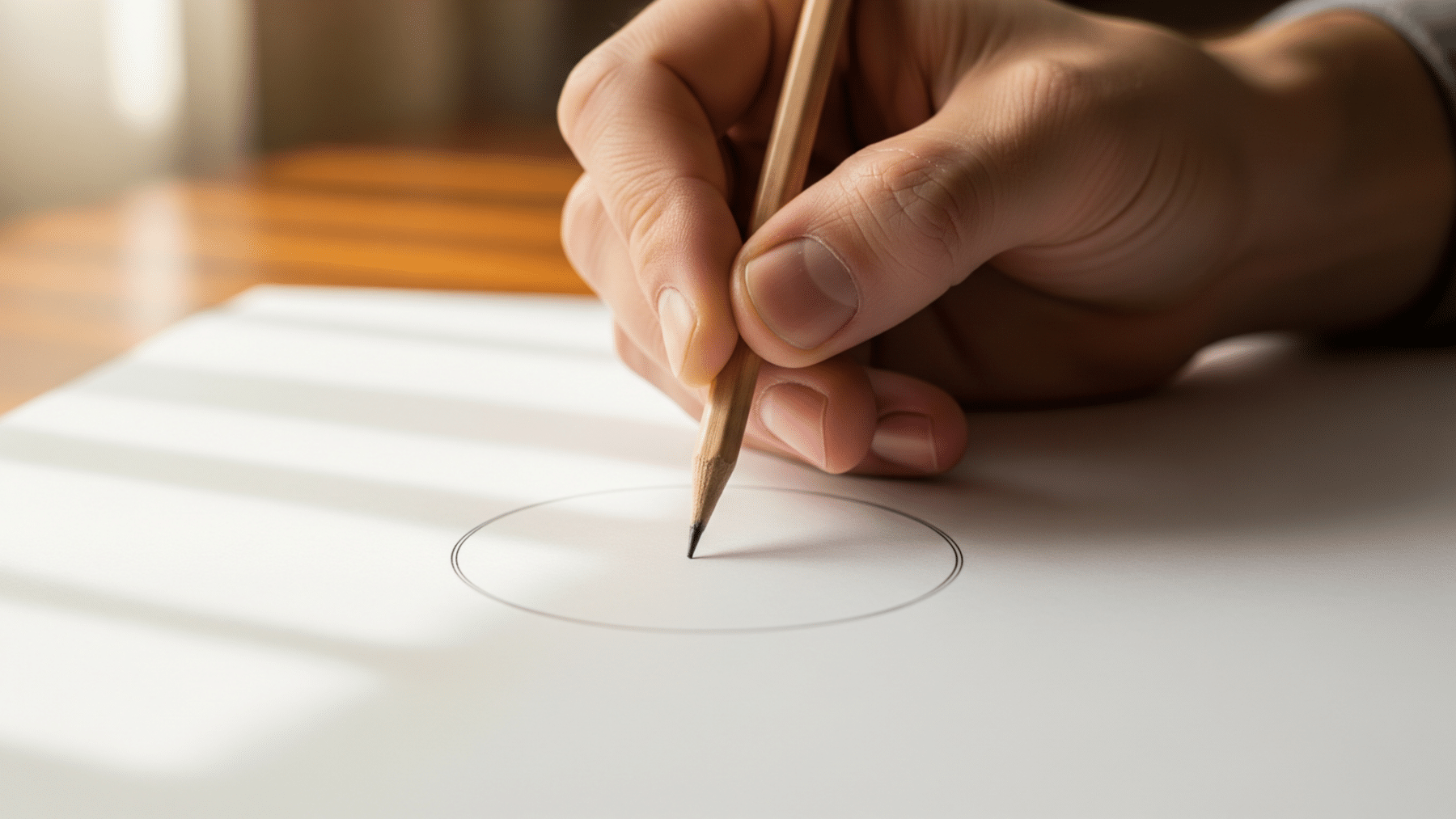
Picture the scene: someone hands you a blank circle and asks you to draw a clock showing 11:10. You sketch in the numbers, line up the hands, and hand it back in under a minute.
For most Americans 43 and older, that task is completely automatic.
For a striking share of adults 42 and younger, new research shows, it falls apart fast, and the reason has nothing to do with how smart they are.
A test that has been used for over a century is running into a problem it was never designed for
The Clock Drawing Test (CDT), introduced in 1915, is a widely used bedside neuropsychological screening tool.
Doctors use it to assess executive function and visuospatial planning, the same mental machinery involved in reading a map, parallel parking, or packing a suitcase.
The CDT assesses multiple cognitive functions, including visuospatial construction and executive planning, and it is a core feature of many cognitive screens.
For generations, healthy young adults sailed through it. Then something shifted.
Emerging evidence suggests CDT validity may be affected by exposure to technology and consequent diminished exposure to analog timekeeping devices, particularly among digital-native adults. Researchers argued that younger individuals may therefore receive less analog exposure than previous generations.
The numbers started slipping and nobody could explain why at first
One study found that 28.6% of neurologically intact college students failed to achieve perfect CDT scores, while another observed that 25% of young adults scored below expected ranges.
This contrasts markedly with historical data showing near-perfect performance among educated young adults.
Researchers were puzzled. These were cognitively healthy people. Their attention, processing speed, and memory all tested normally.
So why were they struggling to draw a clock?
The pattern suggests a breakdown in the conceptual translation of time, likely because digital displays remove the need for spatial mapping.
What the errors actually looked like when researchers examined them closely
A 2026 study published in the Journal of the International Neuropsychological Society ran 92 adults across four generations through the clock drawing task and a full battery of computerized cognitive tests, so researchers could directly compare the two. Participants ranged from 18 to 77 years old and were assessed between October 2022 and December 2024; all were screened to exclude any conditions affecting cognition.
Among the most notable mistakes: instead of drawing clock hands pointing to the right positions, some younger participants would simply write the digits “11:10” inside the circle, a perfect digital readout, dropped into an analog frame.
Common errors included writing digital time (e.g., “11:10”) instead of drawing analog clock hands, or incorrectly placing the hands.
It is exactly the kind of error you would expect from someone whose entire concept of time lives on a screen.
Think about how much of that shift has already happened. Americans now reach for their phones to check the time dozens of times a day, and as nine in ten Americans own a smartphone, the wristwatch and the wall clock have stepped aside as the default time-checking tools for younger generations.
Younger adults were more than four times as likely to make errors as older adults, and their cognitive scores were fine
This is the payoff the researchers did not expect to see so starkly.
Performance errors were significantly more prevalent among younger participants compared with older participants, with a risk ratio of 4.45 and a large effect size.
The generation effect was even stronger after controlling for validated cognitive domain composites, providing strong evidence that generational differences are independent of cognitive abilities.
In plain terms: sharper brain, same gap. Scoring higher on attention and memory tests did not protect younger participants from making clock errors.
The higher prevalence of performance errors in younger generations may reflect reduced exposure to analog time formats, rather than cognitive dysfunction. Digital natives often lack the “analog literacy” required to spatially map time on a circular face, leading to conceptual errors rather than cognitive decline.
The study, published on PubMed Central, also flags a practical consequence: it provides the first evidence that generational differences in clock drawing performance exist independently of cognitive function, and the findings suggest that the test may need revised interpretation guidelines when used with younger, digital-native individuals in neurological assessments.
What daily analog exposure actually builds, and why it is worth keeping
The calm reframe here is real and backed by the same data.
The older adults in the study were not neurological outliers. They were simply people who grew up glancing at clock faces every day, on kitchen walls, classroom ceilings, town halls, and wristwatches, and that repetitive, low-stakes spatial exercise built a mental model of circular time.
This experiential difference could manifest as increased errors in clock construction and time representation, independent of underlying cognitive abilities.
Which also means the skill can be rebuilt the same way it was built: through exposure.
Researchers suggest a simple reframe: analog clock use is a spatial reasoning habit, not a nostalgic one. Reading a round clock face requires you to mentally convert position into proportion, a micro-exercise in visuospatial thinking that happens invisibly, dozens of times a day, for people who still have one on the wall.
The broader shift from calls to texts has already reshaped how generations communicate, just as messaging overtook phone calls as the default daily channel for Americans, and the analog clock finding suggests that what we stop doing habitually can leave equally measurable gaps.
None of this means younger adults are worse at thinking. It means the environments we grow up in silently train specific skills, and that a round clock on the wall might be doing more cognitive work than anyone ever gave it credit for.
