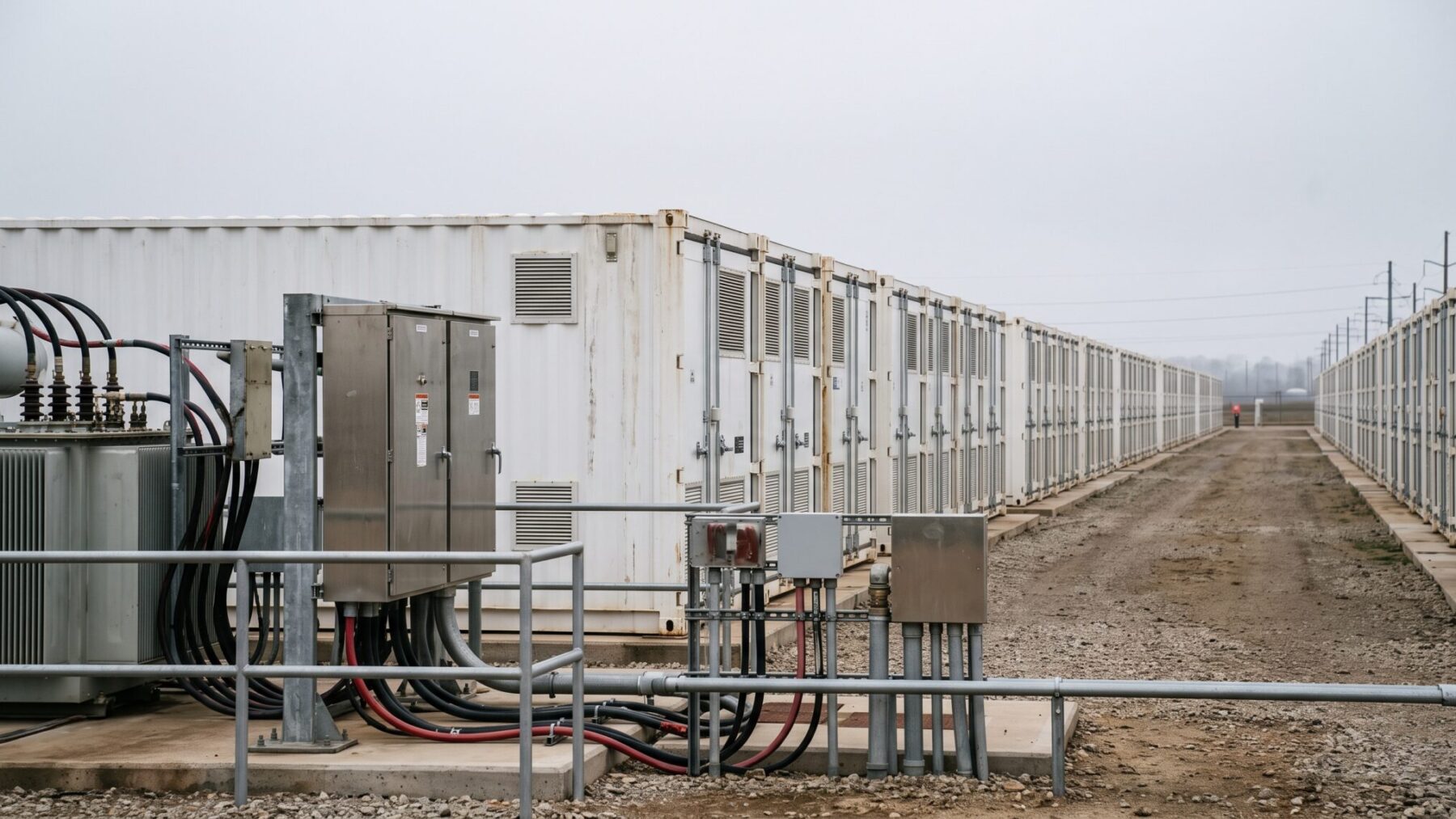
US utility-scale battery storage capacity reached nearly 52 gigawatts (GW) by the end of June 2026, the Energy Information Administration reported last month, capping three consecutive years in which the sector expanded at an average annual rate of 70 percent.
Operators have reported plans to the EIA for another 54 GW of capacity to come online through the end of 2028, a pipeline that, if completed on schedule, would push total national nameplate capacity past 105 GW.
Three years of rapid expansion
Utility-scale battery storage capacity in the United States grew at an average annual rate of 70 percent over the last three years, according to the EIA. By the end of 2025 the US power system had 43.6 GW of operational capacity.
During the first six months of 2026 alone, operators added another 8.3 GW, bringing the nameplate total to nearly 52 GW, based on the EIA’s latest Preliminary Monthly Electric Generator Inventory.
Operators anticipate bringing an additional 54 GW of battery storage capacity online over the next two and a half years, according to plans they report to the EIA. Of that total, 14 GW is expected in the second half of 2026 alone.
The pipeline breaks down to 26 GW planned for 2027 and 14 GW for 2028, with total national operational capacity expected to pass 105 GW by the end of 2028 if those schedules hold.
Projects coming online now
Developer SMT Energy and software-focused storage integrator FlexGen announced the start of operations of a 160 MW/320 MWh energy storage facility in Houston, Texas , adding to a state grid that has emerged as the country’s most active market for large-scale storage deployment.
The Houston project, known as SMT Houston IV, joins more than 12 projects from SMT and FlexGen built to support the Electric Reliability Council of Texas (ERCOT) grid. The facility is one of several standalone projects entering service across ERCOT as the Texas grid balances rapid load growth with an expanding fleet of solar generators.
Solar photovoltaic plants host the largest battery storage capacity units, including AES’ Bellefield Solar and Energy Storage Farm in California and Florida Power & Light’s Manatee Solar Energy Center in Florida, according to the EIA.
The Gemini Solar + Energy Storage project in Nevada, which became fully operational in 2024, carries 690 MW of photovoltaic capacity paired with a 380 MW battery storage system providing 1,400 MWh of dispatchable energy.
What is driving the buildout
Battery storage has expanded in close step with utility-scale solar, absorbing midday generation surpluses and dispatching power during the evening demand peaks that solar cannot reach.
The EIA pegs utility-scale battery storage growth at an average annual rate of 70 percent over the last three years, driven by rapid utility-scale solar deployment and wholesale price arbitrage , a pace that has outstripped earlier projections and reshaped how grid operators plan their capacity reserves.
New federal rules have made domestic supply-chain compliance a condition of tax credit eligibility for storage projects, and a live FERC proceeding is poised to reshape the economics of co-located storage.
Import tariffs have raised equipment costs for some developers. Those pressures have not yet slowed the installation pace, though developers and lenders are watching how the FERC proceeding resolves for projects that pair storage directly with data center loads.
The DOE’s $500 million initiative is aimed partly at reducing the cost exposure that tariffs have created, targeting domestic production of the minerals and cell components that underpin the growing grid fleet.
ERCOT has emerged as the country’s most active storage market, and analysts project continued rapid expansion there through 2027 as the Texas grid absorbs load growth and integrates increasing volumes of solar generation.
Market implications
The EIA’s planning filings point to another 54 GW expected online over the next two and a half years. If that pipeline is completed as planned, operational US battery storage capacity would climb past 105 GW by the end of 2028.
That trajectory would represent a roughly sixfold increase in battery storage capacity in just four years, a shift that industry analysts say is beginning to move beyond a technology story into a wholesale electricity pricing story.
The EIA’s long-term outlook identified data-center and EV load as the structural demand drivers that will sustain electricity growth through 2050, a context that gives the storage pipeline its commercial logic: operators need dispatchable assets to cover peaks that are growing faster than traditional baseload additions can match.
The agency’s next Short-Term Energy Outlook update is expected to reflect any further revisions to the storage build schedule as fall demand data comes in.
