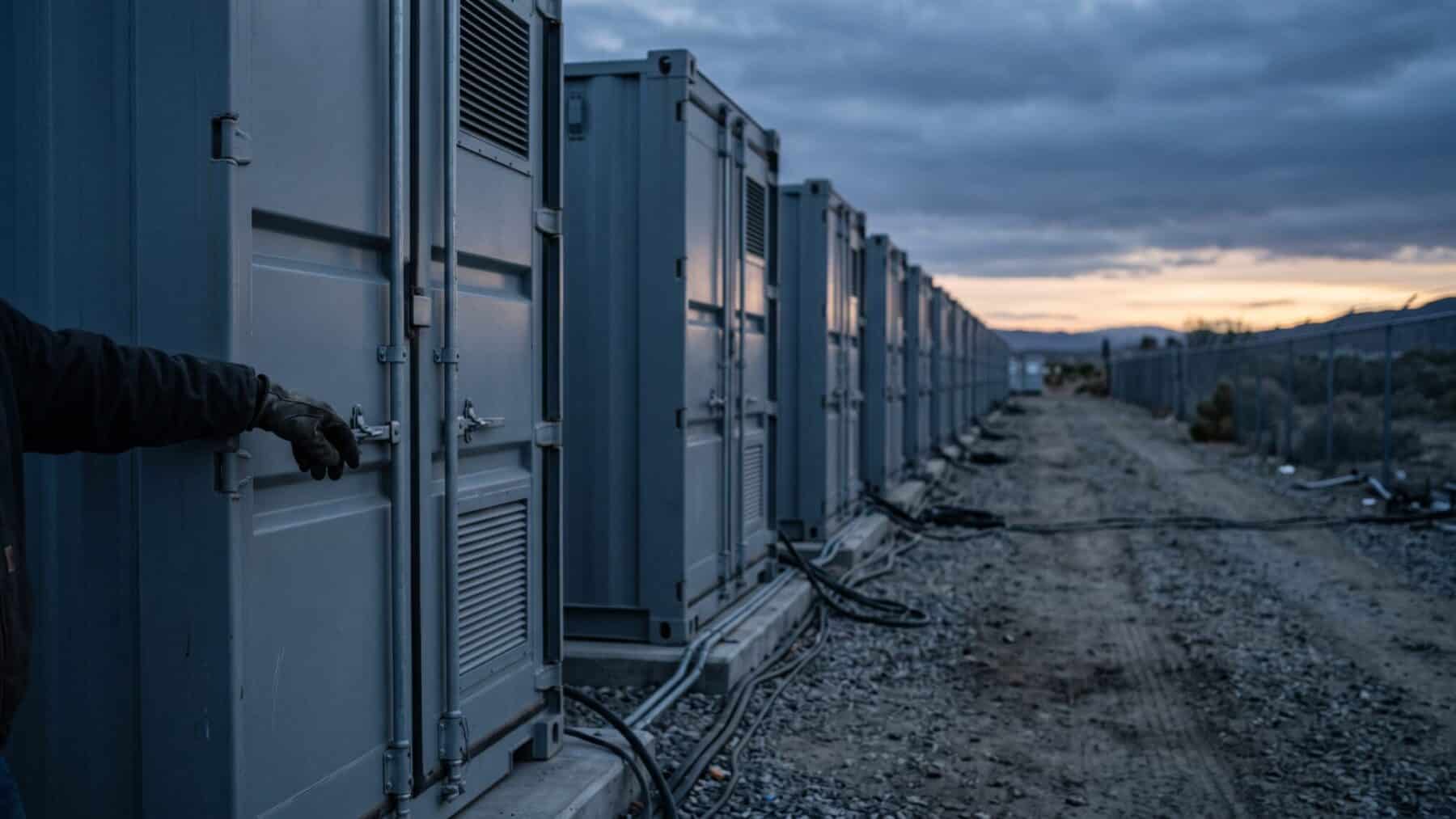
The sun dipped below the horizon on the evening of July 9 and the lights stayed on. Millions of homes and offices drew power not from a spinning turbine but from rows of steel cabinets sitting on flat ground across the state. A wall of heat had pushed demand to levels the grid’s operators were watching closely. Then the numbers started climbing. What sent them to a record nobody had reached before is not an accident of good weather.
How a battery fleet actually feeds the grid at scale
The core technology across most of California’s fleet is lithium iron phosphate chemistry, chosen because it tolerates thousands of charge cycles without the thermal runaway risk of older cell designs. Each cabinet is essentially a sealed rack of cells wired to a power-conversion system that turns stored direct current into the alternating current the grid runs on. Most utility-scale systems on the California grid are sized for four hours of full discharge, though the share capable of longer durations is rising.
The critical advantage on a hot summer evening is speed. A gas peaker plant needs ten to thirty minutes to ramp up from cold; a battery responds in under a second. Grid operators can send a signal and the entire fleet answers almost simultaneously, which is why batteries are now the instrument of choice for the sharpest demand spikes.
Evening hours are historically the hardest moment for the grid, but batteries are stepping up to meet peak demand and spread the solar savings deeper into the evening. The mechanism is straightforward: the same batteries that absorbed surplus solar electricity during the afternoon discharge that stored energy the moment generation falls below demand after sunset.
What July 9 looked like inside the California grid
On the evening of July 9, California’s battery fleet discharged a record 12.99 gigawatts of power, more power than New York City consumes on a hot summer day, and at peak, batteries covered 36 percent of energy demand across the CAISO region. That is a number that would have read as science fiction a decade ago, when the same grid held only a few hundred megawatts of battery capacity.
The following day, July 10, CAISO set another record, with solar generation reaching 23 gigawatts and supplying 72 percent of regional electricity demand, marking the third time since June 1 that California had broken its own solar generation record. So the two records arrived back to back: storage carrying the evening, solar dominating the afternoon. That pairing is exactly what grid planners have been building toward for years, and the summer of this year delivered it in consecutive days.
The significance reaches beyond a single state. California has built the nation’s largest battery energy storage fleet, with resources now exceeding 21,000 megawatts, making the state’s battery fleet one of the largest in the world. Its discharge records are an early signal of what the broader national buildout can eventually do during peak stress hours.
The numbers behind the buildout that made the record possible
The US energy storage industry installed 9.7 gigawatt-hours of new capacity in the first quarter of 2026, the strongest first quarter in the sector’s history, according to the US Energy Storage Market Outlook Q2 2026 released by the Solar Energy Industries Association (SEIA) and Benchmark Mineral Intelligence, with installations up 32 percent year-over-year. That quarter alone added more storage than the entire country held just a few years ago.
The US energy storage industry installed a record 57.6 gigawatt-hours of new capacity in 2025, the largest single year of battery capacity additions on record. The gigawatt-hour threshold matters because gigawatt-hours measure how much energy can actually be stored and discharged, not merely how fast it can be released, making it a truer measure of the grid’s buffer against demand spikes than raw power ratings alone.
On July 9, batteries in the California Independent System Operator region discharged a record 12.99 gigawatts, meeting 36 percent of total energy demand during a difficult evening peak. In the first quarter of this year, 91 percent of all new grid capacity came from solar and storage, the highest quarterly share the two technologies have ever recorded. The July 9 peak discharge was, in other words, the product of years of compounding installation, not a single project.
Where the system still runs into limits
Hitting 36 percent of regional demand for a peak hour is not the same as covering the grid all evening. Most of today’s utility batteries are sized for four hours of discharge, which means a prolonged heat event lasting deep into the night can exhaust the fleet before demand subsides. While Texas has a similar amount of total installed battery capacity, its systems are designed to provide shorter duration discharges, typically two hours or less, whereas California’s fleet is dominated by four-hour duration battery systems, so it can deliver stored energy for approximately twice as long. States like California and Arizona are targeting longer-duration storage for evening renewable energy shifting.
Co-located solar-plus-storage projects now represent a growing share of new utility-scale solar proposals in the interconnection queue, which points toward a future where storage is assumed rather than optional. But interconnection queues remain long, and projects that win approval today can take two or three years to reach commercial operation. The July 9 record was built on capacity approved and installed years earlier.
Pricing pressure follows growth in its own way. Operators who shifted charging schedules away from peak hours, an approach grid managers have actively encouraged through rate structures like those explored in California’s divergent billing models for large customers, can extract significantly more value from the same installed battery. The rate structure question is now as consequential for storage economics as the hardware cost curve.
What this record means for the grid over the next few years
Over 610 gigawatt-hours of energy storage is now expected to be installed by 2030, up from previous projections. By 2030, the market is set to exceed annual installations of 110 gigawatt-hours and reach a cumulative 613 gigawatt-hours. If that trajectory holds, the 12.99 GW peak discharge that set a record this summer will look modest inside a few years. The forward pipeline is real, with battery projects in active build phases across dozens of states.
The 613 GWh forecast also reframes how federal projections for utility-scale storage read against actual market pace. Official forecasts have consistently undershot deployment speed, and the gap between forecast and reality has widened every year since large-scale battery installations began accelerating. The grid is moving faster than the models that describe it.
What July 9 demonstrated, in the end, is that storage has crossed from a support technology into a primary resource. A fleet that can carry more than a third of a major grid region’s demand at the hardest hour of the day is no longer backup. It is the plan.
