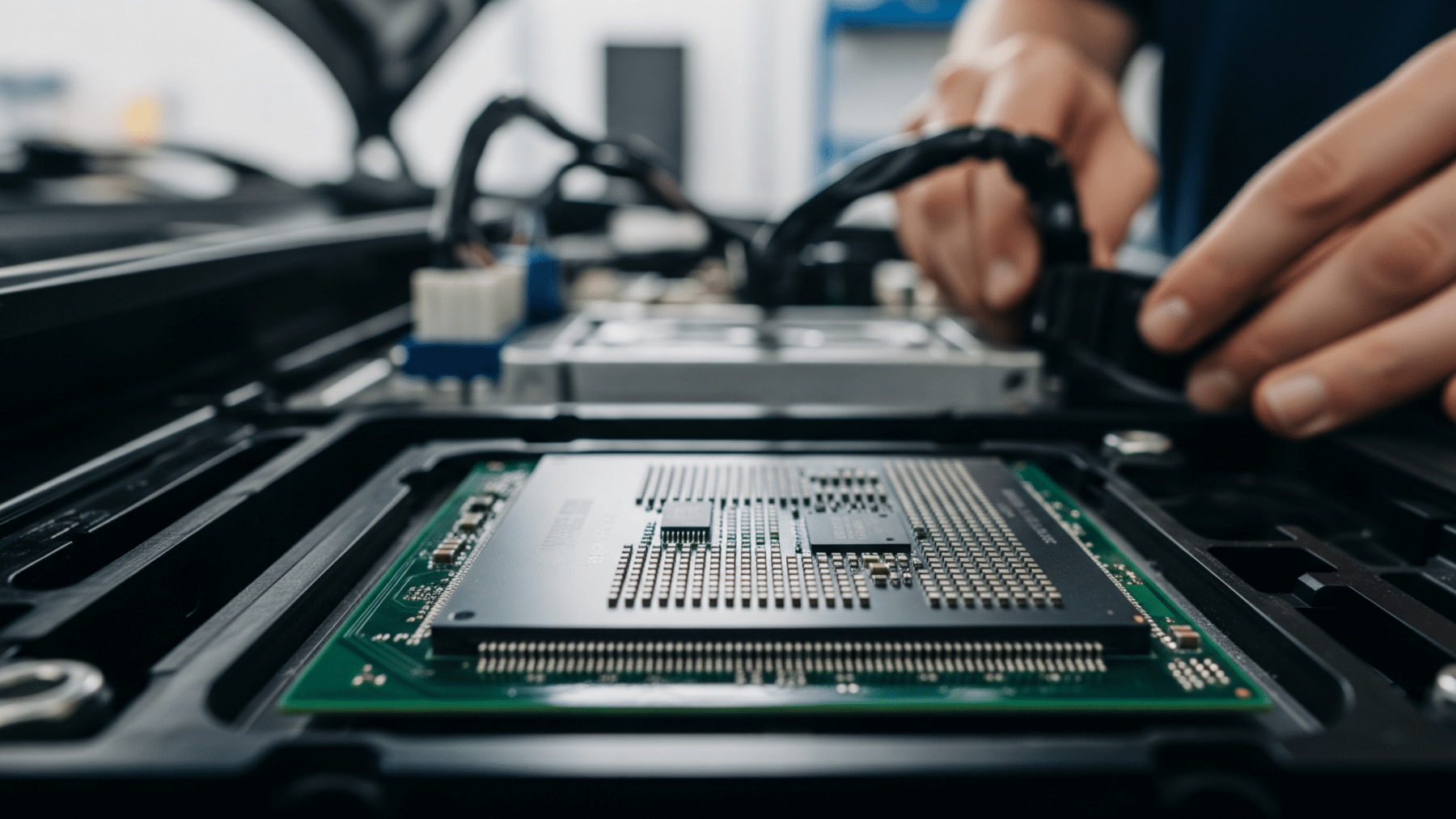
There are roughly 70 to 100 separate computers inside a typical modern car. They control the brakes, the mirrors, the dashboard, the lane-keeping camera, the parking system, and the heated seats.
Most drivers have never heard of them.
Each one is a small electronic control unit, or ECU, wired to the others across a web of cables that can weigh well over 100 pounds in a large vehicle.
That architecture made sense when cars were simpler. It is becoming a serious engineering problem now that vehicles need to process real-time AI video, run large language models, and manage autonomous driving functions all at once.
The old way of building a car’s brain was never designed to last
Every ECU is a separate supplier contract, a separate software stack, and a separate point of failure.
When one goes wrong, tracing the fault through dozens of interconnected modules can take days.
That distribution made it easy to add new features one box at a time, but it created a nightmare for software updates.
Over-the-air updates are nearly impossible to push cleanly across dozens of separate ECUs that each run different firmware.
Automakers have known this for years. The race to fix it comes down to a single question: can one chip do every compute job at once?
Why the AI boom made the problem impossible to ignore any longer
Driver-assistance cameras alone generate enormous amounts of raw sensor data every second.
Add radar, ultrasonic sensors, lidar, and a large-model AI voice assistant, and the old ECU network simply cannot move data fast enough between separate boxes.
Memory chips are part of the strain too. Automakers are redesigning vehicle architectures to support newer memory generations, and systems built around legacy DRAM may need fundamental changes to remain producible.
That redesign pressure is landing hardest on the ECU-per-function model, which was already running out of headroom.
The automotive chip industry is worth $107.34 billion in 2026 and is growing toward $148.57 billion by 2031. The fight for that market is the fight to own the car’s central brain.
How the consolidation race became a chip supplier battle
Several companies are competing for the central computer slot. The technical requirements are brutal.
NXP’s S32 family merges real-time safety cores, application processors, and hardware security to support over-the-air updates without compromising ASIL-D requirements.
Renesas has been advancing its automotive SoC lineup toward cutting-edge process nodes, targeting triple-digit TOPS for sensor fusion and highlighting the rapid migration of automotive logic to smaller geometries.
ASIL-D is the auto industry’s highest functional safety rating, required for systems that, if they fail, could directly cause a fatal crash. Hitting that standard on a single chip running infotainment and autonomy simultaneously is extraordinarily hard.
That is exactly the target one supplier staked its entire automotive future on. You can see the broader automotive chip supply picture shifting fast in 2026.
The single chip now handling what multiple domain controllers used to do separately
DRIVE Thor is the follow-on to DRIVE Orin, which delivers 254 TOPS in current production vehicles.
DRIVE Thor delivers up to 1,000 INT8 TOPS of deep-learning inference performance, and up to 2,000 FP4 TFLOPS using the Blackwell architecture’s 4-bit floating-point support, a major generational leap.
With 77 billion transistors, the system-on-chip is designed to unify the clusters of computer systems that control modern cars into a single platform.
Domain isolation is the key mechanism: the chip partitions itself so that a crashed streaming app cannot reach the autonomous driving core, the same way a corrupted app on your phone cannot access the fingerprint sensor’s secure zone.
By centralizing key compute functions, carmakers can push over-the-air updates that add capabilities years after purchase. In March 2026, NVIDIA confirmed BYD, Geely, Isuzu, and Nissan were adopting DRIVE Hyperion for Level 4 development. NVIDIA’s official announcement positions Thor as the path to software-defined vehicles across the industry.
What a single-chip car brain means for the driver in the driveway
The immediate benefit is not more features. It is fewer independent failure points.
One central compute node means one software update that touches every system at once, cleanly, the way a phone update works today.
A production vehicle still needs automotive-qualified components, redundant power paths, cooling, and a service strategy that may last well beyond a consumer-electronics cycle. That engineering work takes years.
Legacy ECUs will coexist with central compute modules through the late 2020s, and automakers moving fastest toward software-defined vehicles, think of what efficiency engineers are already doing with advanced vehicle systems today, will have the clearest path to simpler, updatable platforms.
The wiring loom that once weighed more than a linebacker is on its way out, one 77-billion-transistor chip at a time.
