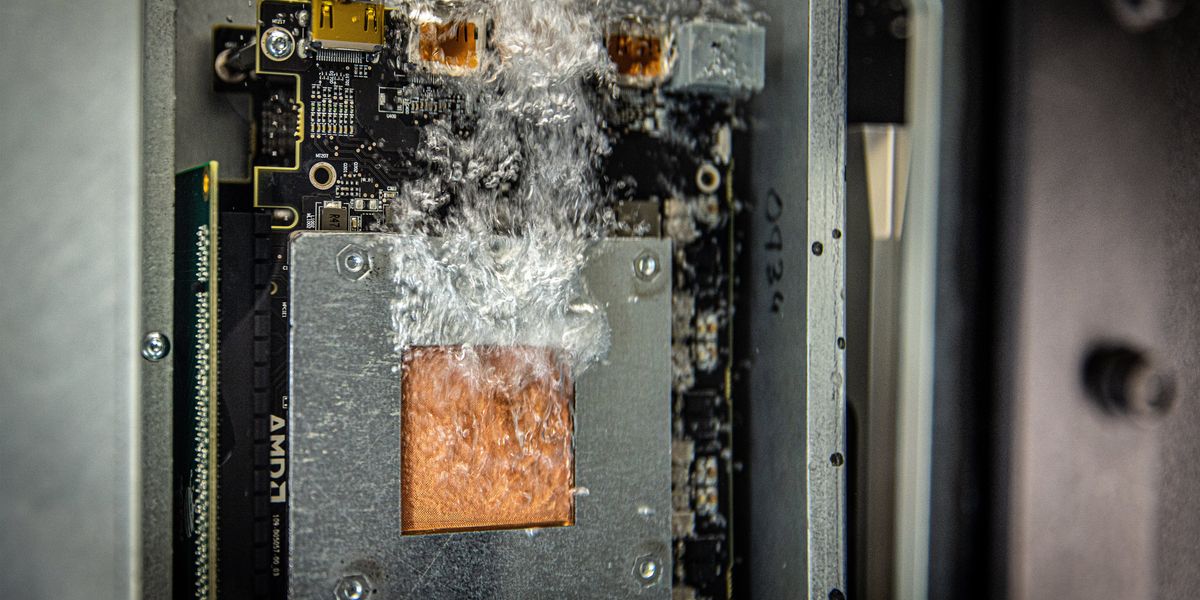
A server rack built for the newest AI chips no longer needs a single drop of water from a cooling tower to stay cold.
Instead it runs liquid straight across every chip inside it, and the coolant comes out hot enough to scald a hand.
That heat is the point.
It lets the whole facility skip the water-hungry towers that have defined data centers for decades.
So how does running hotter water actually end up saving millions of gallons a year?
Why hotter liquid means less water, not more
The trick is counterintuitive: engineers made the coolant warmer so the building could stop evaporating water to cool it down. Conventional liquid-cooled data centers still chill their coolant to roughly 65 degrees Fahrenheit before sending it back to the racks.
That chilling step is usually done with energy-hungry mechanical chillers paired with evaporative cooling towers that lose millions of gallons to the air every year.
Nvidia’s Rubin-generation design flips that. Nvidia’s liquid coolant is a mixture of 75% water and 25% propylene glycol, a formulation similar to antifreeze. Coolant flows through cold plates that sit directly on the processors, pulling heat out at source. The key variable is the supply temperature: Rubin’s system can operate at 45 degrees Celsius (113 degrees Fahrenheit).
Because the fluid is already allowed to run that warm, in favourable climates, its 45C liquid-cooling approach can reduce water use to near zero by moving heat directly from chips into a recirculating liquid loop and then to outdoor dry coolers. That single change removes the need for the evaporative towers that have quietly consumed enormous amounts of water at every major cloud campus.
The vehicle for that claim is the Rubin-generation reference design, the first AI infrastructure platform Nvidia has built with 100% liquid cooling across every chip and every networking component, with no fans anywhere in the closed loop. That is the mechanical heart of the claim Nvidia’s chief sustainability officer Josh Parker made months later, in June 2026 ahead of London Climate Week, when he said “The water consumption challenge for data centers is largely solved.”
What this looks like inside an actual AI building
Picture a hyperscale hall built for a cluster of next-generation GPUs, the kind now being installed by cloud giants expanding campuses in Texas and beyond. Instead of towers of fans pushing cold air across server aisles, thick insulated pipes run coolant directly into each rack, in and out, continuously.
Every chip in that rack sits under a metal cold plate instead of a fan-cooled heat sink. The entire cabinet becomes part of a plumbing system rather than a ventilation system.
That shift is also why installation now moves far faster than before, which matters because rack power keeps climbing fast.
Newer rack-scale configurations are already drawing far more power than older Blackwell-era hardware, and denser local AI hardware is pushing the same cooling problem down from giant campuses toward smaller developer setups too.
The numbers behind the record claim
The figures come from Nvidia’s own published reference architecture, detailed in a report covered by industry coverage of the announcement Josh Parker made at London Climate Week in June 2026.
According to that design, a conventional cooling-tower-based system can consume roughly 2.6 million gallons of water per megawatt each year. In favourable climates, the 45C liquid-cooling approach can reduce that to near zero by moving heat directly from chips into a recirculating liquid loop and then to outdoor dry coolers. That is a specific, measurable drop, not a vague sustainability pledge, and the number multiplies fast as clusters scale into the hundreds of megawatts.
The financial case is just as concrete. Nvidia said a 50-megawatt facility could save more than USD $4 million a year in cooling-related energy and water costs by adopting liquid-cooled infrastructure.
HVAC stocks had already felt the shock months earlier. When Nvidia CEO Jensen Huang previewed the chiller-free Rubin approach at CES in January 2026, declaring that “no water chillers are necessary for data centres,” Trane Technologies shares fell as much as 11% in their worst intraday decline since 2020, while Modine Manufacturing plunged as much as 21%, and Johnson Controls and Carrier Global also declined, as investors reacted quickly to the possibility that newer chip designs may reduce the need for some traditional cooling equipment. That sharp a reaction suggested investors read the shift toward liquid cooling as a real industry shift rather than a marketing claim.
Where the savings run into limits
None of this means every data center on the planet can simply switch over tomorrow. The 113-degree design depends on dry coolers working with outdoor air, which allows facilities in most climates to reject heat without evaporative cooling towers.
But hotter regions may still need backup chilling on the worst days of the year; Nvidia’s director of data center cooling, Ali Heydari, has described it as a closed-loop system with no evaporative water cooling “outside of maybe 1% of the year when we might need chillers in some climates.”
There is also the retrofit problem. Older buildings designed around air handlers and fans cannot simply bolt this system in, so facility teams need months of lead time to rework piping and power delivery before any of this hardware arrives.
Even the rack hardware itself is catching up. Physical density has improved alongside the cooling shift, with a system that previously occupied six rack units reduced to two rack units in the new design. Yet every future generation is expected to draw even more power, keeping the cooling challenge from fully disappearing.
What it means for the next wave of AI buildings
For an industry that has faced growing criticism over water use near new campuses, this is a genuine engineering milestone, though not a complete fix. The claim that the problem is “largely solved” depends entirely on whether the power supplying those racks is generated without significant water consumption, since data centers will still indirectly drive large amounts of water use through electricity generation, and will continue to require enormous amounts of power. Even so, it directly answers one of the most common complaints leveled at hyperscale AI construction over the past two years.
It also reshapes who wins and loses as the buildout continues. Companies that make traditional cooling towers face a shrinking market, while suppliers of pipes, cold plates and dry coolers stand to gain.
Meanwhile the broader data center race keeps accelerating on every front, from capacity expansion plans announced by rival cloud providers to new chip generations arriving on tighter cycles than ever.
Water, for once, looks like a problem engineers have made real progress on. What remains open is how quickly older facilities adapt, and whether this design holds up once the next generation of chips pushes rack power even higher than today’s already steep numbers.
