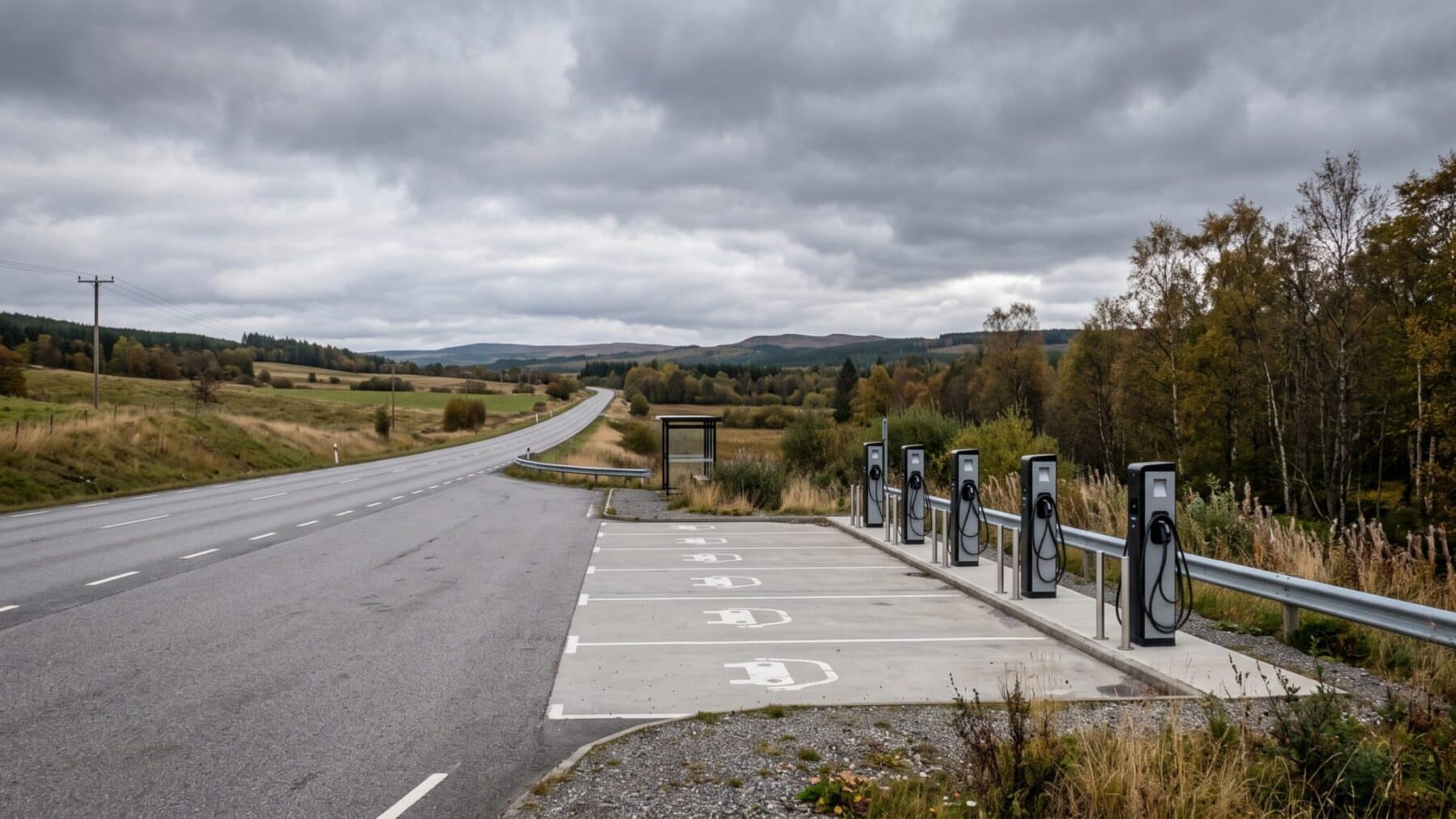
Picture a long stretch of interstate in Wyoming, Kansas or Missouri with no charger in sight and no money spent.
Congress allocated billions to fix exactly that. The money sat, largely untouched, for four years.
And then the program that was supposed to end range anxiety for every American road-tripper ran headlong into a funding freeze, a court battle and a budget knife.
So how does a program with billions in the bank barely move a dollar?
How the program’s own rules kept the money locked up
Congress made $4.4 billion available to states under the National Electric Vehicle Infrastructure program, yet states asked the federal government to reimburse them for only $94 million, two cents on every dollar promised. That gap is not an accident. It is the direct result of how the program was engineered from the start.
Every site had to sit on a designated highway corridor, spaced no more than 50 miles from the next, and be equipped with at least four chargers capable of 150 kilowatts each. States also had to clear labor standards, community-engagement requirements and environmental-siting reviews before a single shovel broke ground.
Key standards required stations maintaining 97 percent uptime with open-access payment options. Meeting all of those boxes at once, on a highway median in a state with a small bureaucracy, proved far harder than the program’s architects assumed.
Five states at zero, two states pulling ahead, one telling ratio
When federal data finally surfaced in a legal filing early this year, the disparity was striking. Five states, Kansas, Louisiana, Missouri, Nevada and Wyoming, had spent no money at all. Each had received its share of the national pot and, on paper, approved state plans. None had submitted a single reimbursement claim.
Pennsylvania emerged as the national leader in NEVI station openings, with Ohio among the stronger early performers, the two states that had moved fastest when the program’s momentum stalled. As of late last year, at least 384 EV charging ports had been built through the program nationwide.
Meanwhile, states had obligated $1.4 billion in funds for future stations, meaning the pipeline exists. The invoices just have not followed.
The evidence trail: a freeze, a court order and a congressional cut
On February 6, 2025, the Federal Highway Administration rescinded its NEVI Formula Program guidance and froze the program for review. The freeze did not just pause spending. It stopped states from obligating new contracts, stranded contractors mid-procurement and reset the program’s momentum precisely when analysts had expected it to accelerate.
The freeze triggered litigation. According to the plaintiff states, before February 6, about $1.5 billion was available for states to obligate; after that date, the number dropped to zero. On June 24, 2025, a federal court issued a preliminary injunction lifting the freeze, and in January 2026 Judge Tana Lin of the Western District of Washington entered final judgment declaring the administration’s rescission of NEVI guidance unlawful under the Administrative Procedure Act.
Budget legislation passed by Congress then cut just over $500 million from NEVI formula grants, trimming roughly a tenth of the program’s original total in a single legislative stroke. The $1.4 billion states had already obligated for charger installation was thrown into doubt, with federal reimbursement suddenly uncertain.
A parallel dynamic is playing out in how utilities are handling grid upgrade costs in EV buildouts, including the eastern Pennsylvania rate case that locked large power users into decade-long contracts before their first kilowatt-hour could flow.
Where the program breaks down: the grid cost nobody budgeted for
Even where NEVI money flowed freely, a second barrier was waiting. Getting a fast charger physically built is only half the problem. Getting the local grid to support it is the other half, and that cost is entirely separate from the federal grant.
In some rural corridors, distribution upgrade costs can exceed the price of the charging equipment itself, and none of that expense is covered by the federal reimbursement formula. The utility bill lands with the developer, the site host or the state, depending on which territory the charger sits in.
That mismatch has quietly disqualified sites that looked viable on paper. A developer signs a lease at a rest stop, applies for reimbursement, then discovers the local transformer cannot support 600 kilowatts and the utility’s upgrade quote exceeds the entire project budget. The station never gets built and another dollar goes unspent.
Those transformer costs are reshaping rate cases elsewhere too: a Washington utility’s $3.2 billion grid plan illustrates how distribution infrastructure costs are landing on residential bills across the country. The companies and states that have survived the shakeout are those that priced grid upgrades into their bids from the beginning.
What the reboot means and what remains unresolved
The program is moving again. Following the June 2025 court order, the Federal Highway Administration issued revised interim guidance on August 11, 2025, that removed extensive community-engagement requirements and non-statutory labor standards. States responded: Pennsylvania launched its first NEVI Community Charging round in February 2026, and multiple states have opened new funding rounds in the months since.
Updated guidance also expanded site eligibility beyond designated corridors and opened NEVI funding to medium- and heavy-duty charging and upgrades to existing stations. That last point matters enormously for freight operators, as truck-stop charging along major corridors can now qualify where it could not before.
Before the budget legislation passed, analysts were projecting NEVI-funded sites would double this year. Whether that doubling still happens depends on how quickly the $500 million cut bites into state allocations and whether the remaining pool can be obligated before the program’s authorization window closes.
The contractors, electricians and site hosts waiting on procurement decisions in more than three dozen states will find out in the months ahead whether the reboot holds or becomes another reset.
