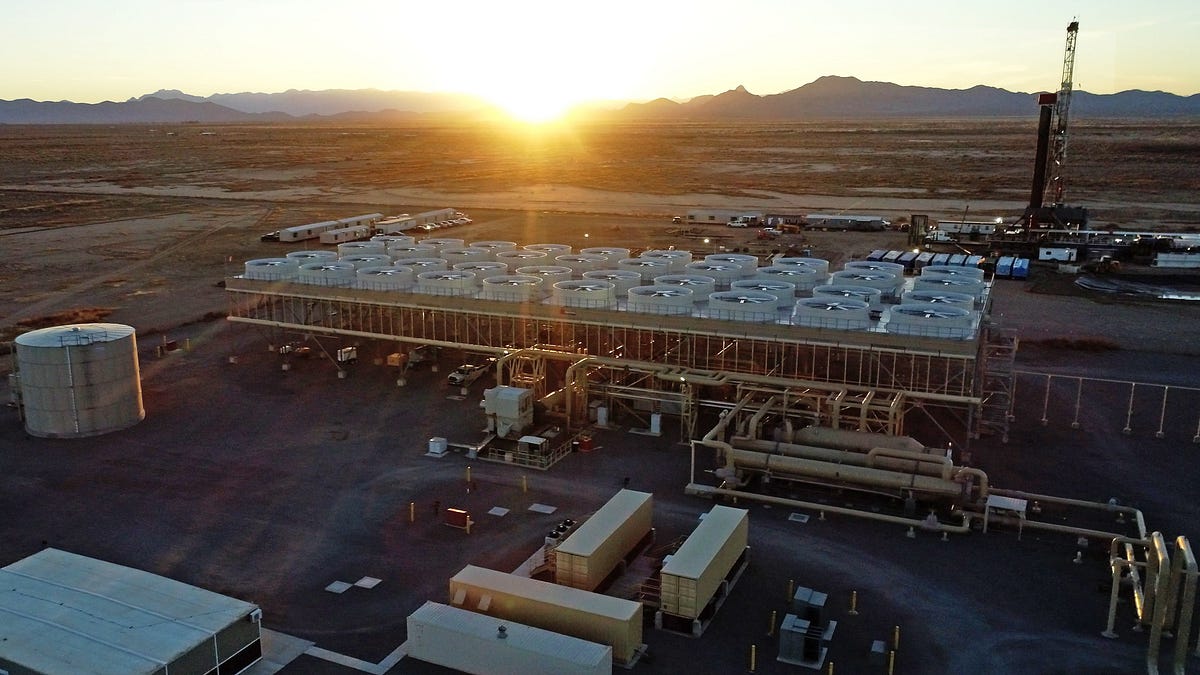
Fervo Energy announced on October 1 that the first power-generating unit at its Cape Station project in Beaver County, Utah, has reached commercial operation, making it what the company calls the first greenfield enhanced geothermal development in the world to hit that milestone.
The unit, known as a GeoBlock, produced 33 MW of net power, meeting the production threshold expected under that agreement.
Grid connection came ahead of contract date
Cape Station synchronized to the grid on September 24 and declared commercial operation on September 30, 2026 , one day before its contractual commercial operation date (COD).
Revenue is now being generated under Fervo’s power purchase agreement. Fervo Energy CEO and co-founder Tim Latimer said that reaching commercial operations at Cape Station is “both a huge milestone for Fervo, and a turning point for the entire energy industry.”
Fervo built and commissioned this power facility for its first GeoBlock in just 23 months, and the company sees substantial opportunity to compress this timeline further and is confident in its ability to reach an 18-month construction timeline for future GeoBlocks.
Dawn Owens, SVP, Head of Development & Commercial Markets, said “Getting our first GeoBlock to commercial operation reflects the strength of our execution and the discipline of our team on the ground,” and “every GeoBlock we bring online makes the next one faster and more predictable, and that repeatability is the foundation of how we scale and bring down costs.”
More capacity is already under construction
Cape Station’s Phase I comprises approximately 100 MW across three 33-megawatt GeoBlocks.
Commissioning continues at the remaining two Phase I GeoBlocks, which are expected to reach contractual COD by January 1, 2027. The next phase, 400 MW across eight 50-MW GeoBlocks, is scheduled to reach commercial operation in 2028.
The project’s economics still hinge on driving down per-unit costs as construction scales up.
According to project data reviewed by industry outlet MLQ, Fervo has disclosed estimated installed costs of about $7,000 per kilowatt for Phase I and $5,500 per kilowatt for Phase II, compared with a long-term target of $3,000 per kilowatt. Fervo says the Phase II estimate reflects its newer 3.0 well design.
Shell Energy is buying the first GeoBlock’s power, while Google backs a later phase
MLQ reported that Fervo has identified Shell Energy as the buyer for the initial commercial power, but has not disclosed the agreement’s price or other terms.
Separately, on September 1, Fervo Energy announced a 396-megawatt power purchase agreement with Google to enable the continued development of the Cape Station enhanced geothermal systems GeoCluster, expected to come online in 2028. Under the agreement, Google will purchase carbon-free energy designed to serve as a foundational building block for a potential data center in Utah.
As part of that deal, Fervo will offer Google an option to expand its offtake by approximately 600 MW, for a total of nearly 1 GW, by June 2030.
Fervo says it has more than 1 GW of binding PPAs across its portfolio. For Cape Station, the company has disclosed agreements involving Shell Energy, Southern California Edison and community choice aggregators.
Why this matters for data center demand
Enhanced geothermal systems drill deep wells and fracture hot rock to generate power around the clock, independent of weather, which has drawn interest from technology companies racing to secure firm, carbon-free electricity for data centers.
Fervo’s milestone follows a wave of geothermal contracting activity across the grid, including Utah’s largest next-generation geothermal plant and Ormat’s recently renegotiated California contracts, as utilities and large power buyers compete for dispatchable clean generation.
The approach also stands apart from smaller residential geothermal efforts, such as shared backyard geothermal loops now being tested in several states for home heating rather than grid-scale power.
That makes the first GeoBlock an operating proof point, not a demonstration that the full project is complete. Fervo still must commission two additional Phase I units and construct the larger Phase II expansion.
