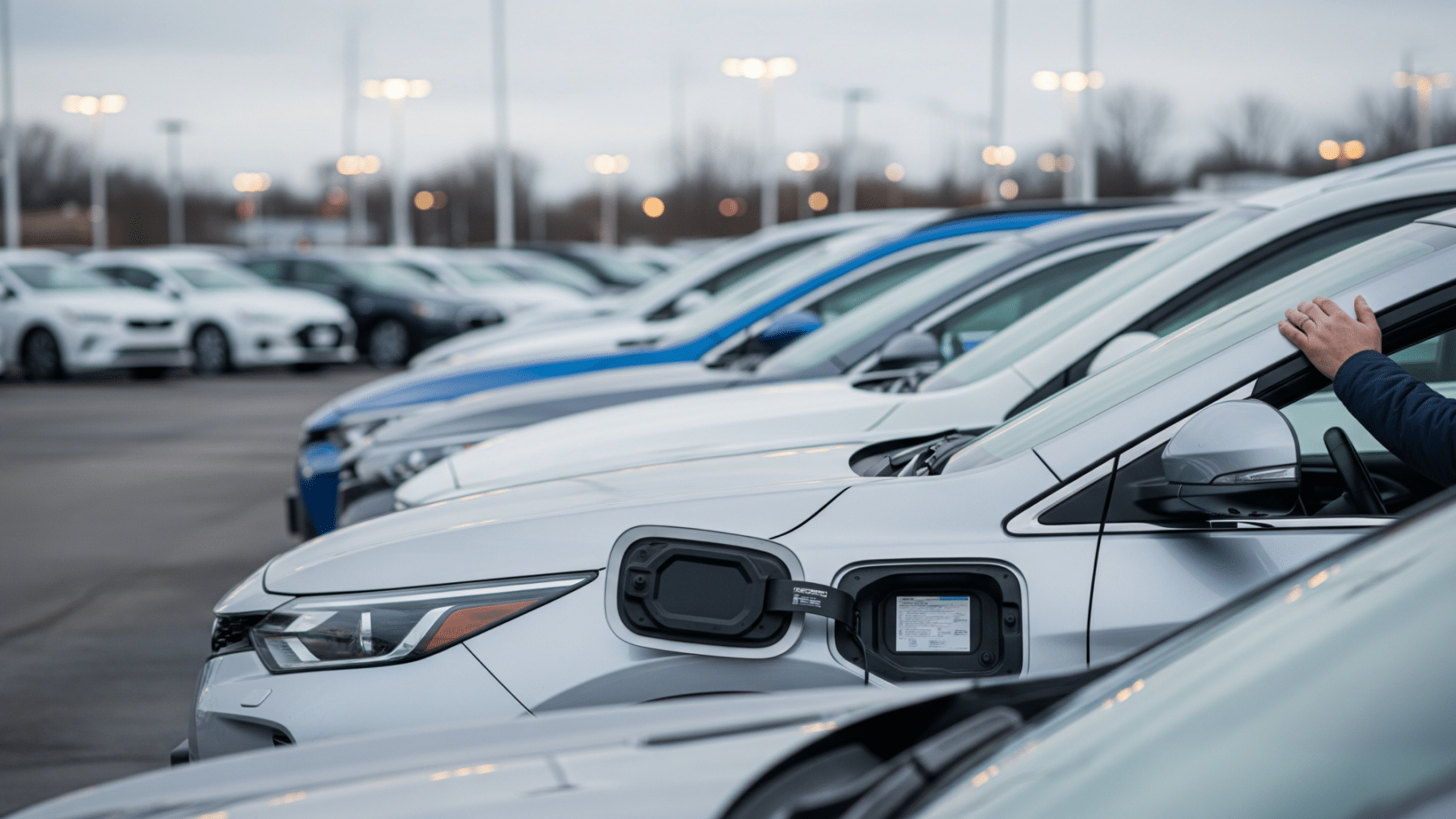
Hybrid vehicles are on track to claim 15.9% of U.S. new-vehicle retail sales in July 2026, a gain of 2.5 percentage points from a year earlier, while the electric-vehicle segment falls 3.3 percentage points to 7.0%, according to a joint forecast from JD Power and GlobalData.
The figures, released Friday, put hybrids at more than twice the retail share of pure EVs for the month.
A record half-year sets the stage
In the first half of 2026, sales of hybrid cars rose nearly 20% year over year to a record market share of 15.4%, according to the Center for Automotive Research, almost three times the share of pure EVs.
“The only growth we’re seeing is in hybrid market share,” said Elizabeth Krear, President and CEO of the Center for Automotive Research. “All other propulsion systems have lost market share year to date.”
Hybrid sales rose more than 9% in the first half of the year and deliveries have jumped more than 80% since 2023, according to Cox Automotive.
Hybrid vehicles captured 22.1% of California’s new-vehicle market through the first half of 2026, the highest share on record according to the California New Car Dealers Association, with quarterly share climbing to 23.2% in the second quarter. Hybrids surpassed electric vehicles in California’s market share in the second quarter, according to the CNCDA.
Three brands control the market
The surge has been a boon to the few automakers that invested heavily in the segment. Toyota, Hyundai Motor Group and Honda together control 86% of the U.S. hybrid market, according to automotive market analysis firm Baum & Associates.
Toyota sold more than 600,000 hybrids in the first half of 2026 across its Toyota and Lexus brands and leads the segment by a wide margin. Its hybrid lineup is pushing overall U.S. volumes closer to top seller General Motors, which has bet heavily on EVs and has only one hybrid in its U.S. lineup in the Corvette E-Ray.
GM told CNBC it sees a role for hybrids in its future product plans.
Hybrids account for 31% of American Honda’s sales, according to the company, and it set a U.S. hybrid sales record in the first half of 2026.
Hyundai Motor, up 4% during the last quarter, reported a 67% increase in hybrids during the first half of the year. Hybrid vehicles drove growth across all four leading Asian brands, led by Kia reporting a 152% increase in hybrid sales during the second quarter, with the Sportage Hybrid among the standout performers.
Incentives shift away from EVs
Incentive spending on traditional ICE and hybrid vehicles is expected to increase $578 per unit year-over-year, up 22.2%, to $3,181 in July 2026.
Meanwhile, EV incentives moved in the opposite direction with a forecasted decline of $759 per unit, or 7.0%, to $10,092. The gap illustrates how manufacturers are now actively funneling promotional dollars toward the segment drawing buyers rather than the one requiring the biggest push.
Gas prices are up more than 20% from the same period last year, according to AAA data, a factor executives across multiple automakers pointed to as driving the hybrid shift.
The plug-in hybrid segment has not been immune to challenges, with BMW recalling PHEVs over a starter relay fire risk earlier this year, but conventional full hybrids requiring no home charging have faced no such friction.
What comes next for laggards
“Consumers want the vehicles. The problem is there are relatively few automakers that offer those vehicles,” said Alan Baum, principal at Baum & Associates.
The data underscores a widening competitive gap. When hybrids are driving a lot of industry growth, GM does not have the same hybrid ammunition as Toyota, Honda, Hyundai or Kia, and the consumer mood is clearly shifting toward fuel efficiency without full EV commitment.
The seasonally adjusted annual rate for total new-vehicle sales in July 2026 is expected to be 16.9 million units, up 0.3 million units from July 2025. That headline figure masks a stark powertrain realignment, one that is rapidly reshaping which brands carry the most momentum into the second half of the year.
The shift also carries implications upstream: automakers building out domestic battery production capacity will need to weigh hybrid-grade cell demand against pure-EV projections that have softened considerably since early 2025.
Automakers are using hybrids strategically. For some, they are a bridge to fully electric lineups. For others, they are a long-term solution that avoids the charging concerns and infrastructure challenges still facing EVs.
Either way, the message for 2026 is clear: gas-electric powertrains are not a niche or a transition anymore, they are the default choice across price points and vehicle types.
