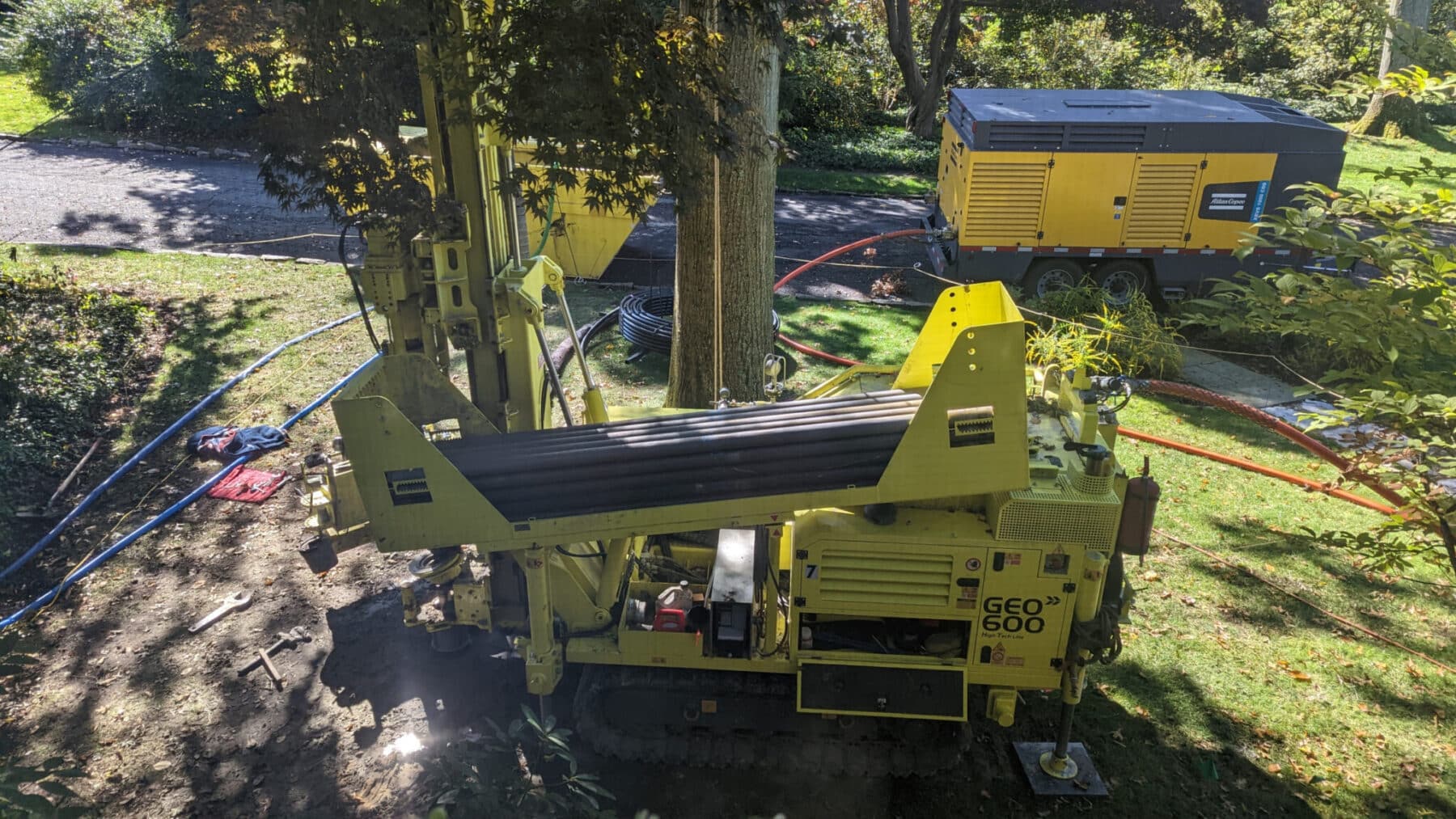
A drilling rig sits parked in a suburban side yard, its mast pointed at a narrow hole in the frozen ground.
Coiled plastic pipe waits in loops nearby, ready to feed into the borehole below. The homeowner watching from the porch had budgeted for a refund that was supposed to cover nearly a third of the bill.
Then the calendar turned, and that math fell apart.
What changed was not the hole in the ground. It was a single date buried in federal tax law.
The mechanism: one word, “completed,” decided everything
The law never cared when a homeowner signed a contract, paid a deposit, or watched a crew start drilling. It cared about one moment only: when the system’s installation was completed. Under the statute, an expenditure for geothermal property counts as made on the date the original installation is finished, not the date it was paid for. An expenditure is treated as made when the original installation of the item is completed, and if installation is completed after December 31, 2025, the expenditure is treated as made after that date , which blocks the credit entirely.
That distinction sounds like fine print, but it decided real money. A geothermal system commissioned on December 30 qualified in full. The identical system, same contractor, same invoice, switched on two weeks later qualified for nothing. Through 2025, geothermal qualified for the 30% Residential Clean Energy Credit with no cap, covering the full system cost including drilling and loop installation, a $10,500 credit on a $35,000 system.
So the trigger was completion, not purchase. Permitting delays, backordered equipment, or a drilling crew pushed back by weather could silently move a project from one tax universe into another.
A loop field built on a deadline nobody saw coming
Picture a typical vertical system: three to five boreholes with about 300 to 500 feet of piping per ton of HVAC capacity, drilled 100 to 400 feet into the yard. That work alone can run into tens of thousands of dollars before the indoor unit ever gets bolted in.
And the price tag was already steep. A typical residential geothermal installation ranges from $18,000 to $45,000, depending on system type, home size, local geology, and regional labor rates . For many households, the only thing that made that number tolerable was the expectation of a federal check erasing nearly a third of it.
That is why the deadline landed so hard. Drilling crews booked solid through autumn, since winter ground conditions and a holiday-season rush to finish before the cutoff left little room for delay. Some industry guidance published after the law passed cautioned homeowners that they needed more than an installed system to qualify in time, down to the final sign-off confirming the work was truly finished before the deadline.
The law behind the cutoff, straight from the source
The cutoff traces to the One Big Beautiful Bill Act, signed July 4, 2025, which accelerated the end of two residential energy credits that had been scheduled to run for years longer. The 2025 instructions for IRS Form 5695 spell out the mechanics for anyone trying to claim the credit on this year’s return.
Those instructions confirm the rate itself never dropped before it disappeared. The residential energy efficient property credit is now the residential clean energy credit, and the credit rate for property placed in service in 2022 through 2025 is 30% . There was no phase down, just a full rate and then a hard stop.
Tax guidance published since the law passed has been consistent on the same point. One detailed geothermal tax credit guide notes the credit “is not available for any property placed in service after December 31, 2025.” Early coverage of the law sometimes muddied that message, since the rules shifted between House and Senate drafts before the final bill locked in the December 31 cutoff, and that widespread confusion likely cost some homeowners money who assumed a longer runway.
Where the catch still bites, even for people who finished on time
Even homeowners who beat the deadline are not entirely in the clear. The credit is non-refundable, which means it can only zero out federal income tax owed, it doesn’t generate a refund check, and any unused portion can be carried forward to future tax years . A retiree or a household with a modest tax bill may need several years to use up a credit earned on a single project.
That carryforward mechanic matters because drilling costs dominate the total bill for most installs. Drilling is typically the single largest line item in a geothermal installation, accounting for 40, 60% of total project cost, with a typical US home spending $8,000, $22,000 on drilling alone . A credit that cannot be used all at once stretches the payback timeline even for a system that qualified.
There is also a quieter trap for anyone shopping now. Readers who followed GCN’s reporting on a geothermal loop lease model already know that financing structure carries its own disclosure rules at resale, separate from this federal credit entirely. And the per-foot drilling costs that make shared systems attractive, covered in GCN’s look at a backyard geothermal loop, do not shrink just because the incentive vanished. Commercial buyers got no such shock, since commercial geothermal heat pump property falls under the Section 48 Investment Tax Credit, which was not terminated by this law.
What this means for anyone pricing a system next
None of this makes geothermal a bad technology. The efficiency case remains intact, and decades of operating savings still accrue to a well sized, properly drilled system regardless of what happened to the tax code around it.
But the sales pitch many homeowners heard, cutting a $35,000 project down near $25,000 with a federal check, no longer applies to anything started today. That gap has to be rebuilt from state rebates, utility programs, or a longer payback period.
So the real lesson is not about geothermal’s merits. It is about reading the placed in service date on any contract before assuming a tax incentive will survive to the day the crew finishes the job.
