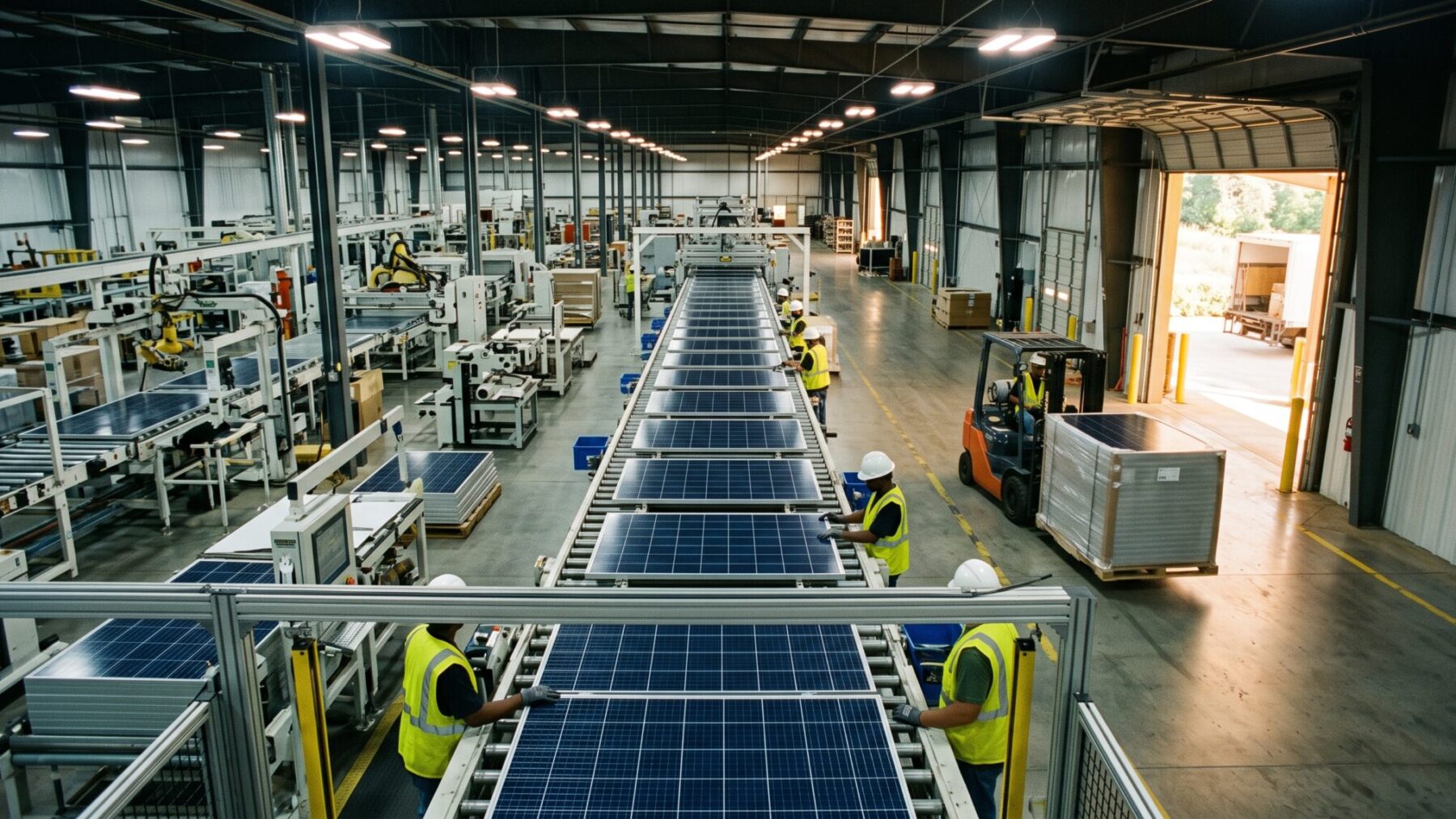
Chunks of polysilicon feedstock enter one end of an integrated campus in northwest Georgia.
By the time the material leaves the other end, it has been melted, pulled into a crystal log, sliced into wafers, coated into a working cell, and laminated into a finished panel. No container ship crosses an ocean carrying an ingot, wafer, cell, or module.
No other facility in the United States can say the same.
So how did one campus in Cartersville finally close a gap that has been open for nearly a decade?
How a solar panel gets built, and why doing it in one place is so hard
Most people picture a solar panel rolling off a single assembly line. The reality is a four-step industrial chain historically split across multiple countries, because each step demands different machinery, different chemistry and enormous capital.
It starts with polysilicon melted above 1,400 degrees Celsius and slowly pulled into a monocrystalline ingot, a cylindrical crystal log nearly a meter tall. That ingot is squared off and sliced by wire saws into wafers less than 200 microns thick.
Those wafers travel to a cell line, where a tunnel oxide layer and a thin film of polysilicon are deposited on the rear surface. This passivating contact step defines the TOPCon cell architecture now dominant in global production, cutting the rate at which electrons escape as heat rather than electricity. Each stage requires a different capital footprint.
Because of that, most US factories built in the last decade skipped straight to the final step, assembling imported cells into finished modules while crystal growing and cell coating stayed overseas. That upstream gap is exactly what Cartersville is designed to close.
What the Cartersville campus looks like running at full speed
Module assembly is already at full capacity, building 16,700 panels a day. Laid flat, those panels would cover roughly 30 football fields of rooftop every single morning.
Cell production began in June of this year, completing the chain from ingot to finished product inside a single integrated facility. By the third quarter, the campus will reach 3.3 gigawatts each of ingots, wafers and cells annually, alongside 3.5 gigawatts of modules. Combined with Qcells’ expanded manufacturing facility in Dalton, Georgia, total annual US output reaches 8.6 gigawatts, approximately the energy needed to power roughly 1.3 million American homes for a year.
It will be the largest ingot and wafer plant ever built in the United States. That is the clearest measure of how dependent US solar became on overseas supply chains.
The numbers that confirm how deep the upstream gap ran
Solar module manufacturing has grown from around 8 gigawatts before federal manufacturing tax credits to 69.9 gigawatts as of June this year, an increase of more than 750 percent. But as earlier reporting on the US solar manufacturing cell gap showed, the upstream steps did not grow at the same pace.
America’s module factories have expanded to more than 65 gigawatts of nameplate capacity, yet the United States currently has just 3 gigawatts of solar cell manufacturing capacity. That stark mismatch meant the overwhelming majority of cells flowing into US-assembled panels were still imported.
Ongoing trade cases and foreign-entity-of-concern rules have hit hardest at the imported cell and wafer steps. Every tariff wave passed straight through to the cost of assembling a module in Georgia or Michigan or Texas. A factory that makes its own cells is insulated from that exposure; producing major solar components domestically gives customers greater visibility into sourcing, pricing and delivery timelines, reducing exposure to international supply constraints and tariff volatility. For more on the silicon-slicing challenge further up the chain, see this GCN feature on a Michigan factory’s silicon wafer effort.
Where the domestic content incentives fit into the production math
Closing the upstream gap is not purely a supply-chain story. There are direct financial incentives built into federal tax law that turn the origin of each component into a dollar figure on a project’s balance sheet.
Modules produced at Cartersville help developers qualify for the domestic content bonus adder under the Investment Tax Credit, because every major solar component is made domestically. That adder sits on top of the base credit and can shift the financing math on a utility-scale installation by millions of dollars. For a developer choosing between two similarly priced suppliers, the ability to document domestic ingots, wafers and cells, not just lamination, can tip the decision decisively. Qcells itself is also eligible for the Section 45X Advanced Manufacturing Production Tax Credit, which applies to each stage of domestic solar component production.
The company has invested over $3 billion in the full supply chain, and the Department of Energy’s Loan Programs Office closed a $1.45 billion loan guarantee to support the Cartersville facility, which will produce ingots, wafers, cells and finished solar panels. The combination of private capital and federal backing reflects how much more expensive the upstream steps are compared with module assembly alone.
What the ramp still has to prove, and what it opens up
The facility is not yet at full run rate. Cell production only began in June, and the ingot and wafer lines are still scaling toward their 3.3-gigawatt nameplate.
The Czochralski pullers that grow monocrystalline ingots operate continuously at extreme temperatures, and yield losses during ramp can be significant before operators dial in the process. Developers are forecast to add a record 43.4 gigawatts of new utility-scale solar to the US grid this year, a 60 percent year-on-year increase, so demand for domestically sourced cells is arriving at exactly the moment supply is starting to climb.
Even so, a single 3.3-gigawatt cell line covers only a fraction of the 69.9 gigawatts of module capacity now operating across the country. The campus proves the integrated model works on American soil, it is the first and only US facility to produce the major parts of a solar photovoltaic module under one roof, from ingot to finished panel, and that may matter as much as its output: it gives the next investor a working template rather than a blank page.
