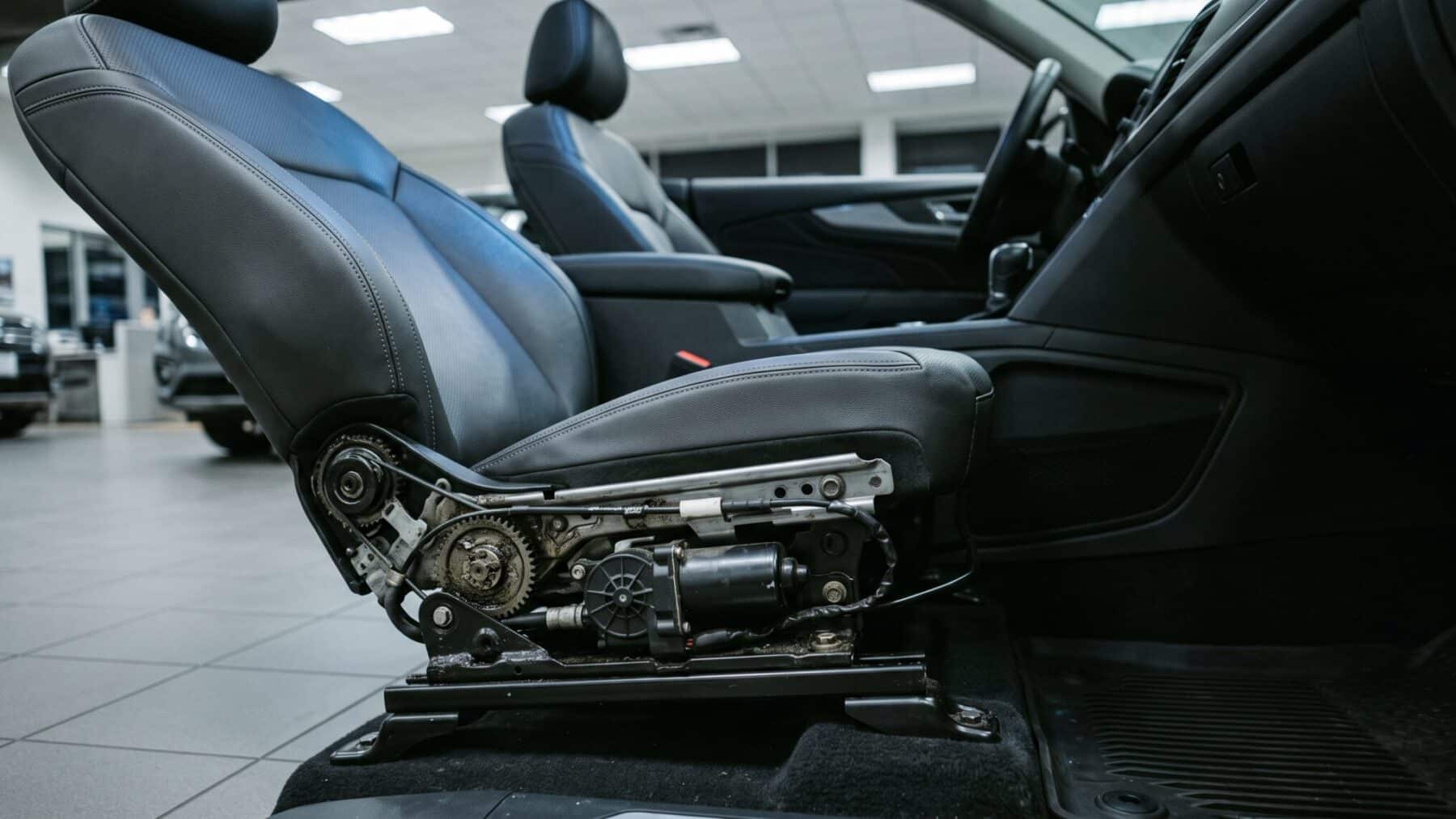
Walk up to a parked SUV with a key fob in your pocket and the door unlocks before you even reach the handle.
The cabin lights come on. Then the driver’s seat starts moving. Nobody is sitting in it. It reclines all the way back, pressing hard into the second row. That is not a design feature. It is a defect, and it has now triggered a federal safety recall covering nearly 80,000 vehicles on American roads right now.
How the memory seat system turns a remote-unlock signal into an uncontrolled recline
Every modern power seat with a memory function stores a driver’s preferred position as a set of motor target values: recline angle, height, fore-aft distance, all saved to the vehicle’s seat control module. When a remote-unlock or remote-start command arrives, it triggers a memory recall sequence, and each seat motor runs until sensor feedback confirms the seat has reached its saved coordinates.
The defect lives inside that sequence. Under specific conditions, the recline motor misreads the seat’s stored physical position and drives the seatback completely rearward without warning. The motor is designed to stall when it contacts an obstacle, and Ford’s internal review confirmed that it will stall, but concluded that the movement could still pose a risk to passengers before that stall point is reached. It runs toward its mechanical limit, pressing the seatback against whatever, or whoever, is behind it.
Engineers traced the behavior to a hardware change in the seat recline motor that entered production in November 2025. The new motor requires a specific combination of motor and control strategy, and that combination contains no reliable check to detect when the seatback has already passed the intended target angle.
Which vehicles are affected and what triggers the seat to move
The recall covers exactly 79,579 vehicles: 64,409 examples of the 2026 and 2027 Ford Explorer and 15,170 of the 2026 and 2027 Lincoln Aviator, filed under NHTSA campaign 26V470, and every vehicle in the population is believed to carry the faulty components. All affected vehicles were produced from November 24, 2025, to June 27, 2026.
The problem is not that the seat suddenly moves while you are driving. Instead, the driver’s seat can begin reclining with no one in the vehicle after the memory seat function is triggered by remotely unlocking with the key fob or app, activating remote start, walking up to the vehicle with a programmed fob in your pocket, or pressing a memory seat button. The seat moves before the driver ever opens the door.
Only vehicles equipped with a specific combination of seat motor and control strategy are affected, in practice, those fitted with the memory seat feature. The system is designed to return the driver’s seat to a saved position automatically, a convenience that became a hazard the moment the motor supplier changed.
How fast the problem surfaced and what the field data showed
On June 4, 2026, Ford’s Automotive Safety Office brought the seat behavior to the company’s Critical Concern Review Group after reports of driver seats reclining without input on 2026 Explorer and Aviator vehicles when the doors were unlocked. The investigation traced the movement to the memory recall function and connected it to a change in the seat recline motor supplier that began in November 2025.
By the end of June 2026, no fewer than 133 field reports had accumulated. That is a fast accumulation for a comfort-system defect, which typically surfaces slowly because drivers assume they accidentally triggered the seat themselves. The Field Review Committee ultimately approved the field action at the beginning of July 2026.
The recall is NHTSA campaign 26V470. The agency’s concern is real: unexpected movement of the driver’s seat back may trap a second-row occupant, increasing the risk of injury. There is no warning before the seat moves and no reversal once it begins; the motor stalls only when it reaches a physical obstacle, not before. Ford is not aware of any reports of accident or injury related to this condition.
Why a supplier motor swap is harder to catch than a software bug
Software defects in modern vehicles are often caught in simulation before production starts, and when they slip through, an over-the-air patch can reach millions of cars overnight. A hardware change inside a seat motor is a different problem entirely.
Ford’s recall documentation identifies the issue as centered on the driver seat backframe structure assembly and the integrated reclining motor, with affected motors sourced from Lear Corporation and Shenghuabo Group, listed by Ford with Chinese and Mexican regional headquarters. A new motor from a new supplier can pass every bench test and still behave differently once installed in a full seat assembly with real cable tension and real mechanical resistance. The interaction only emerged at scale, in real-world build combinations, after vehicles reached owners.
That is exactly the supply-chain fragility that has prompted broader industry moves to lock in parts sourcing further upstream, as seen in a recent multibillion-dollar supply deal aimed at guarding against disruptions. The recall does not carry a Do Not Drive or Park Outside advisory, but owners who have noticed unexpected seat movement should keep the second row clear until the repair is available.
What owners can do now and what a fix will likely look like
Ford told the NHTSA that a fix is still under development and a schedule for notifying affected drivers has not been determined. That timeline is unusual: most recalls arrive with at least a target mailing date, and its absence reflects how complex a hardware-rooted fix can be.
Ford has not yet finalized a remedy for the seat defect. Engineers are still developing the solution, which is expected to combine a software update to recalibrate the seat memory position logic with hardware replacement of the front seat backframe assembly where necessary. Engineers first need to confirm the revised control strategy works reliably across the full range of ambient temperatures and seat-load conditions. When the remedy is ready, it will be free to owners, handled under Ford’s general reimbursement plan already on file.
Owners can confirm whether a specific vehicle is included by checking the VIN at NHTSA.gov/recalls once the campaign becomes searchable, or by contacting Ford customer service at 1-866-436-7332 using recall number 26S53. The broader picture for safety accountability is shifting: a recently expanded federal safety benchmark now subjects driver-assist technology to eight pass-fail criteria, a signal that regulators are scrutinizing automated vehicle behaviors with increasing precision. For the nearly 80,000 Explorer and Aviator owners waiting on a fix, the immediate step is simple: check your VIN.
