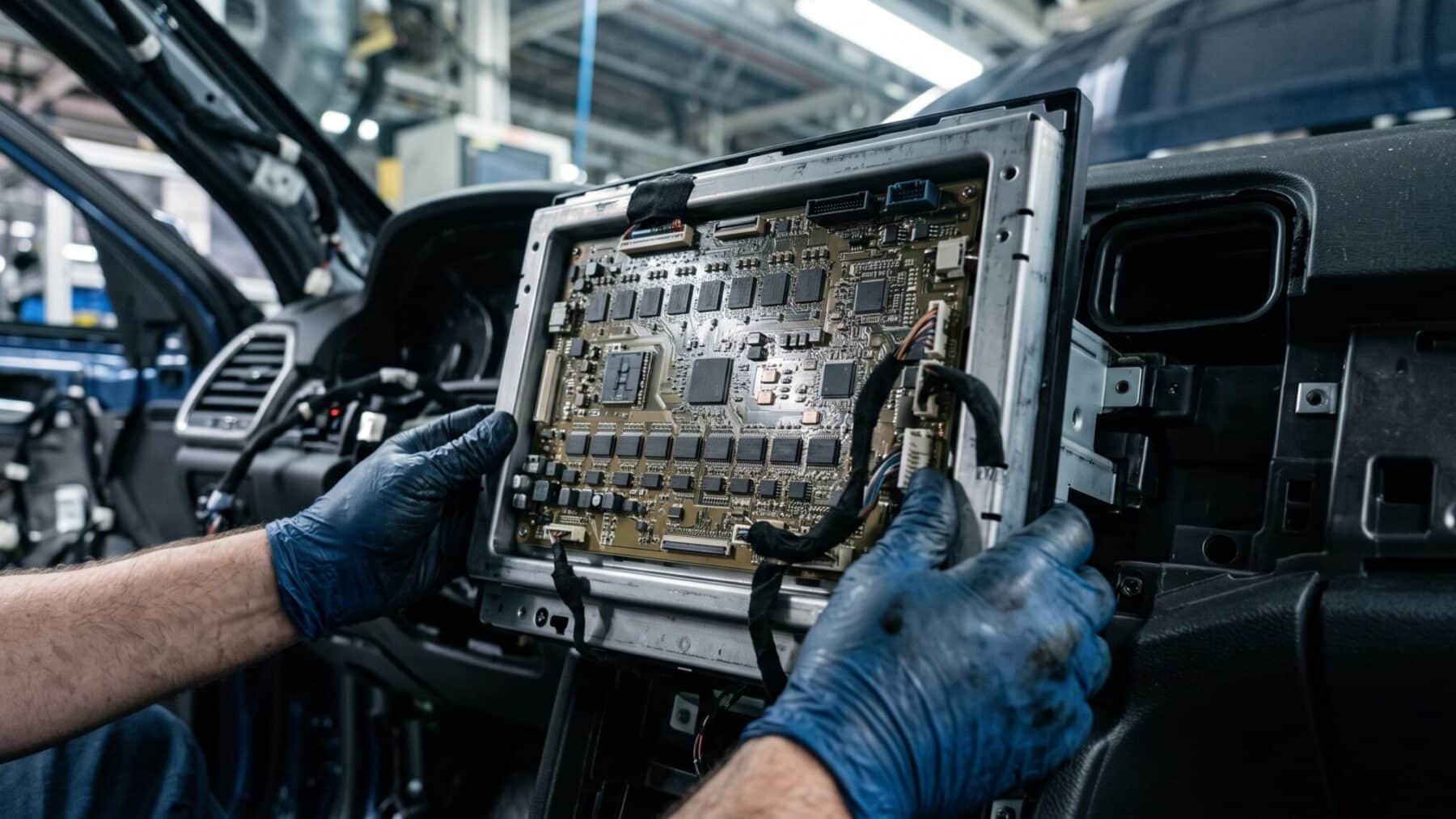
Pull up to any new car on a dealership lot and the first thing that catches your eye is the screen.
Then the safety pitch begins: automatic emergency braking, blind-spot alerts, lane-keep assist. All of it runs on tiny memory chips packed inside the dashboard. Those chips are now caught in a squeeze that has nothing to do with the car itself. And the cost is heading straight toward the sticker.
Why AI data centers are eating the chips your car depends on
The problem lies with dynamic random-access memory, or DRAM, that supports artificial intelligence, infotainment and advanced driver-assistance systems. These are not the same microcontrollers that froze production lines during the pandemic. They are a different kind of semiconductor entirely, one that every modern vehicle needs in growing volumes.
Major suppliers have shifted advanced chipmaking capacity toward high-bandwidth memory used in AI data centers, where margins are higher and order volumes are enormous. Automotive was not deprioritized because it did not matter. It was crowded out because other markets could pay more.
Automotive memory chips require months or years of validation before they can go inside a vehicle. That gap means automakers cannot simply switch suppliers the way a consumer electronics company might. They are locked into a pool that is now being drained from the top.
What sits inside the dashboard and how much of it a modern car actually needs
The demand numbers have grown fast. A Micron-commissioned S&P Global Mobility report found that the average vehicle already uses 90 gigabytes of DRAM and NAND combined, and projected that figure to reach 278 gigabytes for the average vehicle by 2026, with premium models requiring up to 2 terabytes.
Infotainment systems alone require between 4 and 16 gigabytes. ADAS and safety systems need 8 to 32 gigabytes. Centralized computing platforms often start at 16 gigabytes and can reach 64 or more.
So the car your neighbor just drove off the lot is, in memory terms, running closer to a mid-range server than to the vehicles of a decade ago. The exposure is sharpest for EVs and premium models built on centralized computing platforms, which carry significantly more DRAM than conventional vehicles. Those are also the vehicles where buyers paid the most for the features now most at risk, and EV demand across the US market keeps climbing.
The numbers behind the squeeze and where they come from
Legacy memory types such as DDR4 and LPDDR4, widely used in infotainment and ADAS systems, saw price increases of around 70 percent year-over-year for automotive DRAM by early 2026, according to S&P Global Mobility data. In new supply contracts, prices could reach 70 to 100 percent higher compared to 2025, with further increases signaled for 2026 and 2027 as supply for older generations tightens.
Three suppliers, Samsung, SK Hynix and Micron, produce more than 90 percent of the world’s automotive DRAM. SK Hynix has confirmed its 2026 production capacity is already fully committed. New orders are quoting lead times extending well beyond a year, according to supply chain analysts. That means an automaker ordering chips today cannot count on them until well into next year.
The pressure extends beyond DRAM. Embedded storage devices used in vehicle control modules have seen sharp price increases, and suppliers of flash memory used in infotainment electronics cannot confirm supply in some cases. Recalls tied to supply chain failures have already put the consequences of supplier missteps into sharp relief this year. The shortage is wider than the headline number suggests.
Where the cost lands and which buyers feel it most
Luxury and high-tech vehicles are most exposed. Premium models with advanced cockpits, rich displays and autonomy features require more DRAM, and automakers must decide whether to absorb the cost or pass the increase to the customer.
The features that consume the most DRAM, large displays, advanced graphics and AI voice assistants, are often the same features that define brand identity. Removing them saves memory but can undo years of positioning work. That is the bind: strip the screen that sold the car, or pay a supplier double for the chip that runs it.
For dealerships, the implications include mid-year packaging changes where features get bundled or dropped, and subtle constraints on certain displays or ADAS packages. A buyer who ordered a specific trim with a specific safety package may find the configuration quietly adjusted before delivery.
What the industry can actually do and how long the pressure holds
Edward Wilford, senior research director for Automotive at analyst firm Omdia, drew a clear line between this moment and the pandemic: “The main difference is that 2021 was a finite event affecting everyone, 2026 is a dramatic market shift into a new direction.” A finite event ends. A structural market shift does not resolve on its own.
Cockpit and ADAS systems designed several years ago and scheduled to remain in production through the next few years are now most exposed. Redesigning those systems to use newer memory generations takes time automakers do not have in a mid-cycle model.
Chip makers are also phasing out older technologies such as DDR4 and LPDDR4, still commonly used for automotive applications, forcing redesigns that compound the timeline problem. Automakers are being advised to focus on architecture planning and early adoption of advanced memory types.
That is a long-game answer to a right-now problem. In the shorter term, buyers shopping for feature-heavy vehicles should ask their dealer specifically which packages are confirmed in production before signing, because the screen that sold them the car runs on chips that are harder to source by the week.
