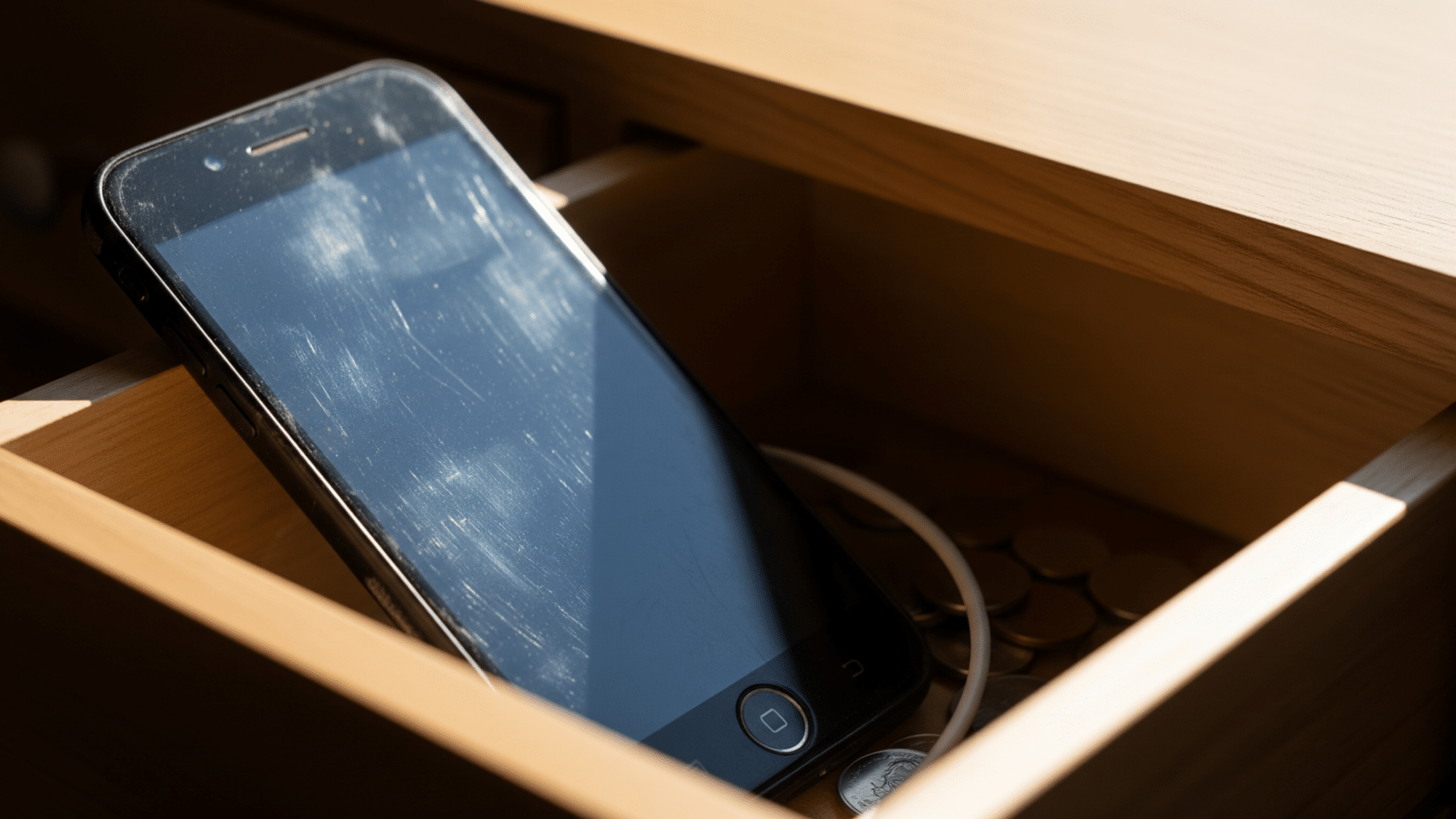
It probably has a cracked corner. Maybe a dinged-up case. The screen still lights up when you press the button, but you replaced it eight months ago and haven’t touched it since.
That device sitting in your drawer is not just clutter. It is, according to the people who track these things, part of the biggest cash pool in the history of the American smartphone trade-in market.
The device most people assume is worthless after one upgrade cycle
The average American household owns several smartphones at any given time, and a significant number of those devices never get traded in.
They sit. They wait. They lose value by the week.
The used and refurbished smartphone market has continued to grow precisely because those devices still carry real dollar value long after they stop being your daily driver, typically selling for 30 to 50 percent less than a new model, which sounds like depreciation, but it also means real money is still on the table.
Most people simply never collect it.
Why the secondary phone market started moving faster than almost anyone predicted
The global used and refurbished smartphone market is expected to grow from $65.20 billion in 2025 to $69.66 billion in 2026, according to Mordor Intelligence. Demand is being driven from two directions at once.
Flagship devices such as the iPhone 16 Pro Max list at $1,399.99, placing premium hardware beyond reach for many buyers. Certified units of the same model sell 30 to 40 percent lower, widening the value gap that fuels the used and refurbished smartphone market.
High new-phone prices push buyers toward used devices. And those buyers need supply, which means your drawer phone has a market waiting for it.
What actually happens to the phone value while it ages in your drawer
Trade-in value is not static. It moves with the calendar, and the direction is almost always down.
Analysts have consistently documented faster depreciation on newer iPhone models than on older ones, meaning the longer a device sits unused, the harder the value loss compounds on top of natural aging.
That means a phone worth $400 in January can be worth significantly less by June, without a single scratch added.
Timing matters more than condition in most cases. And yet the overwhelming majority of Americans never act on the window.
As the secondary market keeps growing, and as it increasingly intersects with the idle computing power already sitting in people’s pockets, the economic logic of holding onto an old phone keeps getting harder to justify.
The $6.4 billion record that landed quietly and changed the math
In March 2026, Assurant released its Q4 2025 and full-year Mobile Trade-In and Upgrade Industry Trends Report, and the number at the top stopped a lot of analysts mid-sentence.
U.S. consumers received more than $6.4 billion in value through mobile trade-in programs in 2025, a 42 percent increase year-over-year. The largest annual total since Assurant began tracking the data in 2015, the growth reflects a combination of newer and higher quality devices entering into trade-in programs through consumer trade-ins.
For the first time on an annual basis, the most commonly turned-in devices were all premium 5G models, including iPhone 13 and iPhone 14 variants.
Then, in June 2026, Assurant’s momentum report for the first quarter of 2026 showed the record pace was holding. Consumers received $1.63 billion in value through mobile trade-in programs in the first quarter of 2026, up 31 percent from the same period in 2025. The first quarter was the most active on record based on volume of devices traded in and total value returned to consumers.
The average age of traded-in devices was 3.81 years in the first quarter, meaning the device you replaced last year almost certainly still qualifies.
According to Assurant’s Q1 2026 report, trade-ins are now doing more than clearing out drawers, they are actively reshaping the economics of the entire upgrade cycle.
Why the people who do trade in are quietly winning a game most people don’t know they’re playing
When paired with protection plans that help keep phones in good condition, trade-ins can turn routine device care into meaningful savings at upgrade.
Smartphone trade-ins can return hundreds of dollars in value to consumers, helping offset higher upgrade costs. Simple choices across the device lifecycle, such as trading in a smartphone instead of discarding or leaving it unused, create meaningful value at upgrade time.
The phones already locking that value in are, overwhelmingly, the same models gathering dust in American junk drawers right now.
And as the secondary market for devices intersects with consumer economics more broadly, a pattern already visible in how everyday digital activity feeds billion-dollar markets, the casual decision to skip a trade-in is starting to look less like laziness and more like leaving a check on the table unsigned.
The record is set. The window is open. The drawer is the only thing standing between most Americans and a slice of the value already being divided up without them.
