
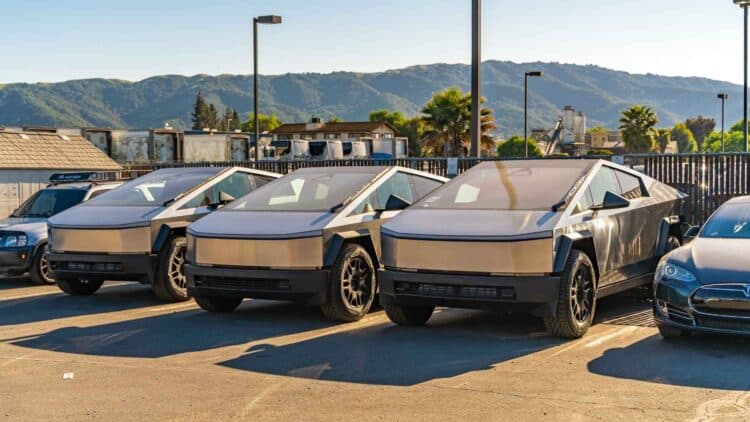
The U.S. Air Force has plans to use Tesla Cybertrucks as missile targets in its test centers. The Air Force plans to acquire two Cybertrucks for target practice. This plan is not only about testing weapons but also a statement about big tech’s role in defense.
Why pick Tesla’s Cybertrucks specifically?
According to an official document released by the Air Force, Tesla’s Cybertrucks have been chosen for use because enemies might start to use them on the battlefield due to their tough design. The justification also states that training must mimic real-life scenarios, and therefore the need to prepare troops using real targets.
Before settling on the type of vehicles to use, the Air Force first conducted market research. The research showed that no other vehicle had unique features such as the stainless steel-clad exoskeleton, aggressive angles, and a 48-volt electrical system in Tesla’s Cybertrucks.
Elon Musk, Tesla’s CEO, called the Cybertrucks “apocalypse-proof,” whose windows can stop subsonic pistol rounds.
Cybertrucks in Military Contexts
This will not be the first time that Cybertrucks have been mentioned in military contexts. The Dubai Police purchased an undisclosed number of Tesla’s Cybertrucks to add to its technologically advanced fleet.
Ramzan Kadyrov, the Chechnya warlord, also published a video of himself on top of a Tesla with a mounted machine gun. He said that the car was invulnerable, fast, maneuverable, and comfortable. However, Elon Musk denied giving the vehicle to the Chechen leader.
Big Tech’s Growing Defense Role
The Air Force’s plan highlights big tech’s growing role in defense. Although Tesla is not directly supplying the Air Force, the tech behind Cybertrucks, from its advanced electronics to resilient materials, could influence how enemies equip themselves in times of war.
According to Gordon Adams, a professor of U.S. foreign policy at American University, the plan by the Air Force to use Cybertrucks as missile targets is a symbol of a growing bond between the Pentagon and big tech companies.
Primary adversaries for U.S. special operation munitions are often militants in South Asia, Africa, and the Middle East who use tough vehicles. Cybertrucks are also tough vehicles, beside their advanced tech, and therefore American forces need to practice how to take them down in case enemies start using them.
Besides Cybertrucks, the Air Force will also use bongo trucks, sedans, SUVs, and pickups in the target practice.
The Cybertrucks Market Struggles
The plan by the Air Force to use Cybertrucks as missile targets comes at a time when their sales are slipping. Data from Cox Automotive shows that Tesla has sold only 6,406 Cybertrucks in the first quarter of 2025. Additionally, the automaker has delivered fewer than 50,000 of the trucks as of March 20, which is a long way from the ambitious targets set out by Elon Musk before launching the Cybertruck in 2023.
A Political Backdrop
Recently, there have been tensions between Elon Musk and President Donald Trump following their fallout earlier this year due to policy differences. However, their conflict does not change the fact that big tech innovations are making it harder to differentiate between gadgets meant for everyday use and military use.
Conclusion
Using Cybertrucks as missile targets indicates how everyday tech can end up in high-stakes defense scenarios. It also shows that companies like Tesla are not only making cars for normal use but also creating tech that could redefine battles. The military has to keep up with the pace of big tech as it pushes to set new limits.