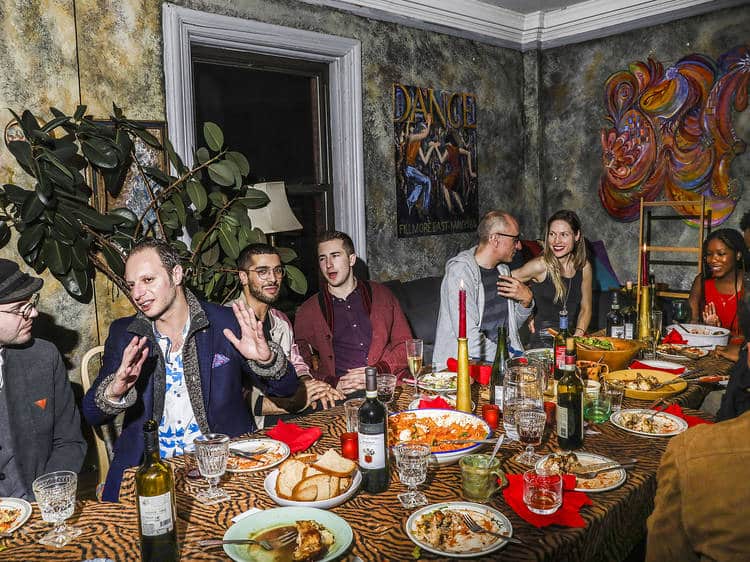
A host seats five strangers at a reserved table, slides menus across the cloth, and says the same line she says every Wednesday.
Nobody at the table has met before tonight.
By dessert, two of them have swapped numbers.
The app that put them there calls this the start of a friendship.
A university friendship study says the start is still a very long way from the finish.
Why one dinner can’t do what the app implies it does
The mechanism is simple and it is not a secret. Shared time accumulates like a balance, and friendship only forms once that balance crosses certain thresholds. A communication researcher at the University of Kansas tracked how real relationships actually moved through stages.
He found that it takes roughly 50 hours of time together to move from mere acquaintance to casual friend, 90 hours to go from that stage to simple “friend” status and more than 200 hours before you can consider someone your close friend. That is not a guess dressed up as science.
Combining the results of both studies, he estimated it takes between 40 and 60 hours to form a casual friendship, 80-100 hours to transition to being a friend and more than 200 hours together to become good friends. So a single two-hour dinner, however warm it feels, is a rounding error against that math.
That is exactly why apps built around one-time stranger meals describe themselves as a starting point rather than a finished friendship, even when the marketing leans hard on the word connection. Almost nobody budgets for the other eighty-some hours before booking the first seat.
Inside the table: how the stranger dinner format actually runs
The best known version of this product is a weekly dinner service that matches four to six personality-compatible strangers for a weekly dinner at a local restaurant, in 200+ cities across 52 countries, with no swiping and no profiles to browse. Reviewers describe a process where diners never browse profiles at all, which removes the swiping treadmill entirely.
That no-profile design is the whole appeal. Instead of scrolling photos and bios like a dating app, a diner just shows up, and the shared context of the meal does the icebreaking a chat thread never quite manages.
But the structure that makes the first dinner easy is the same structure that makes the fiftieth dinner cost real money. The service runs in hundreds of cities and charges per dinner or by subscription.
One detailed review pegs the cost at roughly $20 to $26 a month for a subscription, or $20 to $35 per dinner ticket. The meal is never included. Other entries in the category charge per seat instead, with similar competitors listing comparable per-event pricing plus your own tab.
What the receipts look like once you run the numbers
Here is where the hours math and the pricing math collide. If a single dinner with the same five people runs about two hours, and it takes roughly 50 hours of shared time to move from an acquaintance to a casual friend , a diner would need to return to that same small group across dozens of sittings just to cross the casual line.
Most stranger dinner apps do not even guarantee the same five faces twice. One review of a similar app put it plainly: “the table resets every week.” Next Wednesday is a new group of strangers, so the two hours you banked with this week’s table do not carry over.
The matching resets most weeks, spreading each sitting’s two hours across a different set of strangers instead of letting any single relationship compound. That is good for variety and arguably bad for math.
Researchers who study this exact gap keep landing on frequency over novelty as the real fix. The original Kansas research release notes that young adults who throw themselves into a new social routine condense the timeline fast, because their environment does the accumulating for them. Adults who rely on a paid app to manufacture that repetition are rebuilding, one $20 seat at a time, something a dorm hallway or a work desk used to hand them for free, a trend GCN covered in Pew’s community engagement data.
Where this actually works, and where the format runs out of road
None of this means the dinners are a bad deal. For someone who just moved to a new city, a recurring Wednesday table is a far better shot at accumulating hours than sitting home with no reservation at all.
The limit shows up for people expecting the app itself to deliver the friendship, rather than the dozens of repeat visits behind it.
A reviewer who tested a swipe-based friend-finding app over weeks of real use found the honest math blunter than the marketing. Out of 21 matches, only one became a consistent friend, a 5 percent conversion rate, which is higher than before the experiment started. That was on a swipe-based rival, not even the dinner format itself.
So the catch is not hidden fine print. It is baked into the premise: a service sold as a shortcut to friendship is, by the researcher’s own numbers, a shortcut to maybe the first sliver of the ninety hours required to reach real friend status, a pattern not unlike the planning habits GCN described in how Americans are reshaping shared spaces for recurring social use.
What to actually expect before booking the next seat
The honest pitch for a stranger dinner app is not instant friendship, it is scheduled proximity. It puts a diner in a chair across from new people on a reliable weekly clock, which is more than most adult calendars manage on their own.
What it cannot do is skip the hours. Anyone counting on one great conversation to produce a lasting friend is measuring the wrong unit, and the researchers who logged those 50, 90, and 200 hour thresholds were measuring something slower and far less photogenic than a single dinner.
So the fair way to judge the receipt is across months, not meals.
A diner who keeps showing up, with the same people or new ones, is doing the actual work the hours math demands. The $20 dinner buys a seat at the table. The friendship still has to be built one Wednesday at a time.
