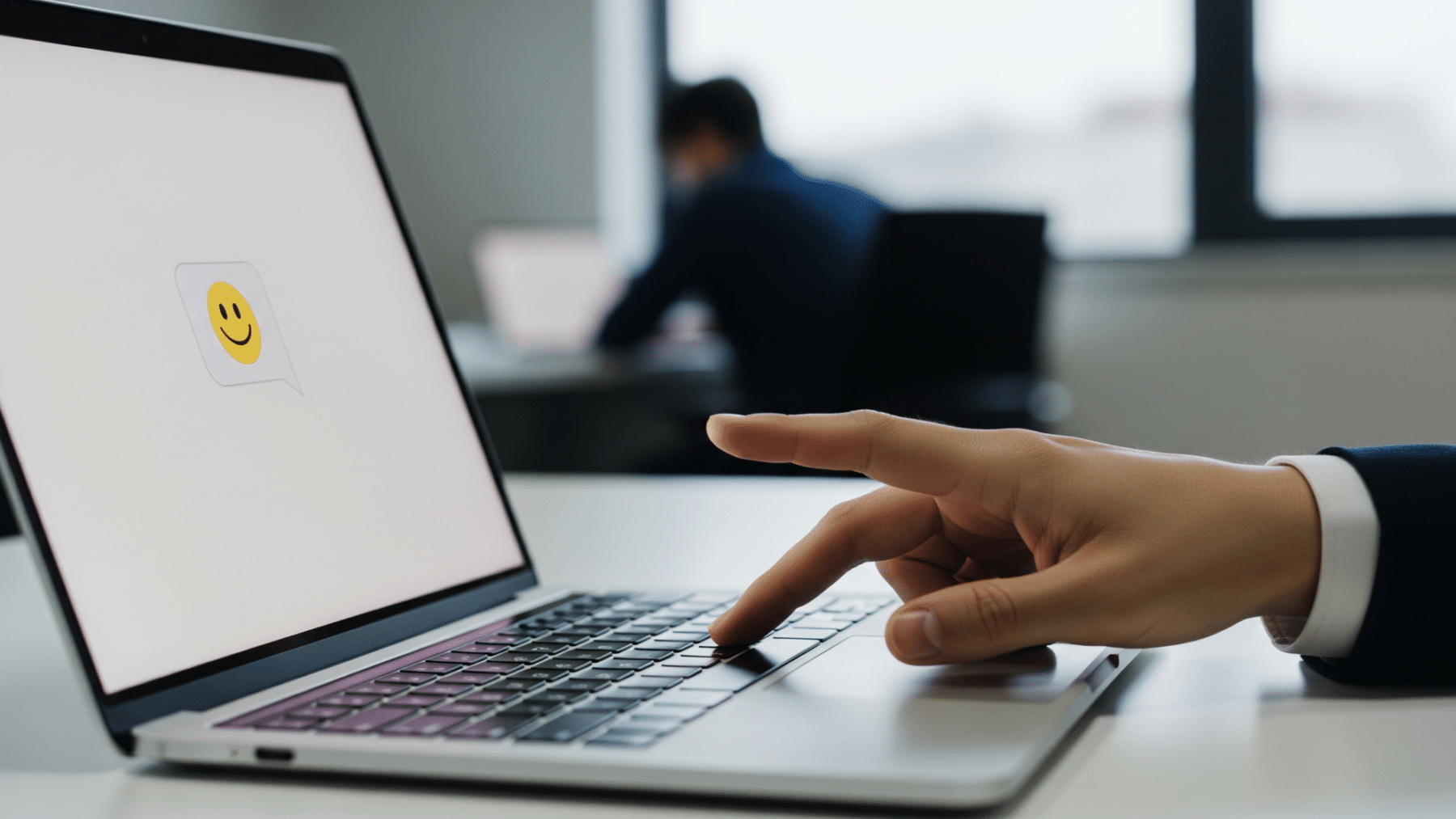
You know the impulse. A colleague sends a tense message, you draft a quick reply, and before you hit send you add a small yellow face to soften the tone. It takes less than a second and feels like the safest possible move.
It might not be.
A wave of new research into digital communication is quietly dismantling some of the most confident assumptions workers carry into their daily chats, and the mechanism underneath is far more precise than anyone outside a psychology lab expected.
The office has never been more text-dependent, and that gap is getting harder to bridge
When people interact in person, subtle signals like facial expressions, body language, and tone of voice play a crucial role in communicating intent and meaning, whereas written communications lack these nonverbal cues and can lead to misinterpretation. The advent of emojis became a popular tool to provide context to written messages, and they work in many settings. Billions of workplace instant messages pass through chat apps every day, with 91% of enterprises using two or more chat platforms.
But researchers had a nagging question: do they actually work the same way in a professional setting as they do in a personal one?
What a text message can and cannot carry on its own
Text-based messaging is a primary use of smartphones, with near-universal adoption across age groups, and the use and variety of emojis in such messages has surged, particularly among young adults.
That surge has pushed the emoji well beyond casual conversation. Workers now use them in performance reviews, project updates, and direct messages to managers.
The question is not whether people use them at work. Everyone does.
The real question is what happens in the reader’s brain the moment one appears in a professional context, and whether the answer changes depending on what the words around it actually say.
How the researchers built a controlled experiment that mirrors a real inbox
A study conducted with colleagues at the University of Ottawa and published in Collabra: Psychology reveals that emoji choice matters: the emoji you pick, and whether it matches the tone of your message, may impact both how competent your co-workers think you are, and how appropriate your message is for the workplace.
The researchers asked 243 participants to read IMs varying in sentence valence (positive, negative, neutral), emoji valence (positive, negative, no emoji), and sender gender (man, woman).
The design was deliberately tight. Their emoji selection was limited to only three options: a positive “grinning face” emoji, a negative “angry face” emoji, or no emoji at all. “We deliberately selected these emojis to represent positive and negative emotional valence because these simple and unambiguous facial expressions minimize interpretive variability,” the team wrote.
That narrow selection left the text doing the heavy lifting, with the emoji as the single variable under a microscope.
The three-variable rule that determines whether your emoji helps or quietly costs you
Here is what the data actually showed, and it is more specific than any general “emojis are unprofessional” warning you have heard before.
Both sentence and emoji valence significantly influenced perceptions of sender competence and appropriateness in professional communications.
Positive emojis enhanced competence perceptions when paired with positive or neutral sentences, but had no effect with negative sentences.
“Negative emojis were consistently considered inappropriate for workplace communication as they made the sender seem less competent, especially when the message itself was already positive or neutral.”
Pairing a positive emoji with a message that already carries bad news offered no benefit to perceived competence, and a negative emoji on any message was the most damaging combination of all, reading as aggressive or inappropriate to the person on the receiving end.
Overall, messages with no emoji at all were clearly the winner, making the sender appear more competent and professional, the safest option in workplace messaging is often the plainest one.
The gender dimension added another layer: women participants perceived negative emojis sent by women senders more negatively than those sent by men.
This connects directly to a broader shift in how Americans communicate digitally. Our earlier look at how messaging overtook phone calls as the default daily communication channel shows why these emoji signals now carry so much weight: text has become the primary arena for professional impression management, not just personal chat.
What this actually means the next time you reach for the emoji keyboard at work
“Emojis are not simply neutral add-ons to text messages; they can influence how others perceive us, particularly in terms of competence and appropriateness,” the study’s lead author, Erin L. Courtice at the University of Ottawa’s School of Psychology, said in a statement.
The practical rule the data supports is a matching principle: a positive emoji on a positive or neutral message is fine and can even sharpen how capable you appear.
A negative emoji on any message erodes that perception almost immediately, and a positive emoji on a negative message offers no rescue.
Meanwhile, separate research published in PLOS One by Eun Huh at the University of Texas at Austin found the opposite pattern holds among close friends: emojis in text messaging increase perceived partner responsiveness and thereby enhance closeness and relationship satisfaction.
There were no significant differences between face and non-face emojis, suggesting that it may be the presence of emojis that drives perceptions of greater partner responsiveness and better relationships.
The same tiny yellow face that pulls a friendship closer can quietly undercut a career, depending entirely on where it lands.
The mechanism is not about professionalism as a vague social norm. It is about whether a small pictograph confirms or contradicts the words it sits next to.
That is worth one second of thought before you hit send. For anyone juggling how they come across digitally while also navigating the pressures documented in research on generational communication gaps, the stakes of that one-second pause are higher than they look.
