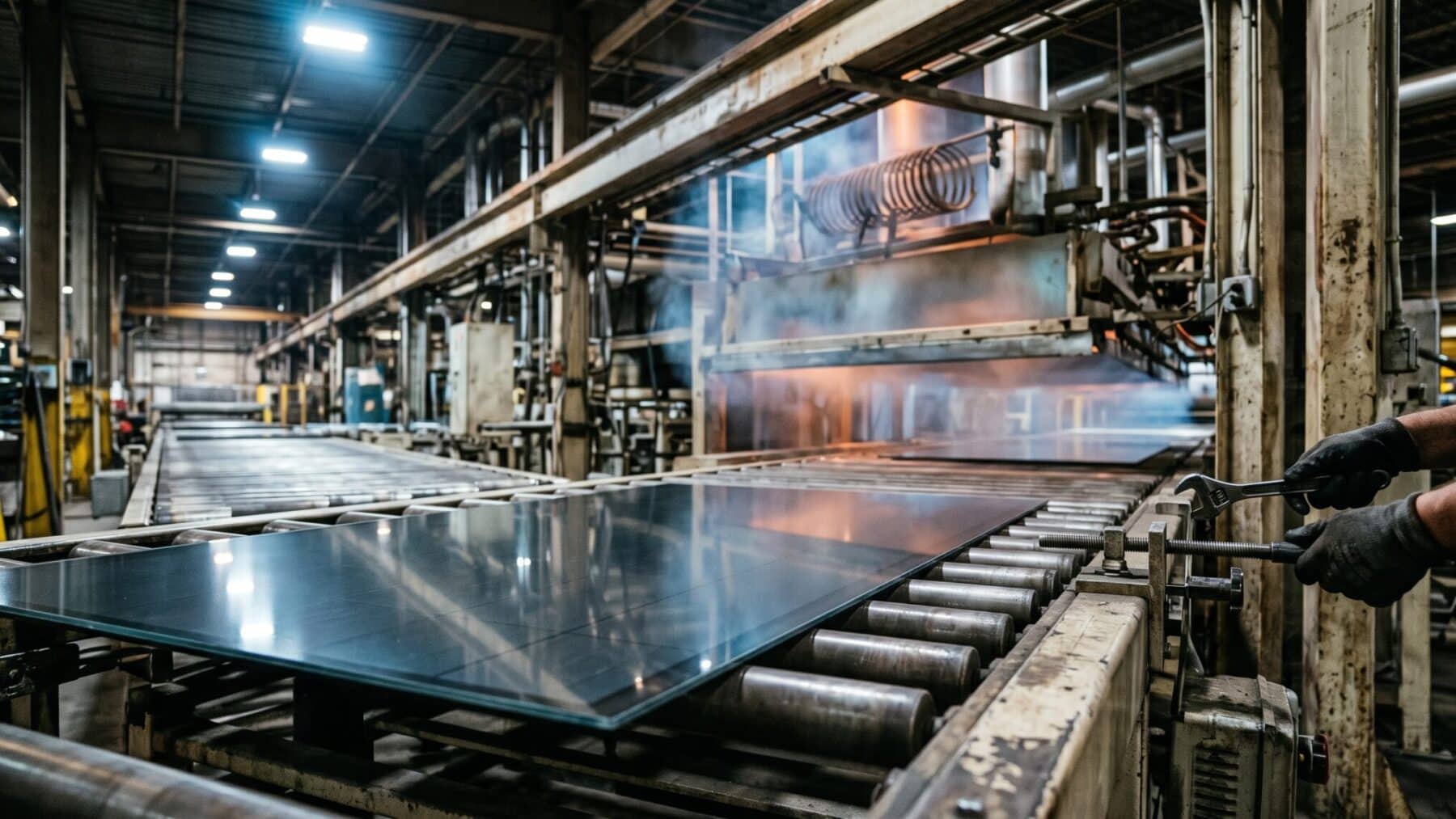
A sheet of glass rolls into a machine and vapor condenses onto its surface in layers thinner than a human hair.
No silicon crystal is grown, sliced, or handled anywhere in the building. About four and a half hours later, a fully functioning solar panel emerges from the other end.
That is the production reality of cadmium telluride solar. Most people buying panels have never heard the name of the material inside them.
So how does a factory skip the most expensive step in solar manufacturing entirely?
How vapor replaces wafers: the deposition process that cuts hours from the factory floor
Unlike silicon modules, which are built from discrete cells arranged in strings, cadmium telluride modules are deposited directly onto single flat sheets of glass. There is no ingot to grow, no block to wire-saw into wafers, no cell to solder into a string.
The CdTe film absorbs most visible light within the first micron of material. The CdTe layer, intermediate layers, and a transparent conductive oxide together form an electric field that converts light into current. Metal contacts go on the back, and all of it lands on incoming glass before exiting as a complete panel in a matter of hours.
That compressed process needs only 1 to 2 percent of the semiconductor material required by crystalline silicon to produce comparable power. An 18.5 percent efficient CdTe module carries about 35 percent of the embodied energy of an equivalent single-crystal silicon module. So far less raw material moves through the building.
Where the raw material actually comes from: a refining byproduct with nowhere else to go
Walk into a copper smelter and solar panels are the last thing on your mind. But the two industries are tightly linked. Cadmium comes from zinc mining residues and tellurium from copper refining waste, and existing output from those processes has so far drawn largely on supply already produced without requiring dedicated new mining operations.
According to the USGS, tellurium is recovered principally as a byproduct of the electrolytic refining of primary copper, where it accumulates in the residues of copper anodes. As of the most recent federal data, two primary electrolytic copper refineries in the United States, one in Texas and one in Utah, produced copper telluride from those tellurium-bearing anode slimes.
Silicon supply chains run through a small number of countries, dominated by China. CdTe feedstock, by contrast, flows from copper and zinc smelters scattered across multiple continents, including the United States. The thin-film process does not touch Chinese crystalline silicon supply chains at all.
Where US production stands: a Louisiana plant, a pipeline of gigawatts and a gap in domestic polysilicon
A CdTe module facility in Louisiana began production in July 2025, several months ahead of schedule, and is expected to reach 3.5 gigawatts of annual nameplate capacity once fully ramped. With that plant running, total nameplate capacity across US, Indian, Vietnamese, and Malaysian sites exceeded more than 20 gigawatts. Three plants in Ohio and one in Alabama round out the domestic footprint.
The pipeline keeps growing. A new 3.7-gigawatt US plant in South Carolina is planned, with roughly $330 million committed to its construction.
Meanwhile, the broader silicon supply chain still has a deep hole to climb out of. The US share of global polysilicon production has fallen sharply over the past two decades, and on ingots, wafers, and cells the country is almost entirely dependent on imports. That gap is precisely why CdTe’s self-contained domestic process draws increasing attention from policymakers. US solar contracts jumped 15 percent even as first-quarter installations fell 27 percent because cell manufacturing lagged so far behind module assembly.
Where the technology runs into limits: efficiency ceilings and a critical mineral under scrutiny
CdTe represents approximately 16 percent of total US solar power generation but only about 5 percent of the global market. That gap tells you something: the rest of the world built its solar industry around silicon, and switching ecosystems carries real cost.
First Solar’s research teams have set a CdTe cell efficiency target of 25 percent and charted pathways toward 28 percent cell efficiency by 2030. Silicon-based cells already operate commercially above 22 percent, so the efficiency race remains close but unsettled.
Tellurium supply is the other pressure point. Copper mining output in the US is not growing fast enough on its own to guarantee the tellurium volumes a very large CdTe industry would eventually need. That constraint becomes sharper as the grid-queue backlog swells, given that only 13 percent of US power projects in the queue ever reach commercial operation.
What comes next: domestic content rules, new tariffs and a factory line that could reorder US solar
Federal trade policy is reshaping the competitive landscape in ways that favor the CdTe process. New duties on imported solar equipment replaced a narrower tariff that expired earlier this year. US-manufactured panels avoid import tariffs entirely, which narrows the price gap with imported panels, though US labor and energy costs remain higher than in Asia.
The US is now producing all the major components in the solar supply chain: polysilicon, ingots, wafers, cells, and modules. That had become rare after domestic manufacturing of upstream silicon components collapsed through the 2010s.
CdTe sits outside that silicon chain entirely, which means its domestic content score under federal procurement rules is structurally cleaner than most silicon alternatives. The roughly four-and-a-half-hour factory cycle, the copper-refinery feedstock, and the absence of a wafer line add up to a manufacturing model that is genuinely harder to offshore than any silicon process ever was. Whether tellurium supply and efficiency targets keep pace with a grid demanding ever more capacity is the question the next decade will answer.
