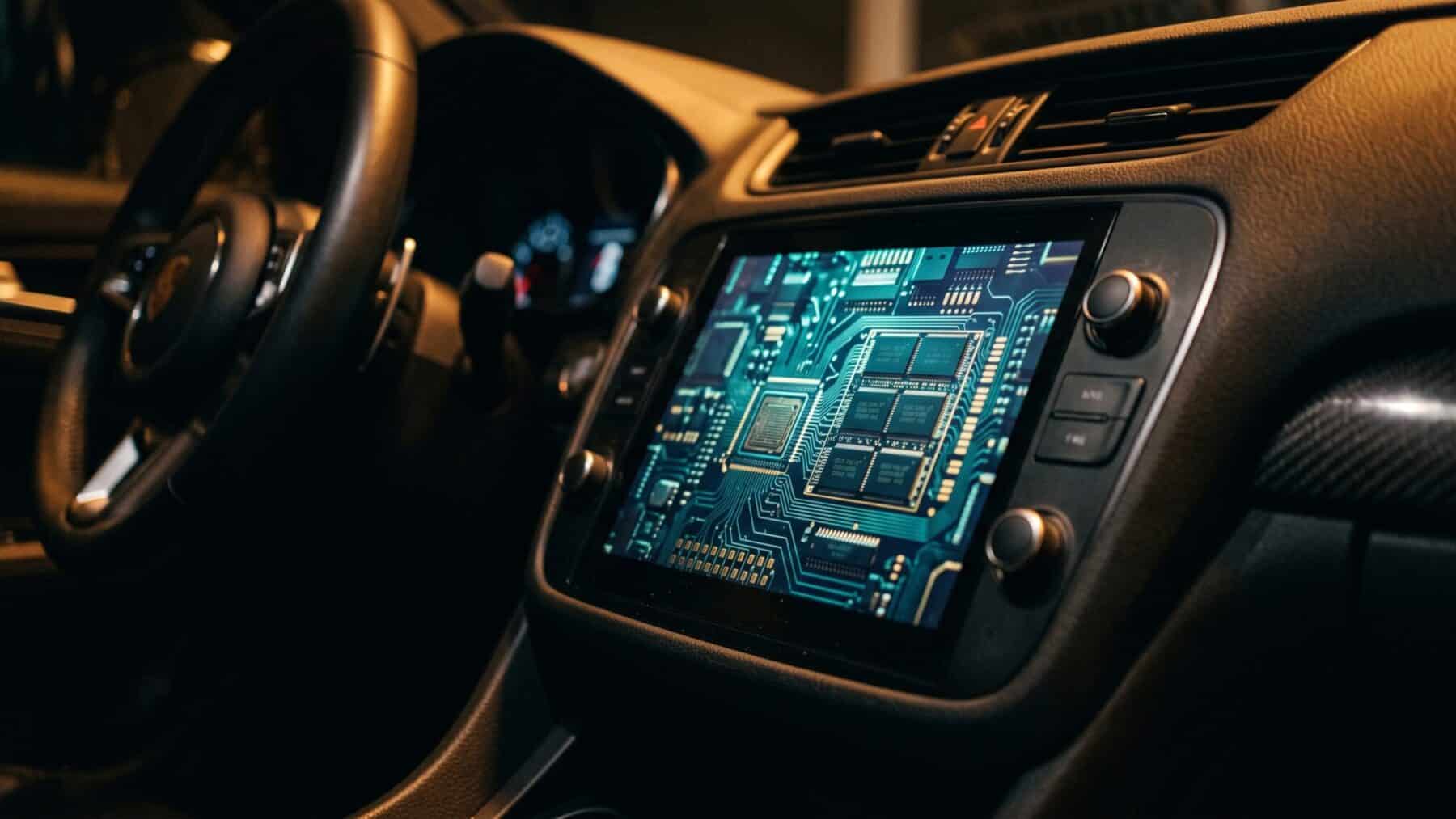
Walk up to any new car on a dealer lot and the screen glows wide and bright, running maps, music, and driver warnings all at once.
Behind that glass sits a stack of memory chips not so different from what powers a data center server.
Automakers promised those features at the sticker price. What they left off the window sticker is what happens when those chips become the most fought-over components on the planet.
How did a dashboard end up in a bidding war with a server farm?
Why the chip inside your dashboard is losing a bidding war to a server farm
The global automotive industry is facing a severe shortage of the DRAM and NAND flash memory that modern vehicles depend on, precisely because automakers are now competing with AI infrastructure builders for the same limited pool of semiconductors. To feed AI data centers, Micron, Samsung, and SK Hynix are diverting production away from DRAM, NAND, and other traditional commodities toward high-bandwidth memory (HBM), gradually shrinking the supply of everything else.
Capacity flowed toward the applications with the greatest volume, the highest margins, and the clearest long-term growth. That is the mechanism in plain terms: not a factory fire or a pandemic port closure. It is a market outbid, playing out in real time.
Unlike the 2020, 2022 global chip shortage, which stemmed primarily from pandemic-related supply chain disruptions, this shortage is driven by the intentional reallocation of manufacturing capacity toward highly profitable products intended for AI data center development, creating a scarcity of integrated circuits intended for the consumer and enterprise markets. This time the fight is over the memory that runs every screen, sensor, and map.
What a modern dashboard actually needs, and how fast those needs have grown
A glowing touchscreen looks like a simple thing. It is not. New vehicles already carry significant combined RAM and NAND flash, and by the end of this year the average vehicle is expected to reach roughly 278 GB of DRAM and NAND, with higher-end vehicles approaching 2 terabytes, roughly triple what today’s mainstream models require.
The bigger the screen, the sharper the cameras, the more intelligent the driver-assist system, the more DRAM it swallows. Micron CEO Sanjay Mehrotra has said that vehicles with Level 2+ autonomy or higher carry more than five times the combined memory and storage content of an average car, and those vehicles’ market share is expected to exceed 40 percent by 2030.
So the cars buyers most want are exactly the ones most exposed to a memory crunch. eMMC devices used in vehicle control modules have seen price increases of 200%. None of that appears on any spec sheet.
The numbers that confirm how serious the squeeze has become
Samsung, SK Hynix, and Micron produce 88% of the world’s automotive DRAM. SK Hynix has said its entire 2026 production is already sold out. New orders are already quoting with lead times exceeding 58 weeks, according to supply chain firm Fusion Worldwide. Fifty-eight weeks is more than a full model year.
Automotive LPDDR4 prices were already up roughly 70% year over year by January 2026, with additional increases signaled for the coming two years, according to S&P Global. Analysts at UBS estimate that automotive DRAM prices have surged a staggering 180 percent over just three months.
GM continues to expect commodity inflation, logistics, and higher DRAM costs to be a headwind of $1.5 billion to $2 billion for the full year. Offsets include backloaded costs for the Orion plant ramp, DRAM inflation, and onshoring investments, with the CFO signaling that some DRAM inflation would be concentrated in the second half of the year. That pain travels downstream, eventually toward the buyer. A related case shows how supplier failures ripple into vehicles already on the road, illustrating just how fragile the parts pipeline has become.
Where the shortage hits hardest, and which buyers feel it first
Not every car is equally at risk. The shortage hits advanced driver-assistance and cockpit systems hardest, especially in higher-end models.
Entry-level vehicles carry less memory and face a smaller immediate bill, but budget-friendly models still face diminished production as carmakers feel growing pressure to phase out lower-margin trims in a high-cost environment. The pressure extends beyond DRAM: suppliers of NAND and NOR flash memory used in infotainment and control electronics are unable to confirm 2026 supply in some cases. Tier-one suppliers are already telling automakers the new prices are non-negotiable.
Shoppers hunting for deals in a used-car market already up 38 percent since 2019 may find that new vehicles with full feature sets become harder to buy at last year’s prices. The shortage runs across the full memory stack a modern vehicle depends on, not just a single chip.
What automakers are doing now, and when relief could realistically arrive
To manage the shortage, automakers are being advised to focus on architecture planning, early adoption of advanced memory types, and carefully balancing feature sets to protect margins. In practice, that means some vehicles being designed right now may ship with fewer software-driven features than their spec sheets currently promise.
Over-the-air updates can add features later, but only if the chip inside the car has the headroom to run them. That is a meaningful caveat for any buyer choosing a trim level today.
A clear judgment has emerged across the industry: the tangible impact of rising memory prices will last for at least another 12 to 18 months. New capacity from chip manufacturers will not make a substantial contribution until next year at the earliest.
SK Hynix has warned that 2027 could be the industry’s worst year for memory supply, and that customer demand could remain above the company’s capacity beyond 2030. UBS separately expects the global DRAM industry to remain undersupplied through 2028. That is a longer runway than most buyers, or most dealers, are being told to expect. The dashboard will keep glowing; the question is what it costs to keep filling it.
