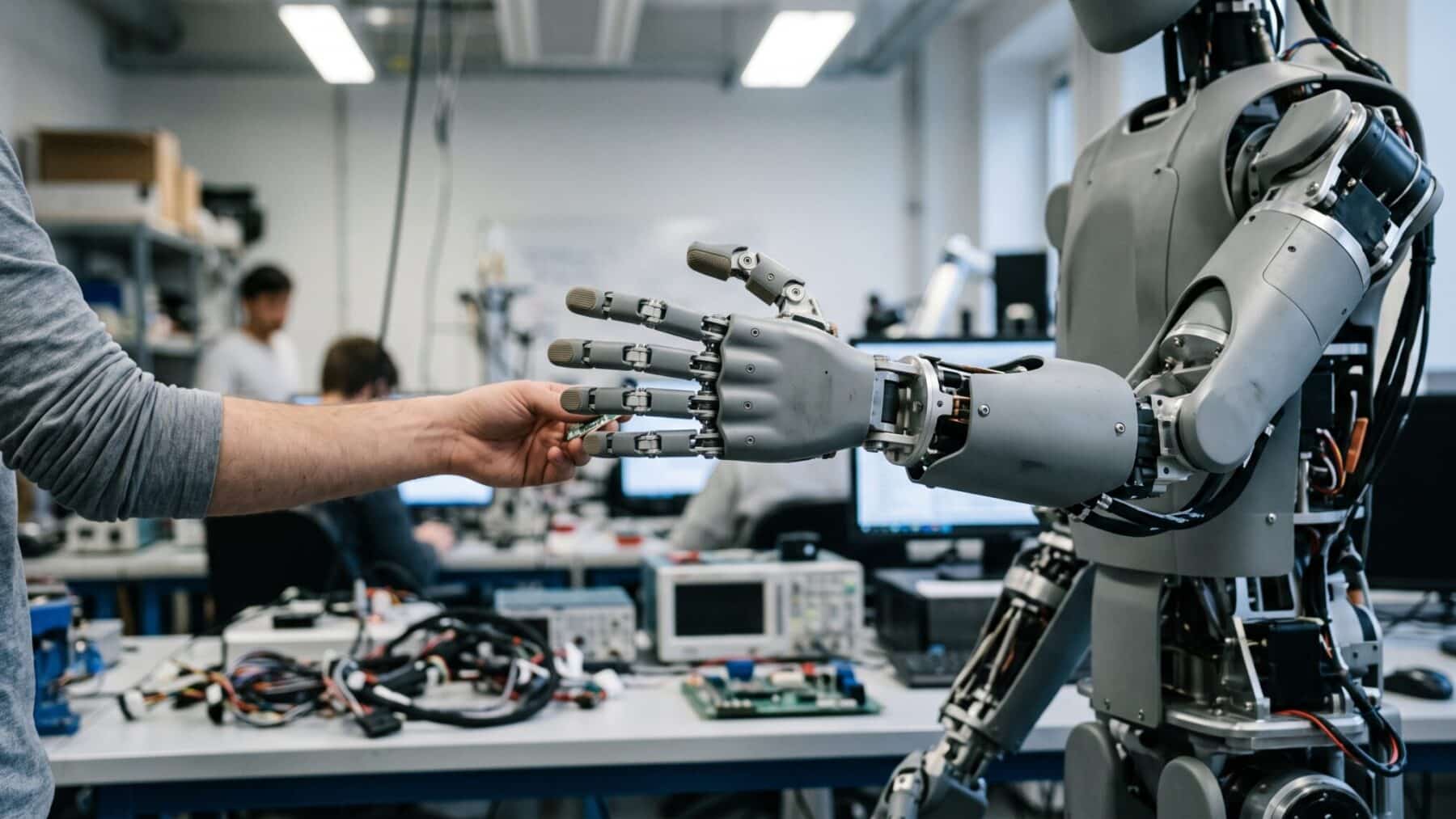
NVIDIA has announced the first open humanoid robot reference design built on its Isaac GR00T platform, giving academic researchers a complete, standardized hardware-and-software stack for frontier robotics work rather than requiring each institution to assemble its own bespoke system from scratch. The announcement was made at NVIDIA GTC Taipei on June 1, 2026.
What the reference design includes
The NVIDIA Isaac GR00T Reference Humanoid Robot is the first open humanoid robot reference design built on NVIDIA Jetson Thor and the NVIDIA Isaac GR00T open development platform.
It combines a Unitree H2 Plus humanoid robot, Sharpa Wave five-fingered hands for dexterous manipulation, Jetson Thor onboard compute for advanced reasoning and control, and Isaac GR00T open software and models.
The platform uses a nearly six-foot-tall Unitree H2 Plus humanoid chassis that weighs 150 pounds, with 31 degrees of freedom across the body. Dual Sharpa Wave tactile hands add 22 degrees of freedom each, bringing the total to 75 degrees of freedom across the full system. Sensing includes a head-mounted stereo camera, wrist cameras for close-range manipulation, and an inertial measurement unit for motion tracking.
The platform is powered by NVIDIA’s Jetson AGX Thor T5000 onboard compute, featuring an NVIDIA Blackwell GPU with 2,070 FP4 teraflops of AI performance, a 14-core Arm CPU, 128GB of unified memory, and a configurable 40- to 130-watt power range for real-time sensor processing and robot inference. A 15Ah, 0.972kWh battery provides approximately three hours of operational endurance.
Software stack and data pipeline
The Isaac GR00T development platform spans data capture and generation to robot model evaluation and deployment, helping researchers and developers accelerate humanoid development workflows. The full stack includes Isaac Lab for simulation, training, and evaluation of robot policies before real-world deployment; accelerated Isaac ROS middleware to move trained policies onto robots; and Isaac Teleop to capture high-quality robot demonstration data for training and policy development.
One of the most significant capabilities sits in how the platform handles training data scarcity. Built on NVIDIA Omniverse and Cosmos simulation frameworks, the platform supports synthetic data generation to let developers generate large amounts of synthetic motion data from a small number of human demonstrations.
Using the first components available, NVIDIA said it generated 780,000 synthetic trajectories, the equivalent of 6,500 hours of human demonstration data, in just 11 hours, and that combining synthetic data with real data improved GR00T N1’s performance by 40 percent compared with using only real data.
Isaac GR00T open foundation models are designed for generalized humanoid robot reasoning and skills, taking multimodal input including language and images to perform manipulation tasks in diverse environments. Researchers retain control of their robot data, training data, telemetry, and logs throughout the process.
Who is using it
Leading research institutions including Ai2, ETH Zurich, Stanford Robotics Center, and UC San Diego’s Advanced Robotics and Controls Laboratory will use the reference design to advance frontier humanoid robotics research.
The uniform platform is intended to make it easier for labs to compare results, share code, and build on each other’s work, a persistent challenge when every group runs different hardware combinations.
NVIDIA framed the announcement around the idea that academic research has historically been bottlenecked by the time and cost of building custom robot platforms before any science can begin. By providing a single open reference design, the company is positioning Isaac GR00T as something closer to what standardized development boards did for embedded computing. The goal is a common baseline that lets researchers spend time on the hard problems rather than on integration work.
Broader robotics context
The release comes as enterprise robotics is shifting from single-site pilots to coordinated multi-site fleet deployments. Automate 2026, North America’s largest robotics and automation trade show, took place June 22, 25, 2026, at McCormick Place in Chicago, Illinois. The show floor featured 800-plus exhibitors and is organized by the Association for Advancing Automation.
That momentum has reached software as well as hardware: compute platforms are being redesigned from the ground up to serve the always-on demands of autonomous systems.
The GR00T platform will also support the Unitree G1 humanoid robot, with the Isaac GR00T reference workflow for the G1 expected to be available soon on GitHub and Hugging Face, giving labs with tighter budgets a path onto the same software stack. For the broader field, the move mirrors the kind of open-platform strategy that has accelerated progress in other compute-intensive research disciplines, where shared baselines let independent teams build comparable, reproducible results across institutions.
NVIDIA has not announced a retail price for the bundled reference design. The complete NVIDIA Isaac GR00T Reference Humanoid Robot will be available from Unitree in late 2026, while the Isaac GR00T software platform is available now for researchers and developers.
