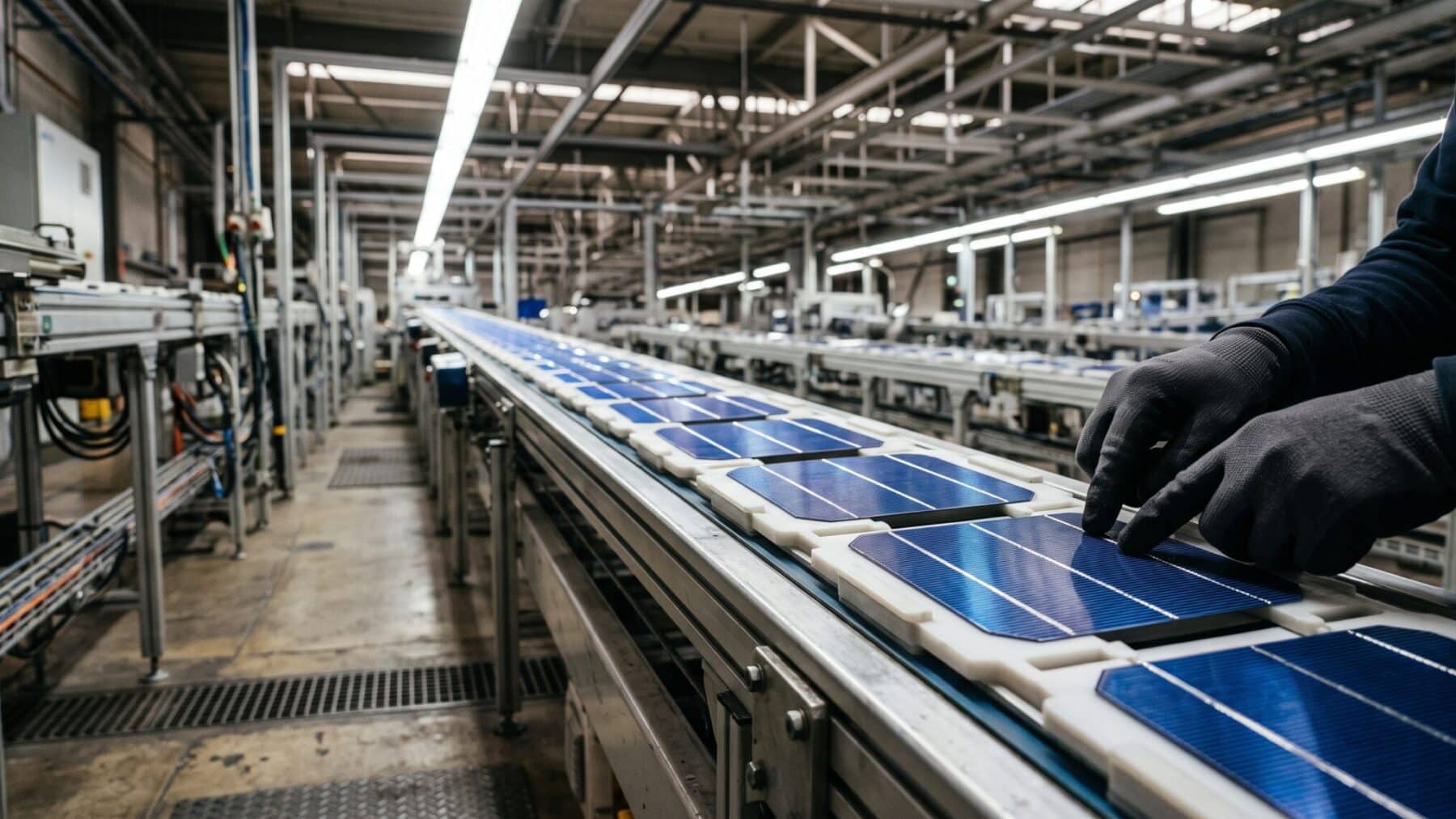
CS PowerTech Inc., a subsidiary of Canadian Solar Inc. and the largest silicon PV solar manufacturer in the US, opened the first phase of its photovoltaic cell manufacturing facility at the River Ridge Commerce Center in Jeffersonville, Indiana, on July 24, 2026.
The facility is the first plant in the United States purpose-built to produce heterojunction bifacial N-type solar cells, a technology milestone that addresses one of the sharpest gaps remaining in the domestic solar supply chain.
A first-of-its-kind US cell plant
The Jeffersonville facility is the first American PV cell facility designed to produce industry-leading heterojunction (HJT) bifacial N-type solar cells. HJT bifacial N-type cells are among the most efficient solar cell technologies available, capable of capturing light from both sides of the panel and commonly used in large-scale utility solar farms.
At full capacity, the plant is expected to produce over 6 GWp of solar cells annually, support more than 1,200 skilled jobs in Southern Indiana, and represent nearly $1 billion in local investment.
The Indiana plant will supply cells to CS PowerTech’s module manufacturing facility in Mesquite, Texas, establishing a localized supply chain for its US operations. That cell-to-module corridor gives the company a vertically integrated domestic footprint without shipping core components across borders.
Filling the cell manufacturing gap
US factories have officially been able to make enough solar modules to meet domestic demand, but cell capacity lags far behind, at just 3 gigawatts.
This year, companies are pushing hard to catch up. The Jeffersonville plant, targeting more than six times that cell capacity at full buildout, is the largest single step yet toward closing that deficit.
The cell gap has real commercial stakes. As GCN has reported, US solar contracts jumped 15% in recent months while Q1 installations fell 27%, a mismatch driven directly by the shortage of domestically made cells. A plant of Jeffersonville’s scale could ease that bottleneck as modules waiting on cells begin moving through the supply chain.
US solar manufacturing capacity has grown from 8 GW before federal manufacturing tax credits to 69.9 GW as of June 2026, an increase of more than 750 percent. Yet most of that growth has been concentrated in module assembly, which has expanded faster than upstream segments such as solar cells, wafers, and key materials.
The Jeffersonville facility is specifically designed to redress that imbalance.
Trade policy sharpens the urgency
Anti-dumping and countervailing duties applied in 2024 to cells produced in Cambodia, Malaysia, Thailand and Vietnam, and subsequently to additional producing countries, have effectively signaled that solar cell production in the United States must be prioritized by companies serious about participating in the domestic market.
Those duties, combined with the Section 232 polysilicon action the Trump administration finalized earlier this year, have made a domestic cell supply a competitive necessity rather than a preference. The new tariff landscape means that Section 232 price floors now reach across the solar supply chain, pressing buyers toward US-sourced components wherever they exist.
The Jeffersonville facility will ramp production to full capacity for phase one over the next few months, and CS PowerTech expects to begin work on a phase two expansion before the end of the year. CS PowerTech president Rusty Schmit said in the company’s official announcement that Jeffersonville is “a cornerstone of our strategy to build one of North America’s most advanced energy manufacturing supply chains.”
Broader context for US solar capacity
The United States added 7.8 GW of new solar capacity in the first quarter of 2026, surpassing 6 million cumulative installations. That Q1 figure represented a 27% decline from Q1 2025.
Sustaining installation pace over the longer term depends directly on whether domestic manufacturers can supply the cells those modules require.
The US now has more than 65 gigawatts of module nameplate capacity, well above the country’s 2025 annual installation total, but the industry’s latest data reveal a critical gap one step upstream. The Jeffersonville plant adds a strategically important upstream link that module-only capacity could not provide.
Indiana Governor Mike Braun said, according to the company’s press release, that CS PowerTech’s investment strengthens Indiana’s position in advanced manufacturing, creates good-paying jobs for Hoosiers in the area, and reinforces the state’s role in building the technologies that will continue to power America’s future.
