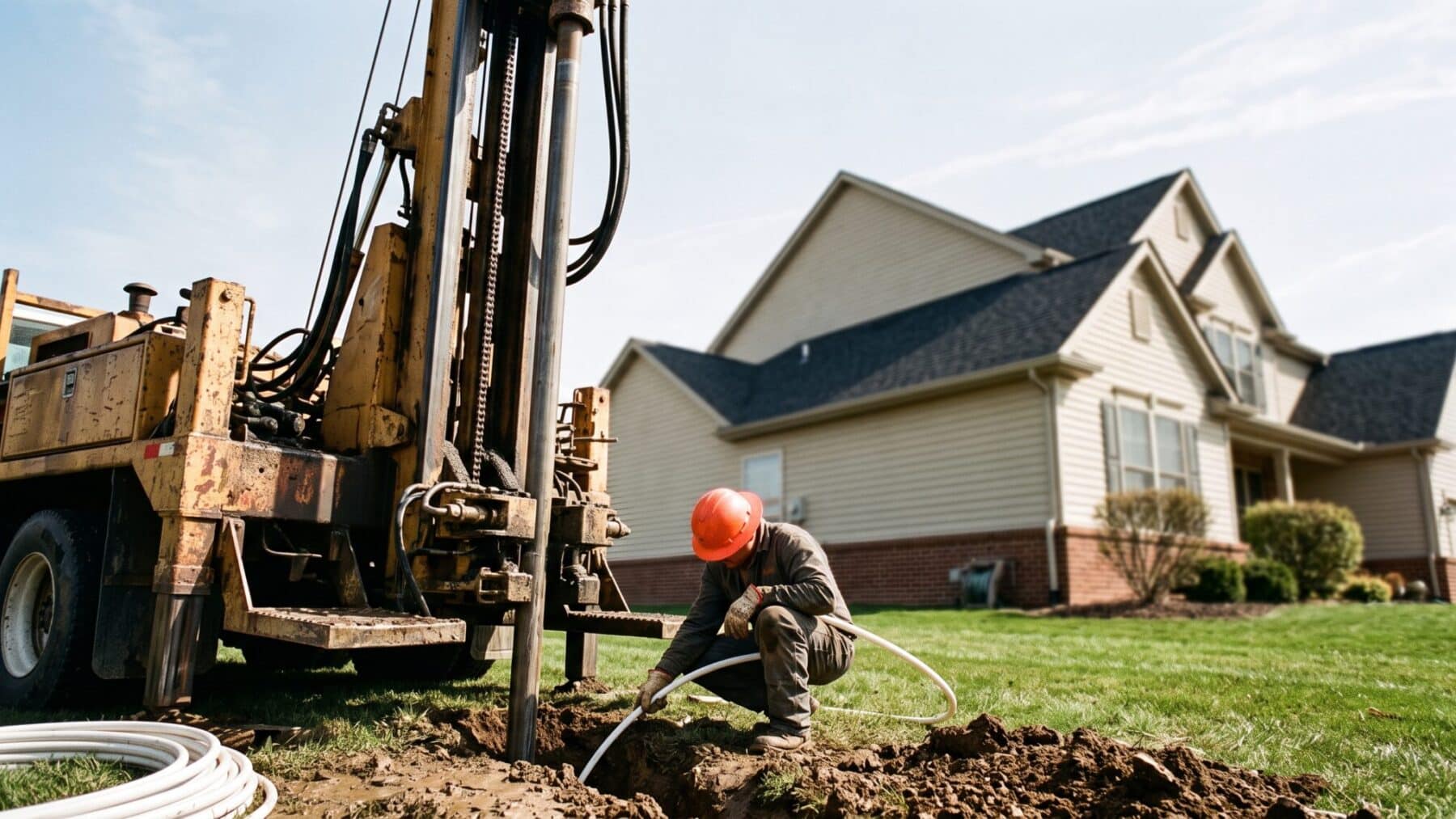
A truck-mounted drill rig backs onto a suburban lawn and the neighbors watch, curious.
The hole goes straight down, typically 150 to 500 feet for a single vertical bore, sometimes more across multiple boreholes in difficult ground. Inside the house, the brochure on the kitchen counter promises lower energy bills for decades. What the brochure leaves for the fine print is where all the money actually goes.
The indoor unit is relatively straightforward hardware. The loop field buried beneath the lawn is not. So what is it about the ground itself that sets the final price?
Why the geology beneath your yard sets the price, not the machine in the basement
A geothermal heat pump works by circulating a fluid through buried plastic loop pipes, pulling stable underground warmth into the house in winter and pushing excess heat back into the earth in summer. The loop field beneath the lawn is where complexity lives, and where most of the budget goes.
Drilling and installing that loop is a specialized trade combining HVAC skills with well-drilling knowledge, and it dominates the budget in ways the sales conversation rarely leads with. The ground loop system, drilling, piping, and loop commissioning, accounts for 50 to 70 percent of the total installed bill. That single line, buried in cost breakdowns that contractors should provide, is where the surprise lives.
The same three-ton system that runs $22,000 in flat Indiana farmland can hit $48,000 on Appalachian granite. The heat pump unit itself barely changed. The ground did.
What a real quote looks like once the drill hits bedrock
According to RSMeans 2026 cost data and industry surveys, the national average installed cost for a three-ton residential system is approximately $25,500, with a typical range of $20,000 to $27,000 in standard soil and $35,000 to $50,000 or more in granite-heavy New England terrain. That range is not a rounding difference. It is the difference between a project that pencils over 10 years and one that barely works at 20.
If a property sits on solid granite, the driller will need specialized equipment and techniques, which can add significantly to the day rate as the drill hits resistance. Geology is rarely visible on the surface, so most homeowners do not know which situation they are in until a contractor does a site assessment or, worse, until the drill hits resistance and the day rate climbs.
Even a property with good soil carries secondary costs that stack quickly. Ductwork modifications alone can run $1,400 to $5,600, because geothermal systems rely on ductwork reaching every room. Retrofit jobs on older homes push that figure toward the top of the range.
The numbers behind the savings promise, and where they come from
Geothermal heat pumps can cut energy consumption by up to 50 percent. That figure is real and widely confirmed. These systems typically deliver coefficients of performance of 3.0 to 5.0, compared to 2.0 to 4.0 for quality cold-climate air-source units, meaning genuine bill reduction across a full heating season.
But the payback window depends heavily on what fuel is being replaced. The case is most compelling for a long-term owner replacing expensive propane or oil heat in a climate where geothermal’s stable-ground efficiency clearly beats air-source alternatives.
ENERGY STAR figures show certified geothermal units use around 61 percent less energy than a standard model, saving roughly $830 per year. That savings clock starts the moment the system runs, but it runs against a bill that depends entirely on local electricity rates. As US rate-hike requests hit record levels, those electricity costs are not static, and the math shifts with every approved increase.
Where the ground-loop cost catch hits the hardest households
A three-ton system that would cost considerably less as an air-source heat pump runs $22,000 to $35,000 as a geothermal. That gap is the premium the homeowner is betting against future savings. On hard-rock terrain, the premium widens to a point where even an optimistic savings estimate struggles to close it before the indoor unit needs replacing.
The indoor heat pump unit lasts 20 to 25 years. The loop in the ground lasts 50 or more.
Complicating the picture further, the One Big Beautiful Bill Act, signed July 4, 2025 as Public Law 119-21, terminated Section 25D for systems placed in service after December 31, 2025, meaning installations completed in 2026 and beyond receive no federal residential clean energy credit. That 30 percent credit had been absorbing a large portion of the ground-loop premium for thousands of families every year. Without it, the full geological lottery lands directly on the buyer.
For context on how grid-queue bottlenecks shape where geothermal power ever reaches commercial operation, see why only 13 percent of queued projects make it to the grid.
What a buyer can actually verify before the drill arrives
A geothermal installation is not something a homeowner can simply order the way they can order a furnace. It requires ground loop design, drilling or trenching, loop pressurization and flushing, and heat pump commissioning. Contractor scarcity is itself a hidden cost driver, since fewer qualified installers means less competitive bidding in most ZIP codes.
A county geological survey map, often available free from a state geological agency, can identify surface bedrock before any money changes hands. Drilling depth, soil type, local labor rates, and permitting requirements all drive final cost. None of those factors appears in a standard energy-savings brochure, but all of them appear in the final invoice.
The clearest path to a positive decision runs through a cold climate, an expensive fuel being replaced, adequate land, and a long time horizon. Homeowners missing two or more of those factors should look seriously at cold-climate air-source heat pumps, which often deliver strong returns at a substantially lower upfront cost.
The earth’s heat is genuinely free and genuinely stable. Getting to it reliably is the part that costs, and knowing that before the rig backs onto the lawn is the only leverage a buyer has.
