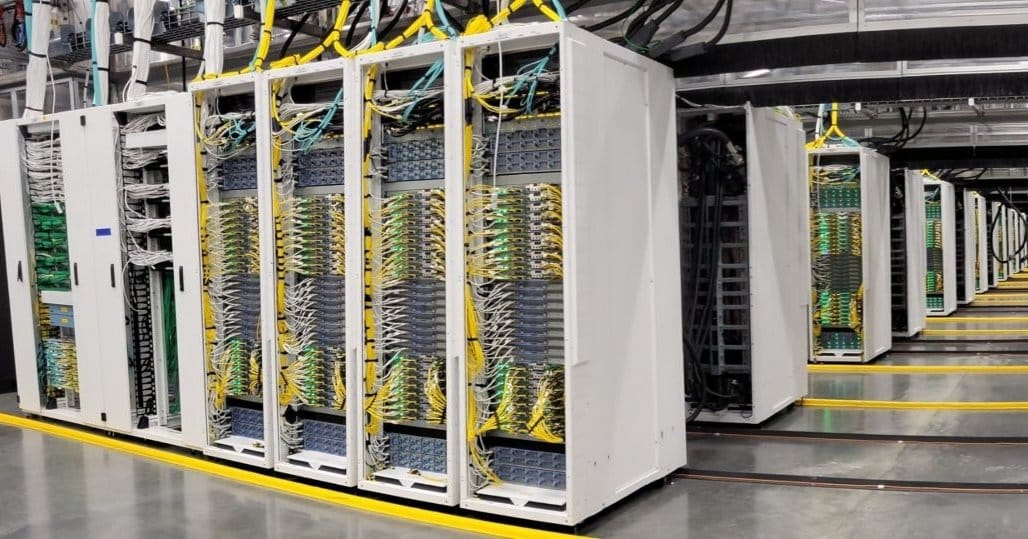
Picture two warehouses the length of several football fields, one in Wisconsin, one outside Atlanta, 700 miles apart on the map.
Inside each, rows of server racks hum under a two-story ceiling, cooled by pipes instead of fans.
Engineers in both buildings watch the same training job crawl across their screens at the same moment.
Neither site is actually doing the job alone.
A dedicated fiber link now makes them behave as one single machine.
So how do two buildings hundreds of miles apart start acting like they share the same room?
How a fiber backbone turns two buildings into one computer
The trick is not more chips, it is the wiring between them. The data center is connected to Wisconsin using a dedicated fiber-optic “AI WAN” (wide area network) to create a massive supercomputer running on Nvidia chips. A dedicated fiber-optic network allows data to move between locations with minimal delay, supporting large-scale AI training jobs that span multiple states. According to Microsoft, this approach means that instead of a single facility training an AI model, multiple sites work in tandem on the same task, enabling what the company calls a “superfactory” capable of training models in weeks instead of months.
Inside each building, the same principle operates at a smaller scale. Microsoft is using NVIDIA GB200 NVL72 rack-scale systems that can scale to hundreds of thousands of GPUs across sites.
That tight coupling inside a rack is what gets stretched across an entire state line. This connection allows the datacenters to share GPU workloads in real time, maintaining steady performance and avoiding the delays that can occur when systems operate in isolation.
Inside the two sites doing the actual work
The Wisconsin site anchors the pair. The Fairwater site spans 315 acres and comprises three large buildings with a combined 1.2 million sq ft under roofs in Mount Pleasant, Wisconsin, a facility Microsoft CEO Satya Nadella and President Brad Smith call the world’s most powerful AI data center.
Getting there took serious groundwork. Construction required 46.6 miles of deep foundation piles, 26.5 million pounds of structural steel, 120 miles of medium-voltage underground cable, and 72.6 miles of mechanical piping.
Wisconsin was Microsoft’s first Fairwater site, with the Atlanta campus following as the second, sharing the same architecture as the Wisconsin build. Microsoft operates the facility as the second campus in its Fairwater family. Atlanta went operational first, however: Microsoft announced in a blog that it brought the Fairwater AI datacenter in Atlanta online in October and connected it with its first Fairwater site in Wisconsin to run as a unified AI superfactory. Together the pair forms what the company calls its superfactory, a term meant to separate this project from an ordinary data center buildout elsewhere in the country. Inside a single Fairwater building, each NVL72 rack contains 72 NVIDIA Blackwell GPUs connected via NVLink and NVSwitch at 1.8 TB/s of intra-rack GPU-to-GPU bandwidth and 14 TB of pooled memory, and every rack functions as a single accelerator, with each rack able to process 865,000 tokens per second.
The hard numbers behind the superfactory claim
Microsoft brought its data center in Atlanta, Georgia, online, the company’s second “Fairwater” site, and connected it to the first Fairwater site in Wisconsin with an AI Wide Area Network using dedicated fiber optic cables. That announcement, posted on the company’s own newsroom, is the primary record of the claim.
Independent estimates help check the scale against numbers the company has not disclosed. Epoch AI fills the gap with modelled estimates: 176,391 Blackwell GPUs and 369 MW of IT power in Wisconsin, and 304,279 GPUs and 636 MW in Atlanta. But Microsoft has published no official count or megawatt figure of its own.
What the company has confirmed is the cooling approach. Fairwater uses closed-loop liquid cooling for over 90% of its compute capacity, suggesting that liquid cooling is becoming a baseline for dense AI data center infrastructure rather than an optional upgrade.
Timing moved fast for Wisconsin specifically. Going live ahead of schedule in April 2026, Fairwater connects hundreds of thousands of Nvidia GB200 and GB300 GPUs into a single seamless cluster, delivering 10 times more performance than today’s fastest supercomputer , according to the company’s own account of the superfactory connection.
Where the claim still needs context
Even the company’s own framing comes with caveats worth noting. Microsoft has not published an exact GPU count, a megawatt figure for either site, or a benchmark behind its claim of ten times the performance of the world’s fastest supercomputer , leaving independent researchers to fill in the gaps with modeled estimates. In fact, the claim is based on AI training throughput, not the High Performance Linpack benchmark used by the TOP500 list, and has not been independently verified.
The full rollout timeline for next year is not mirrored across every one of the company’s technical posts. That gap between marketing language and verified detail is normal for infrastructure this new.
None of that undercuts the basic shift in design. Unlike traditional cloud data centers that run millions of separate applications for different customers, Microsoft says the new facilities are designed to handle single, massive AI workloads across multiple sites.
Competition adds context, too. The buildout sits alongside rival systems already running comparable GPU counts, a race that has also pushed smaller local AI hardware to scale down in parallel.
What the link means for everyday AI use
For most people, none of this cabling will ever be visible, yet its effects show up indirectly. Faster training cycles mean the AI assistants baked into phones, browsers and office software can be updated on a shorter development clock than before.
That shorter clock is the real promise behind the superfactory idea. Microsoft says instead of a single facility training an AI model, multiple sites work in tandem on the same task, enabling what the company calls a “superfactory” capable of training models in weeks instead of months.
Questions remain about cost, power demand and whether rivals can match the approach without owning comparable real estate in two states at once. The network supports OpenAI, the Microsoft AI Superintelligence Team, and Copilot workloads, with additional Fairwater sites under construction to join the AI WAN.
For now, the two buildings 700 miles apart stand as the clearest public example yet of a data center built to act as one machine, never meant to be a single building at all.
