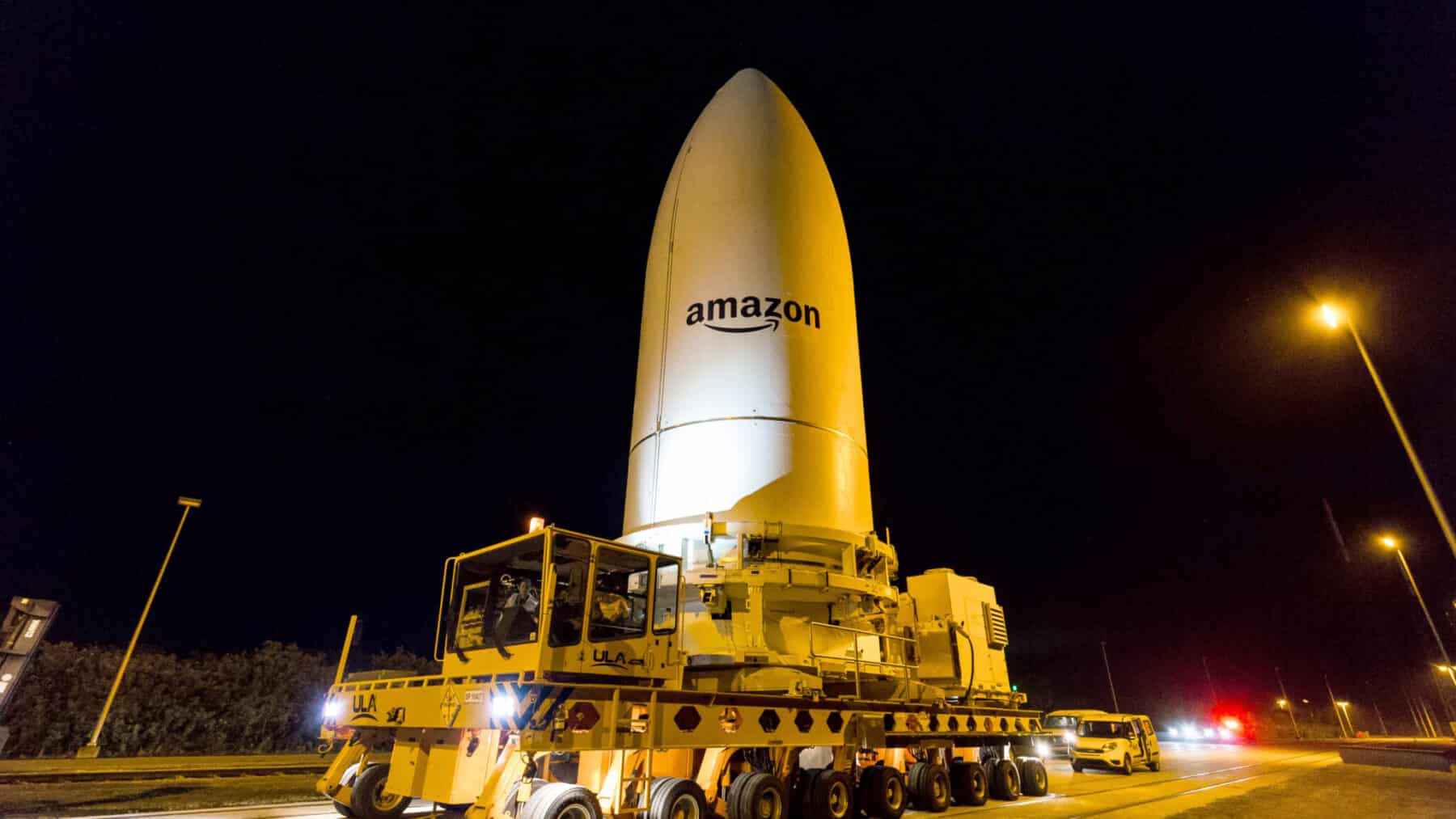
A rocket lifts off from a Florida coast pad carrying two dozen boxy satellites stacked like crates in a cargo hold.
Hundreds of miles away, inside a federal building, a clock that started ticking years ago quietly runs out.
Nobody switches off the servers.
No fine gets written.
Instead, a regulator does something rarer: it changes the rules mid race and lets the company keep going anyway.
So what happens when a company promises a number, falls short by a wide margin, and stays in the game regardless?
How a missed deadline turned into a workable deal instead of a shutdown
A federal communications regulator had granted a license requiring half of a planned 3,232 satellite broadband fleet, 1,616 spacecraft, to be in orbit by July 30. The FCC set the deployment deadlines years ago, when it initially approved the constellation known then as Project Kuiper, as part of measures to prevent companies from warehousing spectrum after being awarded access to the critical communications resource.
Under normal circumstances, if a licensee failed to meet the set interim milestone, its total number of authorized satellites would be capped at the number of satellites that were in orbit and operating on the date of the missed milestone, freezing the fleet at a tiny fraction of its planned size.
Instead, regulators chose a middle path with teeth. On June 5, the FCC granted Amazon a limited waiver of its 50 percent deployment requirement, but temporarily demoted the spectrum priority of satellites launched after the missed milestone, since priority decides who wins when two companies’ radio beams overlap.
Inside the gap between the promise and what actually reached orbit
The company filed an application on January 30 this year seeking an extension of the deployment deadline by 24 months, or alternatively a complete waiver of this milestone requirement. At the time of filing the application, Amazon Leo reported that it had launched just 180 satellites and estimated that it will have deployed approximately 700 by the July 30 deadline.
Even that lowered bar proved optimistic. By the actual deadline, the count landed at 391 active satellites in CelesTrak’s active catalogue, with 396 production satellites launched across 14 missions, about a quarter of what was required.
Meanwhile, the rival it is chasing faced no such trouble.
At this time, only one operator, SpaceX, is providing broadband to American consumers from low-Earth orbit, and that company’s constellation already numbered approximately 9,000 broadband satellites around the time of the ruling. A quarter built against a market already dominated is the whole shape of this shift.
Why the company blamed rockets, not rules, and how regulators responded
Here is where the evidence gets specific, because the company did not dispute the number, it disputed the cause. In January, Amazon asked for a two-year extension of that deadline, citing the limited availability of commercial launch opportunities, pointing to grounded vehicles and limited spaceport capacity as the real bottleneck.
That claim lines up with the money already spent. Amazon has booked more than 100 launches to deploy dozens of satellites at a time. The company said in the filing that it has bought 10 more launches with Elon Musk’s SpaceX, as well as a dozen additional rides with Blue Origin, part of a project in which the company committed over $10 billion, a bet suggesting the factory line was never the constraint, the launch pad calendar was.
So it asked for two extra years, pushing its deadline toward 2028. Instead of pushing back July’s interim deadline, the FCC issued a conditional waiver. On June 5, the FCC granted Amazon a limited waiver of its 50 percent deployment requirement. However, the company is still expected to meet its final deployment deadline of July 30, 2029, for the entire constellation, splitting the difference between punishment and a blank pass, according to the FCC’s order.
Where the deal still bites and what it does not fix
This is not a free pass, and that is the complication worth sitting with. First-generation satellites not deployed and operating by 30 July 2026 lose their processing-round priority for 20 months or until half the constellation is deployed, if sooner, and for 15 months if Amazon certifies that it has built half the satellites and bought their launches.
Every satellite launched under that cloud effectively arrives as a lower priority asset in spectrum terms until the company catches up.
Worse, the agency kept financial skin in the game.
The FCC kept the 2029 deadline and declined to waive Amazon’s surety bond, money that would be forfeited if the next milestone is also missed. A rival’s hardware strategy already shows how fast a product line can turn over when a company treats a chip or chassis as disposable the moment a better version ships, the same restless redesign cycle running through a laptop chip maker’s approach to wringing more performance from existing silicon.
What the waiver means for the next few years of orbital competition
Even so, the regulator’s own language makes clear why it chose leniency over a cap. It said the waiver serves the public interest by promoting a second large satellite broadband constellation, language that reads less like a scolding and more like a bet that competition is worth protecting.
That framing matters because the alternative, a hard constellation cap, would have locked in a single provider’s dominance for years. Instead the agency chose a path that keeps a second large network plausible, even if it arrives late and temporarily disadvantaged.
Ground infrastructure for all this orbital traffic still has to land somewhere.
The same pressure now showing up around new data center approvals tied to major cloud buildouts is a reminder that satellite broadband is only half of a bigger infrastructure race playing out at once. The final deadline, in 2029, is still years out, and whether the spectrum penalty changes behavior, or simply becomes a cost of doing business, is the question the next round of launches will answer.
