A service writer slides a repair estimate across the counter.
The owner of a seven year old electric sedan braces for a number that could total the car.
That old fear is fading fast.
Across the most common electric vehicles on American roads, full battery swaps now land somewhere between a few thousand dollars and a new car’s down payment.
The spread between the cheapest and priciest jobs has never been wider.
So what actually decides whether an owner pays 4,000 dollars or 30,000 for the same kind of repair?
Why one battery swap costs ten times another
The gap comes down to two things working against each other: pack size and cell chemistry. A compact sedan built around a smaller, simpler cell chemistry pulls from a cheaper, more mature supply chain than a three row SUV stacked with dense, nickel heavy cells built for towing and long range.
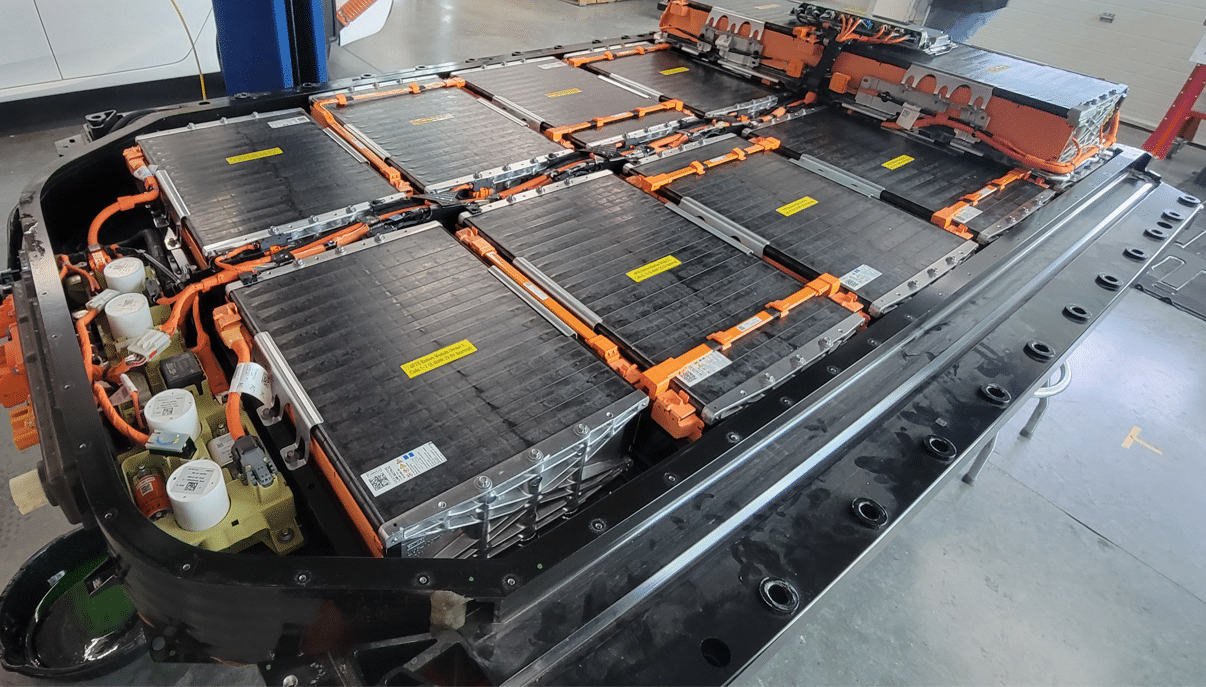
Out of warranty replacement runs from roughly $4,000 to $9,500 for a Nissan Leaf up to $10,000 to $18,000 for a Tesla Model 3, and $15,000 to $30,000 for large truck packs including the F-150 Lightning and Rivian.
That spread is not random. Smaller, lithium iron packs skip nickel and cobalt entirely, which keeps raw material costs down and lets manufacturers produce cells at scale with fewer bottlenecks.
Even so, the real driver behind falling prices is scale, not a single breakthrough. Pack level prices have slid from over 1,000 dollars per kWh down to roughly 100 to 140 dollars per kWh, and that long slide is what turned a once catastrophic repair into something closer to a transmission job.
What a trip to the shop actually looks like now
Walk into a dealership service bay today and the conversation has changed. A technician plugs in a diagnostic reader, checks the state of health reading, and tells the owner whether the pack has actually failed or whether only a handful of cheaper modules need swapping.
That distinction matters because full pack jobs and partial module repairs sit at opposite ends of the price scale. Dealer new pack jobs for a mainstream sedan like the Model 3 or Bolt run $12,000 to $16,000, while a refurbished pack or module swap runs $6,000 to $9,000.
So the same car, the same failure, can produce two very different invoices depending on which shop handles it.
Independent refurbishers have grown into a real alternative, especially for older Leafs and Bolts where parts supply is now mature. None of this changes what happens to a used EV once a battery issue shows up on a vehicle history report. Shoppers comparing a used sedan’s clean history report now weigh battery health alongside accident records, since a weak pack can matter more to resale value than a clean crash record.
The warranty numbers behind the falling price tags
Here is where the hard data lives, and it explains why most owners never see these invoices at all. A recent analysis of more than 22,700 electric vehicles found average annual electric vehicle degradation rate is 2.3% . At that pace, most packs stay well above any failure threshold for a decade or more of ordinary driving.
Replacement because of outright failure, rather than a recall or accident, is genuinely rare.
Battery replacement remains uncommon in newer EVs. Recurrent reports about a 0.3% replacement rate for 2022+ vehicles in its dataset, excluding major recalls. That single figure undercuts years of anxiety about packs failing early.
Federal and state rules have locked in a safety net underneath that already low failure rate. Federal rules have effectively pushed EV makers to provide at least an 8-year/100,000-mile warranty on the high-voltage battery, with many automakers covering that period against capacity falling below roughly 70 percent.
California is pushing that floor even higher for newer cars. Beginning with the 2026 model year, California will require EV batteries to retain at least 70% of their range for 10 years or 150,000 miles, with 2030 models and beyond required to retain at least 80% for that period.
Where the falling price still runs into trouble
The discount story has real limits, and trucks expose them fastest. Heavy, high capacity packs built for towing and long range still carry the industry’s steepest invoices, and that gap is not closing as quickly as the sedan market’s.
Large truck packs in the F-150 Lightning and Rivian still run $15,000 to $30,000 out of warranty, even as smaller packs have gotten dramatically cheaper.
Labor adds another wrinkle that has little to do with the battery itself. The same eight hour replacement job that costs $800 in a low cost state can exceed $1,400 in a high cost state before the pack itself is even added.
Shoppers chasing the fastest charging speeds face a related tradeoff, since the densest, quickest charging packs tend to carry the chemistry least forgiving on repair bills. That is part of why a 400 kilowatt charging pull from a premium SUV pack sits at a different price tier than a compact sedan’s pack built for low cost durability over raw speed.
What this means for anyone shopping used right now
For a buyer browsing a used lot, the practical lesson is straightforward. Checking a battery’s warranty term, its remaining mileage coverage and its chemistry now matters as much as checking tire tread or brake pads.
A Leaf or Bolt buyer faces a modest worst case bill near the low end of the scale, while a used truck or premium SUV buyer should budget for a dramatically higher ceiling if the pack ever needs full replacement.
That said, the overall trend line points toward relief rather than dread.
Falling cell costs, maturing refurbishment networks and stronger state mandated warranties are pulling the worst case scenario further out of reach for most owners. Even the priciest trucks are not exempt from the broader cost curve forever, and as cheaper chemistries spread into larger vehicles, the gap between a sedan’s bill and a truck’s bill should keep narrowing.
For now, the number any shopper should remember is simple: most owners will never pay a battery bill at all, and those who do are paying less than they would have just a few years ago.
