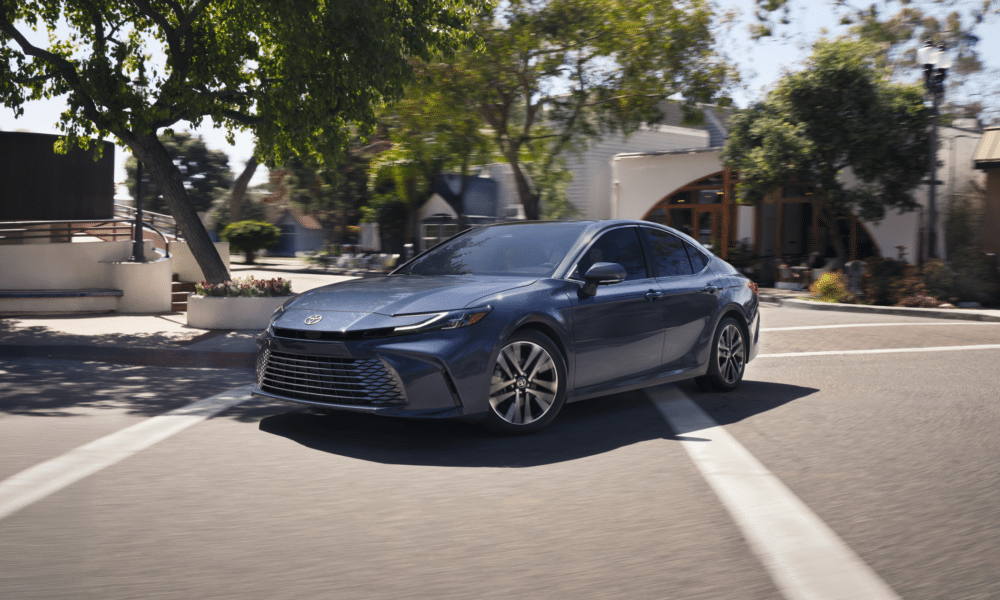
Toyota has confirmed pricing and specifications for the 2027 Camry, keeping the midsize sedan exclusively hybrid for a third straight model year.
The automaker said the car arrives in five grades with a manufacturer-estimated 51 mpg combined rating on the base trim, according to Toyota’s official announcement.
Pricing and trim lineup
Toyota’s pressroom release states that the 2027 Camry is expected to arrive at Toyota dealerships this fall, with a Manufacturer’s Suggested Retail Price, excluding dealer processing and handling, that starts at $29,700. Including the $1,295 destination charge, the FWD Camry starts at $30,995, according to Cars.com’s pricing breakdown, while the AWD version is priced from $32,520.
Full pricing, including the $1,295 destination charge, runs from $30,995 for the LE up to $37,395 for the top XSE trim, with all-wheel drive adding an additional $1,525 on every grade.
That represents only a modest increase over the outgoing model.
Kelley Blue Book reported that Toyota has announced pricing for the 2027 Camry, and like the model itself, little has changed compared to the 2026 version, with pricing for the popular midsize sedan starting at $30,995, including destination fee, just $100 more than the outgoing version. The 2027 Camry carries over unchanged, and all models continue to come standard with a highly fuel-efficient hybrid powertrain.
Hybrid powertrain across every grade
Available in LE, SE, Nightshade, XLE and XSE grades, the 2027 Camry offers Front-Wheel Drive or Electronic On-Demand All-Wheel Drive across the lineup, giving customers a range of refined and sport-inspired options.
The Toyota Camry is exclusively hybrid, pairing the fifth-generation Toyota Hybrid System (THS 5) with a 2.5-liter, 4-cylinder engine that produces 225 net-combined horsepower on FWD models and 232 net-combined horsepower on AWD-equipped models.
The LE FWD has a manufacturer-estimated 51 MPG combined rating. The all-wheel-drive system is designed to react to road conditions automatically, providing on-demand front-rear torque distribution based on driving conditions.
The decision to drop a gas-only engine option entirely was made with the car’s prior redesign.
Following its ground-up redesign last year into an exclusively gas-electric lineup, the Toyota Camry carries into 2027 with its winning formula completely intact, with 225 horsepower in front-wheel drive and 232 horsepower with all-wheel drive.
Chassis and driving dynamics
Toyota says the hybrid powertrain is paired with a MacPherson strut front suspension and multi-link rear suspension across all grades.
The SE, Nightshade and XSE grades add a sport-tuned suspension that Toyota says is calibrated to sharpen cornering response.
Toyota’s continued hybrid-only strategy for its best-selling sedan lands as automakers weigh how fast to push fully electric models against steady consumer demand for hybrids, a shift already visible in dashboard and infotainment technology discussed in GCN’s coverage of zone-based vehicle wiring and in driver-assistance systems detailed in GCN’s reporting on hands-free driving hardware adoption.
That broader hybrid momentum has also shown up on the sales charts, with hybrid vehicle volume increasing 23 percent from Q2 last year to Q2 this year, pushing hybrid share to a record 16.3 percent, up from 13.0 percent a year ago, according to Cox Automotive data, as more automakers lean on electrified gas engines rather than full battery power.
Why it matters for buyers
The Camry has been Toyota’s top-selling sedan in the United States for years, and its hybrid-only approach signals the company is not reverting to a gas-only option even as pricing holds nearly flat.
With trims spanning roughly $31,000 to $37,000 before options, Toyota is betting that fuel economy near 50 mpg combined can keep the Camry competitive against a growing field of hybrid-only and hybrid-optional midsize sedans.
The 2027 Toyota Camry is on sale now, giving shoppers access to the updated pricing structure across all five grades.
