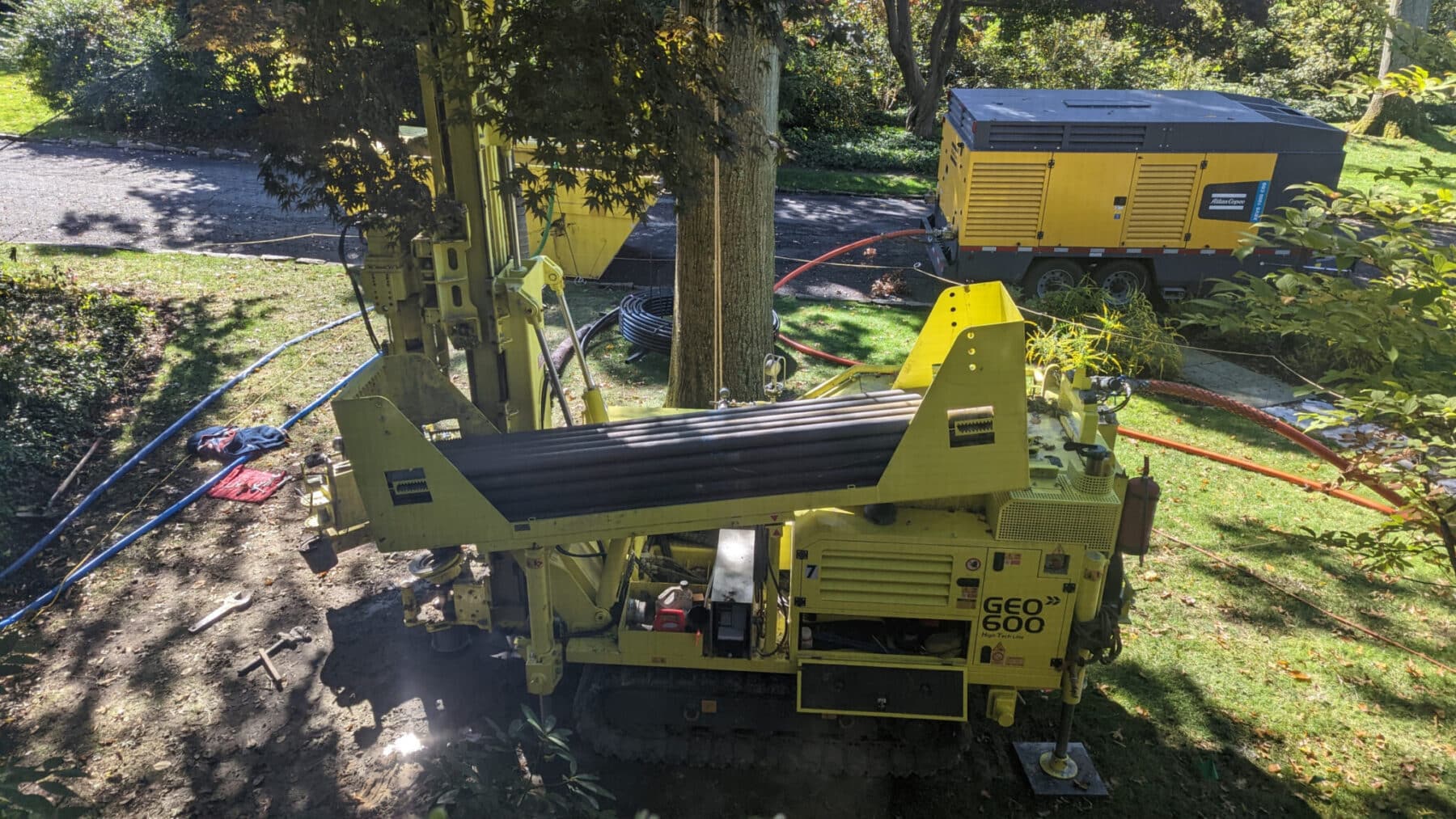
A drill rig sinks a narrow hole a few hundred feet into a suburban backyard, and a coil of black plastic pipe disappears into the ground behind it.
The homeowner is told this loop will trade heat with the earth for the next half century.
Next door, another rig is doing the exact same thing.
And three doors down, another one.
None of those crews are talking to each other about what happens underground once all three loops start pulling and pushing heat at once.
Why packed-in boreholes slowly change the ground around them
A ground source heat pump works by trading heat with soil that normally sits at a steady temperature year round. In winter the loop pulls warmth out of the earth; in summer it dumps excess heat back into it. That exchange only works as advertised if the ground has time to reset between seasons.
The trouble starts when a system draws more heat than it returns, year after year, which engineers call a load imbalance. In most borehole array projects, the annual cooling and heating load is often not fully balanced, meaning thermal plumes can form and accumulate in the subsurface, causing the working fluid temperature to gradually increase or decrease over time.
So the fluid coming back up that pipe arrives a little colder than it did the first winter. That smaller gap forces the heat pump to work harder for the same heat delivered, the entire mechanism behind the slow fade owners notice years in.
None of that is a defect in the equipment. It is simple thermal math, the same reason a bucket refills slower if you dip into it faster than rain can top it off.
What that looks like on a street lined with loops
Picture a newer subdivision where half the driveways still have the same contractor’s yard sign from installation day. Each house has its own borehole field, and industry design guidance calls for spacing a minimum bore-to-bore spacing of 15 to 20 feet in residential field layouts, with at least 5 feet of buffer between any borehole and a building foundation, property line, or buried utility.
That spacing is tight enough that neighboring boreholes can thermally interfere with one another once systems run for enough winters. A field built in isolation behaves differently than the same field surrounded by more just like it, all pulling on the same patch of ground. Research on thermal interactions among vertical geothermal borehole fields has found that significant thermal interactions among neighboring borehole fields are responsible for temperature drops of up to 5.9 °C during geothermal operations lasting 50 years .
Separate simulation work on dense residential clusters has found that results show significant thermal interference between neighbouring boreholes, confirming the need of tailored models for its calculation, and showing the importance of an accurate estimation of ground thermal properties to correctly forecast underground temperature change in densely packed geothermal heat pump areas. That rarely shows up on a sales brochure.
Buyers aren’t wrong that the technology beats a furnace on efficiency. They are often unaware the number they are promised assumes their field behaves like the only one for miles, not one of several tapping the same ground.
The numbers researchers are now putting on the slide
Simulation and field studies on this effect have moved past theory into measured decline curves. A TRNSYS-based simulation study of ground source heat pump performance under ground temperature disturbance found a near-linear inverse relationship, with COP decreasing by approximately 0.038 for every 1 °C increase in GT .
A separate coupled study of a logistics building under severe cold climate conditions, where heat extraction significantly outpaced heat rejection, found annual heat extraction significantly exceeding heat rejection caused ground temperature to decline by about 1 °C per year, with cumulative drops over five and ten years reaching 2.65 °C and 4.71 °C, respectively, leading to a noticeable reduction in borehole heat exchanger performance and system COP.
That is not a one-time glitch. It is a curve that keeps bending the same direction every year the imbalance continues.
Sweden offers a real-world preview of what dense adoption looks like: about a fifth of Swedish buildings use ground source heat pumps, making Sweden a leading country within this technology. That scale is exactly why researchers studying borehole arrays have paid close attention to long-term thermal interference, with modeled effects on borehole wall temperatures compounding over periods of 15 years and beyond in dense fields. That timeline outlasts the parts coverage on the heat pump unit itself, which typically runs a handful of years, while the ground drift compounds for decades after that coverage ends.
Where the mechanism breaks down, and where it does not
None of this means every geothermal install is destined to fade. Systems sized correctly for a single, isolated lot, with loops long enough and spaced wide enough for the local soil and climate, can run close to their original output for decades, part of why the technology still beats ordinary furnaces on lifetime cost.
The imbalance problem is sharpest in climates that lean hard one direction, with long heating seasons and little cooling load to balance the ledger. A home running its system roughly evenly between heating and cooling keeps the ground much closer to its starting temperature.
Density compounds the risk rather than causing it outright. One loop on a rural lot has room to spread its thermal footprint and recover between seasons.
Several loops sunk into neighboring quarter acre yards are effectively sharing one underground battery none of them were sized to share. That echoes other hidden costs already surfacing across the industry, from drilling bills that can swallow over half a project’s capital before a utility-scale plant generates power, to lease terms that can leave sellers disclosing a long-term contract at closing.
What it means for anyone pricing a loop this year
None of the research says homeowners should walk away from ground source heat pumps. It says the pitch sold at the kitchen table, decades of free heat with no asterisk, deserves the same scrutiny buyers already give a car’s advertised mileage.
So the practical question for anyone getting quotes is not just how deep the drill goes, but how the system is sized against the home’s actual heating and cooling split, and how close the nearest neighbor’s loop field sits. A reputable contractor can model that interference before the rig ever shows up.
Even so, the technology remains one of the most efficient heating methods for a house. The fade described here is gradual, not catastrophic, often shaving efficiency points rather than breaking a system outright.
Utilities exploring shared neighborhood loop networks are, in effect, running the same large scale balancing problem homeowners now face lot by lot. The honest pitch is less dramatic than forever free heat. It is efficient heat for a long time, if the ground gets the same careful planning as the pipe going into it.
