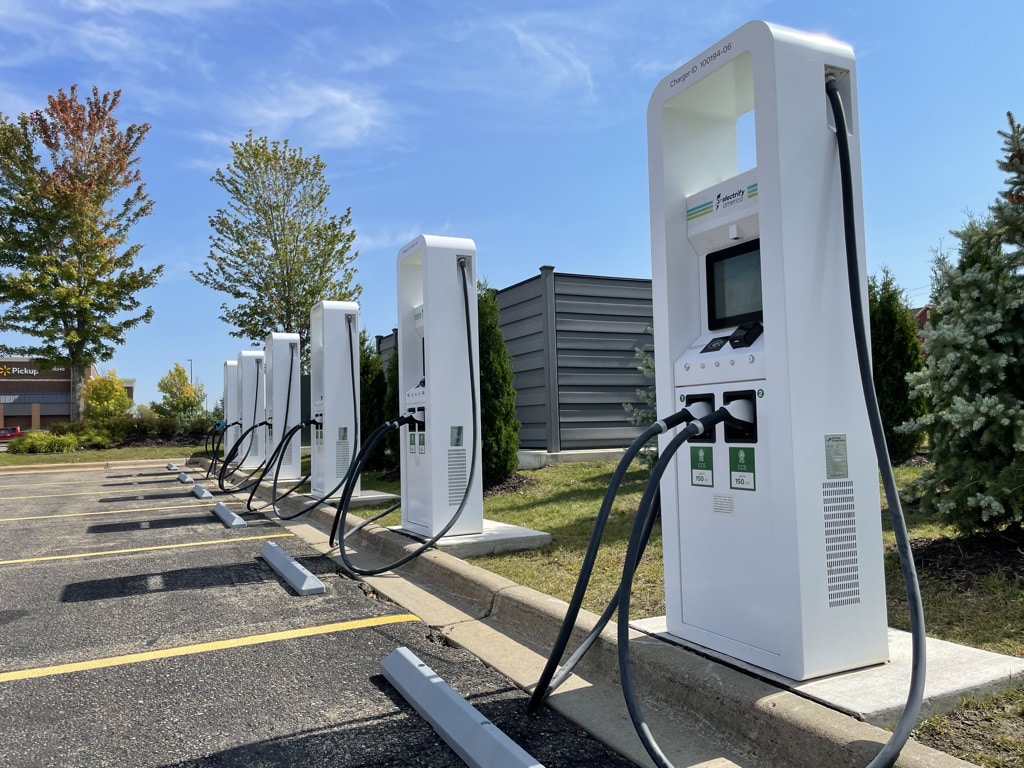
Electrify America has opened its largest public charging station to date, a 24-stall hub in Orlando, Florida, built to serve both local drivers and the steady stream of travelers heading to the city’s airport and theme parks.
The company announced the opening this week at the Sand Lake Corners South shopping center.
What the new station offers
The new facility features 24 DC fast chargers, each capable of delivering charging speeds of up to 350 kilowatts, located at 8111-8481 South John Young Parkway.
The site sits within convenient reach of Interstate 4, Orlando International Airport, and some of Central Florida’s biggest attractions, including Walt Disney World and Universal Orlando Resort.
Each of the 24 chargers features a CCS connector and supports charging speeds up to 350 kW, although actual charging performance will depend on the vehicle’s capabilities, battery temperature, and other conditions.
All 24 chargers at Sand Lake Corners South feature CCS plugs only, meaning Tesla and Rivian drivers would need an adapter to use it, though Electrify America is testing NACS connectors at selected sites, including another station at Florida Mall in Orlando.
The shopping center location means drivers can shop or eat while their vehicles charge, a layout Electrify America has leaned into at its newer large-format sites.
Florida’s growing role in charging infrastructure
Florida is an especially important market for public charging expansion. Florida already operates more than 350 chargers at over 60 sites across the state, where the company says had the second highest number of registered EVs in the US in 2025 after California.
Electrify America already operates more than 350 chargers at 60+ stations across the state.
Another Orlando site, with 10 chargers at 10226 Curry Ford Road, is expected to open in the coming months, although the company hasn’t announced a specific opening date.
Anthony Lambkin, vice president of operations at Electrify America, framed the opening as part of a longer-term push into the state.
“This new station in Orlando represents our continued commitment to bringing fast, reliable and convenient charging to Florida,” said Anthony Lambkin, vice president of Operations at Electrify America. “Florida’s EV community is growing fast, and we’re excited to keep growing with it.”
Part of a wider buildout
The Orlando hub follows a similar large-format station Electrify America opened in Santa Barbara, California, in June, which featured 20 charging bays with power outputs of up to 350 kW and incorporates a 1.9 MW battery energy storage system (BESS).
The approach reflects a shift among charging networks toward fewer, bigger sites designed to reduce waiting and serve more drivers at once, rather than scattering smaller clusters of two or four stalls across a region.
Nationwide, federal data tracked by the Alternative Fuels Data Center put Electrify America’s total footprint at more than 6,000 DC fast charging ports across roughly 1,200 stations as of mid-October, according to industry tracking.
The company has also been rolling out a separate white-label charging program, called a turnkey, white label offering that helps businesses own and operate their own branded EV charging networks without the complexity of building and managing one themselves , letting retailers such as Wawa and Costco brand and operate their own stations on Electrify America’s network, an approach the industry has watched closely as competition in public charging intensifies among operators, automakers and retailers alike.
Rival networks have been expanding in parallel. Automaker-backed charging consortium Ionna recently doubled its US footprint since the start of the year, while retailer EVgo has moved to deploy branded Supercharger-style stations nationwide.
The competition comes as public charging remains a central bottleneck for EV adoption, with drivers in many states still reporting long waits at smaller stations during peak travel periods.
Electrify America has not disclosed the construction cost of the Orlando site or said whether similarly sized large-format stations are planned for other Florida cities.
