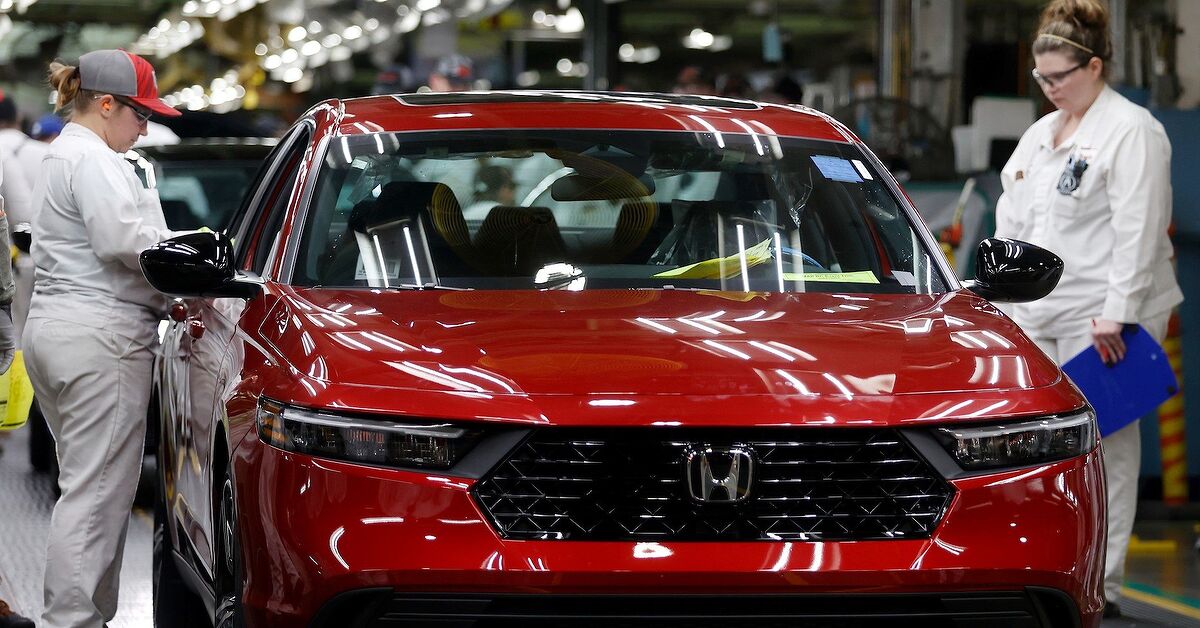
A dealership lot in Ohio tells the story without a single word of marketing copy on it.
Rows of gas electric crossovers sell almost as fast as they arrive.
Tucked in a back corner sits a lone electric SUV with a sticker that keeps getting marked down.
That contrast between the crowded hybrid row and the quiet EV corner is no accident.
It reflects a real split in what buyers are choosing to drive home this year.
So why did one powertrain take off while the other stalled.
The mechanism: why hybrids are winning the showroom floor right now
The math is simple at the pump. The automaker’s hybrids carry a higher sticker price than their gas counterparts, but they claw that money back through fuel savings, and with gas prices elevated this year, that payback period has gotten dramatically shorter for ordinary commuters.
That shift matters because hybrids no longer feel like a niche upgrade. They behave like a regular gas vehicle at the pump and on the road, with no plug and no charging anxiety, while still cutting fuel bills noticeably.
Meanwhile the math on a pure EV got harder. The federal EV tax credit of up to $7,500 expired in September 2025, erasing a meaningful price cushion that had pulled hesitant buyers toward the brand’s only all electric model, the Prologue.
Hybrids simply became the easier emotional choice.
The scene: a sales chart with two powertrains moving in opposite directions
The automaker’s own sales reports show just how lopsided the summer became. Americans purchased 36,609 hybrids in July, setting a new July record, as the national gas average climbed to $4.10 per gallon.
The CR-V carried most of that weight. Hybrid variants accounted for 54% of all CR-V sales, with CR-V Hybrid volume reaching 20,710 units for an 18.4% year-over-year increase. That single model line is doing more work than almost anything else in the lineup.
The Accord told a similar story. The Accord Hybrid ran a 41% sales mix and climbed 28.7%, while the Civic Hybrid, at a 32% mix, slipped 6.8%, a sign the surge is not spread evenly across every nameplate.
Now place the Prologue next to those numbers. The outgoing Prologue electric crossover, by contrast, dropped 75.4% as dealers moved 1,554 units in July, and sales will be discontinued with the 2026 model year, reflecting weak demand, with the company instead prioritizing hybrid and traditional internal combustion engine models in the US. One powertrain is breaking records while the other is being wound down in the same showroom.
The hard evidence: a filing that confirms the pivot is deliberate
This is not just a sales blip buried in a monthly press release. A regulatory filing spells out a multi year spending shift away from electric vehicles and toward gas electric hybrids as stated corporate strategy, not a guess from outside analysts.
According to that filing, during the three-year period until the fiscal year ending March 31, 2029, Honda will reallocate resources it had scheduled to invest in EVs to hybrid vehicles, and control EV-related investments at a level of approximately 0.8 trillion yen. Honda will invest 1.0 trillion yen in software technologies and 4.4 trillion yen in gasoline and hybrid vehicles, resulting in total resource investment of 6.2 trillion yen during this 3-year period.
That is a company putting its money where its sales data points. The automaker also confirmed to multiple outlets that after roughly two years on sale, the Honda Prologue will be discontinued after the 2026 model year, closing the book on the only fully electric model it currently builds for American roads.
Honda has pointed to soft EV demand industry-wide as the reason for the pullback, a trend that has also weighed on battery electric sales across the market over the past year and a half.
Where the hybrid bet gets complicated
None of this means the automaker is walking away from electrification entirely. It is reportedly weighing whether to make its two biggest sellers, the Accord and the CR-V, hybrid only by around 2030, following in the footsteps of Toyota’s decision to drop the gas-only RAV4 and Camry.
But going hybrid only carries a real cost that a sales chart does not show. A hybrid powertrain uses costlier internal parts than a standard gas engine, and that gap shows up directly on the window sticker.
The CR-V makes that tradeoff visible. The 2026 CR-V starts at $30,920 with its 1.5-liter turbocharged gas engine, while the least expensive CR-V Hybrid, the Sport Hybrid, starts at $35,630, so dropping the gas version would erase the lowest cost entry point that budget conscious shoppers rely on.
Plug in hybrids and future EV platforms remain on the roadmap even as the Prologue exits. Rivals across Detroit are watching closely, as seen in GM’s own compact hybrid SUV sales records this year.
What it means for buyers and the industry watching closely
For an ordinary shopper walking a lot this fall, the takeaway is straightforward. Hybrids now sit at the center of the lineup rather than the edge of it, and dealers are stocking accordingly.
That also reshapes how fast other automakers move. Several US and Japanese brands have pulled back EV spending this year in favor of expanding hybrid offerings, a pattern that looks like an industry wide recalibration.
Even so, the EV story is not over everywhere. Other brands are still posting strong plug in growth, much like the surprising resilience seen in used EV pricing this year despite a flood of returning lease vehicles.
What happens next likely depends on gas prices holding steady and whether a revived federal incentive returns. Until then, the hybrid aisle looks like the busiest corner of the American new car market.
