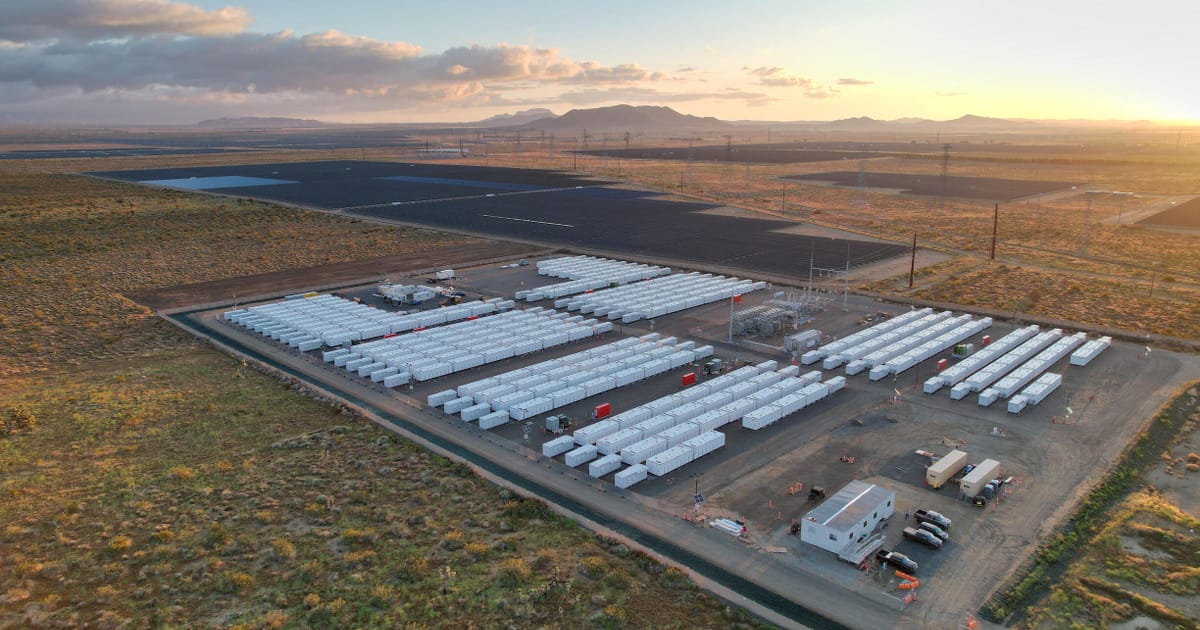
A stretch of Kern County desert now hums with rows of white steel boxes stacked beside endless solar panels.
Each box holds thousands of battery cells wired to soak up sunlight the grid cannot use at noon.
By dusk, those same boxes start pushing that stored power back out across California.
This month, the facility is doubling in size, on paper and on the ground.
So how does one solar field end up holding more stored power than any other site connected to the US grid?
What actually lets one field store this much power
The trick is not a new battery chemistry or some experimental breakthrough. It is simple scale paired with timing: the facility was built with room to add a second identical phase, and that expansion plan is maturing into steel and wiring this fall. The result is a side by side pairing of solar panels and lithium battery racks sized almost equally in megawatts.
Because the batteries sit right next to the array, power barely travels before it gets stored. That cuts transmission losses and lets the site capture nearly all the solar energy it generates during the sunniest midday hours, rather than sending surplus power to a grid that often does not need it then.
The facility, known as Bellefield, began with 500 megawatts of solar paired with 500 megawatts of storage when it came online in December 2025. That one to one ratio is what let operators plan a second phase without redesigning the interconnection.
Doubling an existing site is also simply faster than building new. The land, substation and grid connection already existed.
Inside the numbers behind the record
Federal energy data lay out the plan in stark, specific figures. Plans for Bellefield call for doubling both PV and storage capacity, with the new capacity expected to be operational by this November. That would push the site toward roughly 1,000 megawatts of solar and 1,000 megawatts of battery storage working in tandem.
The next closest project on the storage side is Florida’s Manatee Solar Energy Center, which has run since 2021 pairing 75 megawatts of solar with 409 megawatts of storage, a far smaller battery footprint than Bellefield is set to carry.
Why build the battery side this large? California’s electricity prices swing hard. Solar floods the grid at midday and prices often turn negative, then spike again once the sun sets. A battery bank this size is designed to capture that entire swing.
None of that happens without the broader boom reshaping the state’s grid. California’s utility-scale storage capacity has grown from under 700 megawatts in 2019 to more than 21,000 megawatts today, according to the state’s energy commission.
Where the hard data comes from and what it measures
The milestone is documented in the Energy Information Administration’s Preliminary Monthly Electric Generator Inventory, the same dataset agency analysts use for their Today in Energy briefs. That report tracks every utility-scale generator and battery system as it comes online, project by project, state by state.
Nationally, that dataset shows the pattern Bellefield fits into. Battery storage capacity grew at an average annual rate of 70 percent over the last three years, reaching nearly 52 gigawatts of nameplate capacity by this past June, a trajectory federal forecasters expect to keep climbing as storage capacity hits new highs over the next two years.
Much of that fleet sits beside solar rather than standing alone, since solar photovoltaic plants host the largest battery storage units in the country. Pairing the two lets operators store power when wholesale prices are low and discharge it later when prices are high, capturing a larger profit.
That arbitrage logic is what makes a project this size financially viable. Storing cheap power and discharging it during the evening peak remains the single biggest use case for grid batteries nationwide.
The limits nobody should skip past
Even a record holder has a shelf life. California’s grid operator has queued still larger projects, and most storage records in this market get broken within a year or two of being set. Bellefield’s claim to the top spot, once confirmed, is unlikely to last long, especially with a backlog of proposed projects still waiting on interconnection studies nationwide.
There is also a duration limit worth noting. Most lithium plants, Bellefield included, are built around four hours of continuous discharge rather than the eight or more hours that longer duration projects elsewhere in the state are starting to deliver. That gap is covered in recent reporting on a different Kern County battery built for twice that duration, and scale alone does not solve every grid problem. A battery this size smooths daily price swings, but it cannot replace steady baseload power the way a nuclear or geothermal plant can.
Even so, one site set to hold roughly 1,000 megawatts of paired solar and storage shows how far the economics have shifted in under five years.
What the record means for ratepayers and the grid ahead
For an ordinary California ratepayer, the effect is quieter than the headline number suggests. More stored solar at dusk means fewer gas plants firing up during the evening spike, which can ease wholesale prices when air conditioners and lights peak together.
That is the same mechanism now playing out at smaller scale across dozens of similar projects nationwide, from Texas to Arizona, as developers race to pair batteries with new solar fields rather than build either alone.
Whether Bellefield holds its title through next year is almost beside the point. The bigger story is that doubling a solar and storage site toward the thousand megawatt mark is now routine enough to finish on a single construction timeline, not a decade long feat reserved for one flagship project.
That shift is what planners will be watching as similar expansions move from blueprint to switched-on hardware across the country.
