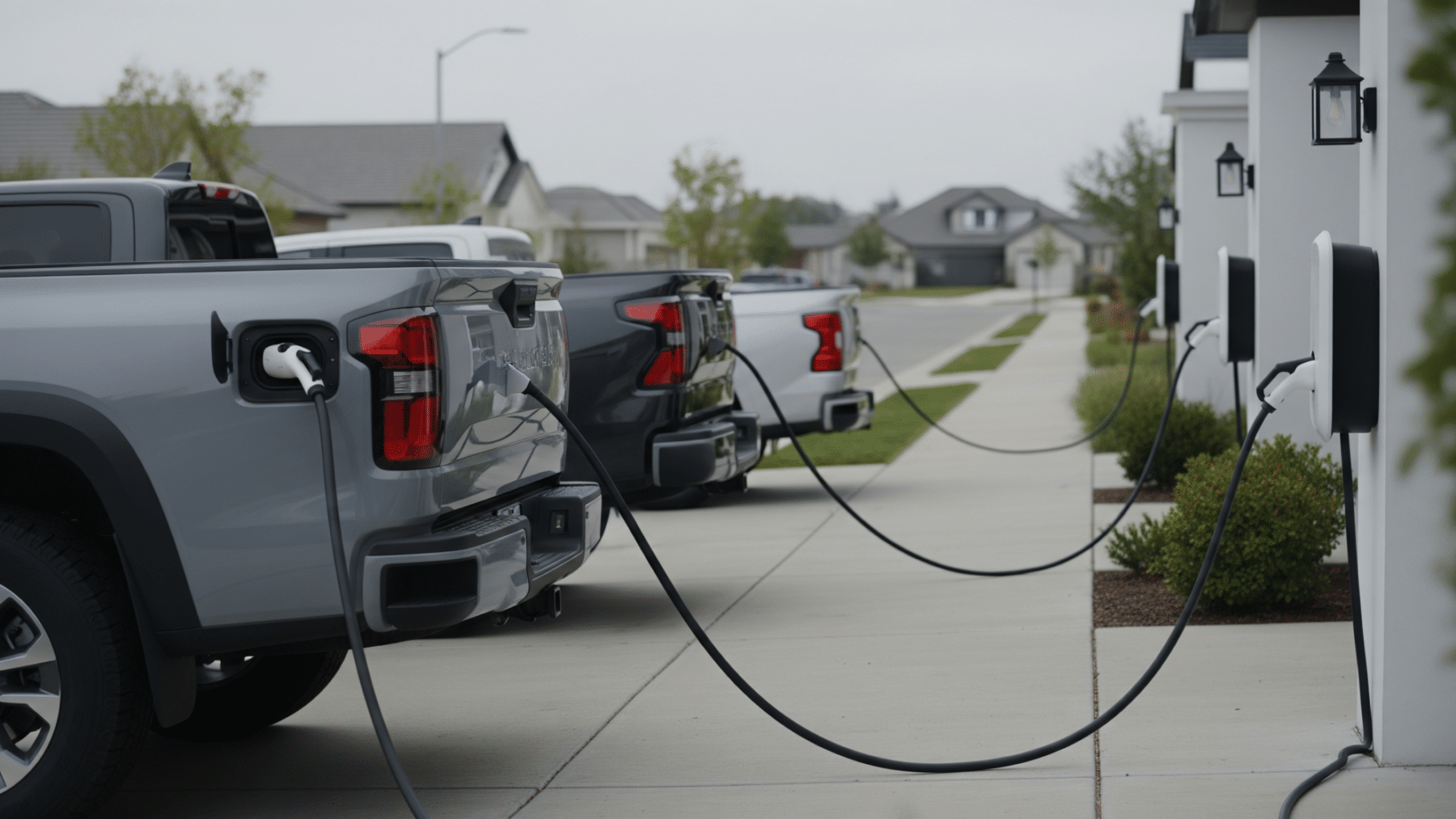
Something changed on American driveways this summer, and most drivers never noticed it happen.
A software update arrived the way they always do, and the vehicles it touched became something fundamentally different the moment it finished installing.
Not a new car. Not a new charger. Not a single dollar spent at a dealership.
The shift is real, it is already underway, and it is about to collide with one of the most urgent numbers in American power.
The grid is facing a load surge that no one had on their five-year plan
The five-year forecast of U.S. utility peak load growth has reached 166 gigawatts projected by 2030, a sixfold increase over the flat growth that was forecast in 2022.
That is not a rounding error. That is a sixfold increase over the near-flat growth that was expected just three years ago. Much of the higher estimate is due to data center development, which is expected to account for roughly 90 gigawatts of the new peak demand growth, with manufacturing accounting for another 30 gigawatts and the remainder coming from building and transportation electrification, mining, and other loads.
The evening surge is a core piece of that remainder. Utilities push EV owners toward time-of-use rates that encourage charging overnight, away from weekday late afternoons when demand peaks.
Persuading millions of drivers to shift habits voluntarily, night after night, is a slow game. The DOE’s draft transmission study warned that load growth demands a grid expansion effort without modern precedent.
Thirty-two states moved on managed charging in a single year, and the race to sign up drivers was closer than it looked
In 2025, legislative or regulatory efforts in 32 states and Puerto Rico addressed improving residential access to managed charging, according to the North Carolina Clean Energy Technology Center’s annual EV policy review.
Utilities want the same thing automakers want: enrolled drivers, vehicles on the platform, real load they can shape.
Two competing platforms are running hard to capture that enrollment. ChargeScape is a vehicle-to-grid joint venture announced by BMW, Ford, and Honda in September 2023 and formally launched in September 2024 , with Nissan entering into an agreement to join as an equal 25% investor in October 2024. It enables passive managed, active managed and bidirectional charging frameworks.
The numbers reveal how early this market still is. DTE Energy received regulatory approval to extend its program through 2026 and as of mid-2025 had roughly 1,400 customers enrolled through ChargeScape and over 1,300 through WeaveGrid.
Those are useful pilots. They are not yet scale.
The platform war between automakers is reshaping who controls the charging window
Utilities are tapping the flexible capacity of EVs on U.S. roads as data-center demand strains the grid, according to ChargeScape’s CEO.
An EV parked at home for most of the day is not just a consumer appliance. It is a dispatchable battery on wheels.
Bidirectional charging allows energy to flow from vehicle batteries back into homes or the grid itself. But it has required specific hardware on both the car and the charger, a friction point that has kept rollout slow.
Rivian partnered with ChargeScape, the automaker-owned vehicle-grid integration platform, to enroll Rivian’s EV batteries in utility managed-charging programs across North America. Rivian’s electric vehicles, which feature some of the largest battery capacities in the market, will be able to contribute flexible energy resources to help utilities manage peak electricity demand. Rivian’s large battery packs matter because bigger batteries offer more grid flexibility when participation scales broadly.
That deal landed on June 16, 2026. One week earlier, a different automaker had made a move the industry is still processing.
GM released a firmware update giving existing vehicle-to-home customers vehicle-to-grid capability, with no new hardware modification required
General Motors announced progress that brings that vision closer to reality, including vehicle-to-grid capability for existing GM Energy vehicle-to-home customers through a firmware update, plus work with DTE Energy in Michigan and a long-term vision with PG&E in Northern California.
Every compatible GM vehicle already on the road, already in a garage, already paid for by a GM Energy vehicle-to-home customer, can now export power back to the grid without its owner returning to a dealer or buying additional hardware.
On June 9, General Motors announced a software update enabling certain U.S. electric vehicle owners to transmit power back to the electric grid, expanding the existing vehicle-to-home system, which already allows EVs to supply residential power during blackouts.
That trajectory, combined with a no-hardware barrier for enrolled owners, puts GM in a materially stronger position than rivals still requiring customers to upgrade equipment before joining utility vehicle-to-grid programs.
Every firmware-only activation GM completes is one fewer hardware upgrade sold by a competitor.
What utilities and grid planners now have that they did not have six months ago
The managed charging market is moving from persuasion to infrastructure. The difference matters enormously for grid operators trying to close a 166-gigawatt gap.
Through EV managed charging programs, charging can be shifted in time to support grid reliability and reduce electricity costs. The firmware route compresses the timeline for doing that at meaningful scale.
GM says it is talking with around ten utilities, while GM Energy says it already has thousands of vehicle-to-home users. GM has announced work with DTE Energy in Michigan and a long-term vision with PG&E in Northern California. GM has stated plans to make bidirectional capability standard on future EVs, and according to GM Energy’s Chief Revenue Officer, commercial rollout focused initially on Texas and California is expected to start in the coming months. Regulators are now developing the frameworks that will govern how enrolled EV fleets are counted as dispatchable resources on the transmission system.
For ordinary drivers, the near-term consequence is straightforward: utilities in Michigan and California are now prepared to pay enrolled GM owners for the power their parked trucks and SUVs push back onto the grid during peak hours.
A firmware update that most people slept through may, in retrospect, be the moment the American EV fleet stopped being purely a load problem and started becoming part of the solution.
