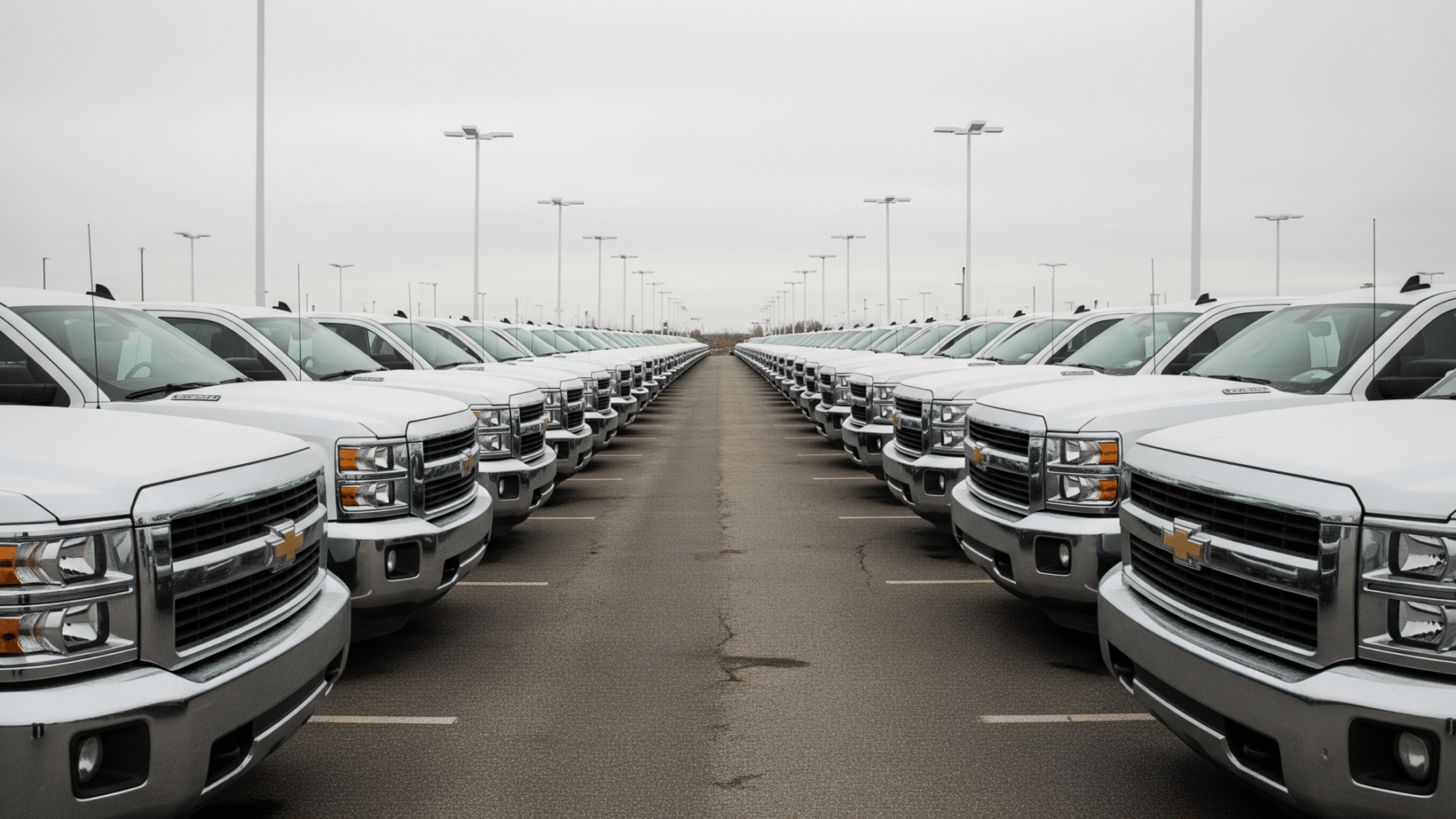
General Motors, Ford and Stellantis are collectively navigating billions of dollars in tariff-related costs in 2026, according to their reported financials and updated full-year guidance, and the three companies are now pursuing sharply different strategies on how much of that burden reaches the buyer’s window sticker.
Q2 results reveal a widening split
Second-quarter results show that automakers are absorbing tariffs and other market pressures with varying degrees of success, making their ability to protect margins increasingly important for dealers, as it could shape pricing, incentives and inventory decisions.
GM revised its estimated gross tariff costs downward to $2.5 billion to $3.5 billion for the full year, from an original estimate of $3.0 billion to $4.0 billion. GM CFO Paul Jacobson said tariff costs came in around $900 million in the second quarter and the company expects similar exposure in Q3 and Q4. Ford’s tariff outlook improved from earlier expectations, with the automaker tracking below its previously projected roughly $1 billion in net tariff costs for 2026 and expecting about $500 million in cash recoveries related to tariffs. Stellantis reported a net tariff headwind of €300 million ($346 million) in the first half of 2026, including a €400 million IEEPA tariff refund, and now expects a €1 billion to €1.2 billion net tariff headwind for the full year.
Honda reported a positive year-over-year tariff impact, with earnings benefiting substantially from lower tariff-related pressure than in the prior-year period, while Toyota and Mercedes-Benz did not disclose their second-quarter tariff charges.
The divergence reflects how differently each company’s supply chain is configured. Last year, more than 40 percent of the 1.2 million vehicles Stellantis sold in the United States were imports, mostly from Mexico and Canada, making the Jeep and Ram parent one of the most exposed of the Detroit names.
Sticker prices and destination fees climb
U.S. auto tariffs have added substantial costs to the automotive industry, leading to increases in average vehicle MSRPs. Imported vehicles bore the brunt, with price hikes ranging into the thousands of dollars per vehicle, while domestic vehicles also saw increases due to higher material costs for steel and aluminum.
Automakers have also adjusted pricing strategies by incorporating costs into destination fees, which reached record highs for 2026 models. Analysts tracking 2026 model pricing are seeing those vehicles come in notably higher on average compared to last year, with luxury imports hit hardest, but even domestically assembled vehicles are affected, since no U.S.-made car uses 100 percent domestic parts.
Incentives fill some of the gap
Rather than pass every dollar of tariff cost directly to buyers, many brands have leaned on incentives to protect sales volume. With leftover 2025 models still sitting on dealer lots, manufacturers are offering incentives including zero-percent financing deals and cash rebates to move inventory.
The federal EV tax credit of up to $7,500 on electric cars and plug-in hybrids expired on September 30, 2025, due to the One Big Beautiful Bill Act. With the purchase credit gone, some manufacturers have leaned harder into lease incentives and cash-back offers to keep EVs moving off lots.
For context on how off-lease EV values have responded to those shifts, the downstream impact on used lots has been substantial.
When a manufacturer quietly pulls an incentive that existed six months ago, that is often a tariff-related margin recovery that is not reported as a price increase, according to automotive pricing analysts. Buyers focused only on the sticker price can miss the real cost increase hidden in reduced support programs.
Trade framework offers partial relief
The EU-US trade deal took effect July 1, 2026, capping most EU-origin goods, including automobiles, at a 15 percent all-inclusive U.S. tariff ceiling. That deal eases cost pressure on German brands including BMW, Mercedes-Benz and Volkswagen Group, which together account for a significant slice of U.S. luxury sales.
The Supreme Court struck down the IEEPA tariffs on February 20, 2026, holding that IEEPA does not authorize the president to impose tariffs. President Trump promptly announced a replacement 15 percent tariff on all countries under Section 122 of the Trade Act of 1974. Section 232 tariffs on steel, aluminum and automobiles remain fully in effect, and automakers still face billions in additional costs depending on the origin of imported vehicles and parts.
The One Big Beautiful Bill Act, signed into law on July 4, 2025, ends the new, used and commercial EV tax credits on September 30, 2025. The legislation also introduced a new deduction of up to $10,000 per year in interest on qualifying new personal-use vehicles, available for loans originated after December 31, 2024.
That provision adds a new layer of complexity to the incentive calculus, potentially steering buyers toward U.S.-built models even as import-reliant brands compete on financing terms.
