You have almost certainly watched one at an aquarium and had no idea what was actually going on.
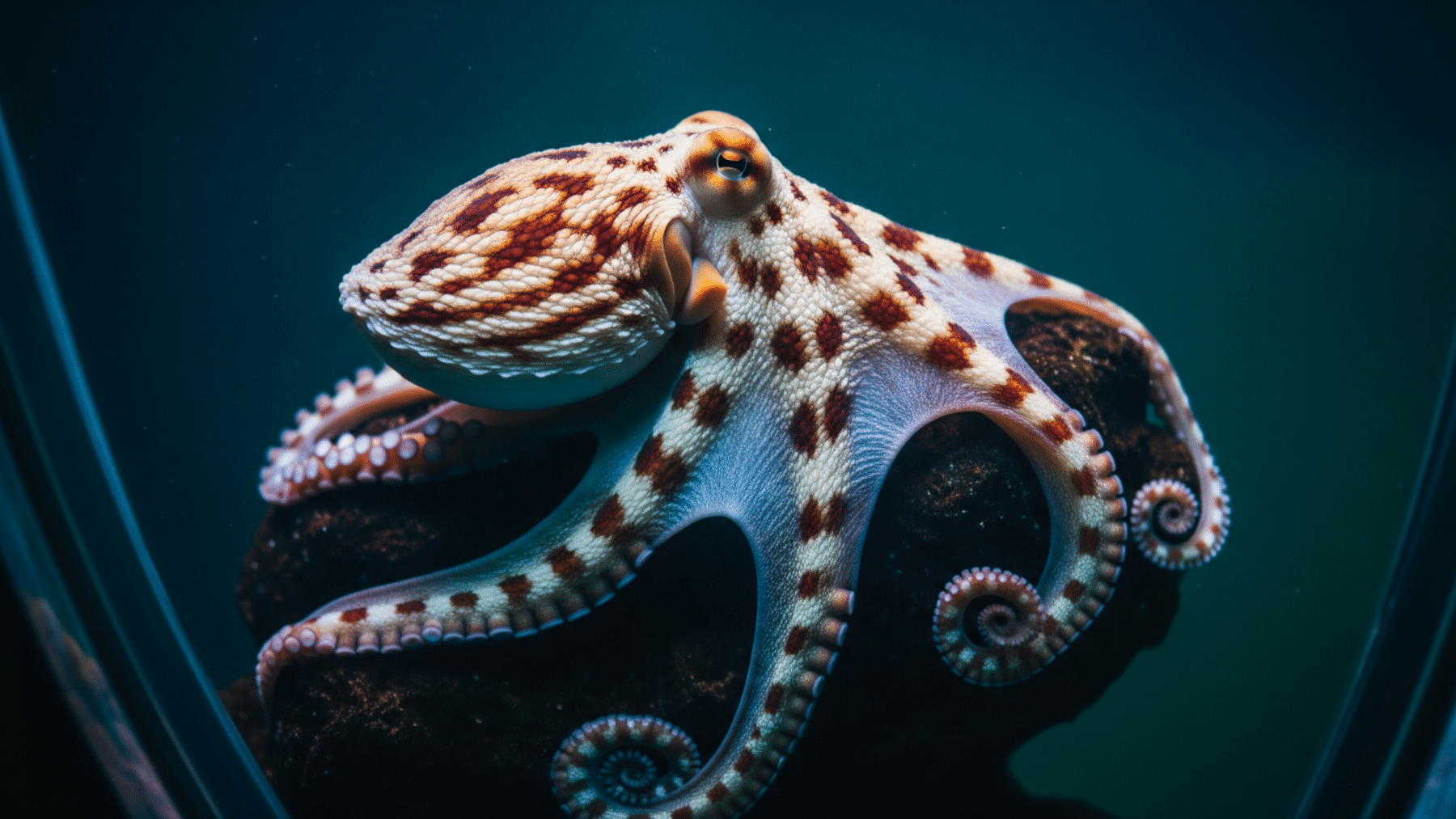
The octopus sitting motionless in its tank, skin quietly pulsing color, looks like it is simply resting. It is doing something far stranger than that.
And now, scientists have the brain evidence to prove it.
The animal in the tank that almost nobody really watches
Walk past an octopus exhibit and most people glance for a few seconds and move on.
The animal is usually still. Its arms are loosely curled. Its eyes are shut.
But look for long enough and something unsettling starts to happen.
The skin begins to shift. Amber bleeds into rust. Pale patches flare and vanish. The arms give a single slow twitch.
Then it stops, and the animal goes pale and still again, as though nothing happened.
A skin display that confused researchers for decades
Scientists have known for years that octopuses change color while they sleep.
The puzzle was always why it happens, and what, if anything, it means for what is going on inside their minds.
The color changes happen in two stages. Octopuses cycle through quiet sleep, where they stay still and pale, and then something else entirely.
That second state, active sleep, is where things get remarkable.
During active sleep, octopuses display rapid changes in skin color and texture, visible twitching, and noticeable body movements.
These active sleep episodes occur every 30 to 40 minutes and last around 40 to 60 seconds.
Think about that. A full light show. Gone in under a minute. Then silence.
The number that made the comparison almost impossible to ignore
Here is where the timeline gets striking.
Octopuses and mammals are separated by roughly 550 million years of evolution, and yet both exhibit a REM-like sleep state.
Five hundred and fifty million years. That is longer ago than the first fish with a backbone.
These animals are about as distantly related to us as any creature alive.
Octopuses have a very different brain structure to humans, but they have independently evolved large brains and share some of the same functions as mammal brains.
Scientists have spent years wondering whether this parallel means anything real, or whether it is just a coincidence written in skin pigment.
It turns out the skin was telling the truth the whole time.
Just as researchers studying human memory found that the wandering mind is doing real cognitive work even when it seems idle, the same logic now applies to a creature most people assume has no inner life worth measuring.
What the brain readings confirmed, and why it changes the picture entirely
Researchers at the Okinawa Institute of Science and Technology (OIST), in collaboration with the University of Washington, went deeper than the skin.
They measured brain activity during those vivid color-flashing episodes and found direct links between neural firing and the patterns playing out across the animal’s body.
The researchers examined the brain activity and skin patterning of Octopus laqueus, a tidal-pool species, and confirmed that not only is the animal asleep during these active sleep moments, but its skin flashes with vivid color, its eyes and arms twitch, and its breathing rate quickens. Roughly once an hour, each octopus entered an active sleep phase lasting around a minute.
When awake, octopuses change colors and textures to camouflage with their surroundings or communicate.
But during sleep, the color changes are driven by brain activity and are unrelated to their environment.
That distinction matters enormously. The skin is not reacting to the tank wall or the light.
It is reacting to something internal, something the brain is generating on its own, in the dark, with the eyes closed.
The study was published in Nature, with the research team describing the active sleep state as containing wake-like neural activity analogous to REM sleep in vertebrates.
Separately, Brazilian scientists found that the octopus switches between active and quiet sleep just as humans switch between deep sleep and REM sleep, publishing those behavioral findings in the journal iScience.
Together, the findings show how sleep may have evolved in a similar way in very different creatures.
What this means for how we think about the minds around us
The question scientists are now wrestling with is what, exactly, the brain is replaying during those brief seconds of color.
One theory behind sleep is that an organism rehearses and solidifies traces in the brain from experiences of the previous day. In octopuses, brain activity during quiet sleep was found in regions associated with learning and memory, suggesting the sleeping brain may serve a similar function.
That leads researchers to suggest that if dreaming is linked to what has happened before, octopuses might dream.
That idea connects to something researchers studying human memory have also found: memory consolidation is far more active and surprising a process than most people assume.
Octopuses have special learning abilities, including being able to solve problems and other sophisticated cognitive abilities. The sleep state may be how those abilities are maintained.
Nobody is claiming the octopus in your local aquarium is replaying a vivid underwater hunt in high definition. The science is careful about that.
But the brain evidence now makes the alternative, that those flickering seconds of color mean nothing at all, the harder position to defend.
The next time you stop at the tank, look for the one that has gone still and pale. Wait a while. Then watch what its skin does, and consider that you may be watching something dream.
