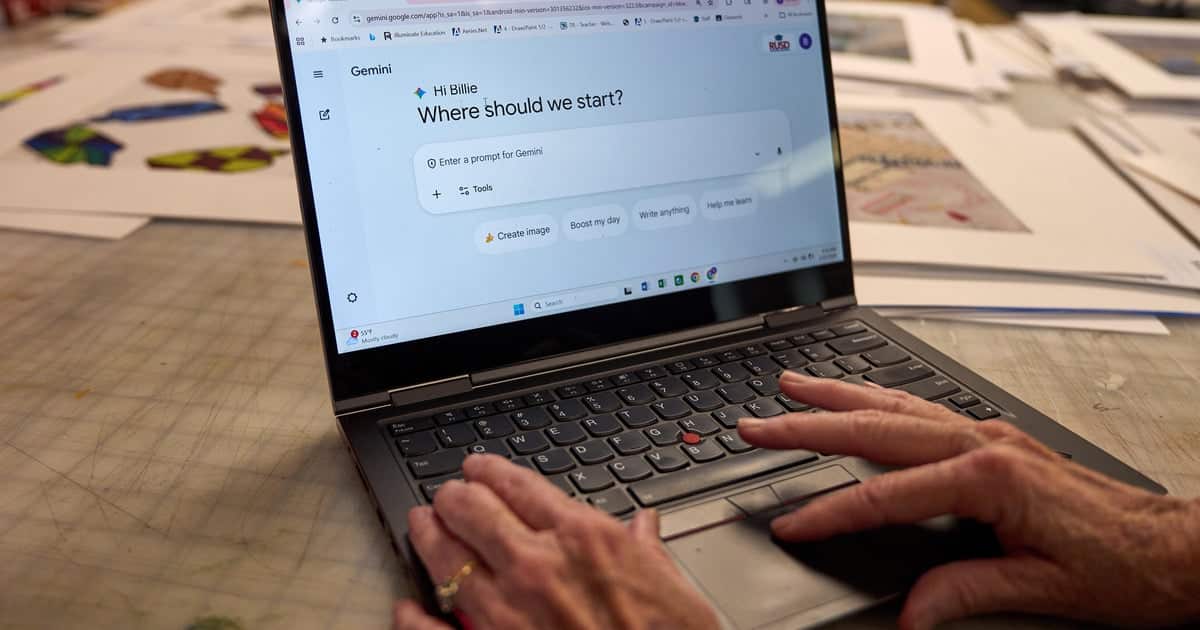
A widening generational divide over artificial intelligence is reshaping how American families talk about technology at home. New Pew Research Center data released this month finds that roughly half of US adults say they never use chatbots, even as most teenagers now rely on them regularly.
That gap creates blind spots for parents trying to supervise a tool their kids already use daily.
Half of adults are opting out entirely
According to Pew’s October short read, although chatbot use is rising in the United States, about half of U.S. adults say they never use one, according to Pew Research Center’s February survey of U.S. adults. The pattern is heavily tied to age.
Across all adults surveyed, 51% said they had never used an AI chatbot, including 77% of adults 65 and older and 58% of those ages 50 to 64, according to Pew’s data.
The non-user shares were 39% among adults ages 30 to 49 and 34% among those 18 to 29, Pew found.
The research is based on a survey Pew conducted among 5,119 U.S. adults from Feb. 17 to 23, 2026, and the survey represents the views of the full U.S. adult population.
Most adults who have never tried a chatbot are not waiting to be convinced. Two-thirds of non-users said they were not too likely or not at all likely to use a chatbot in the next 12 months, while 16% said they were somewhat likely and 5% said they were very or extremely likely. Pew said 40% of non-users placed themselves in the “not at all likely” group. Lack of interest was the most common major reason among non-users, cited by 60%. Concerns about how personal information would be used followed at 54%, while 45% cited doubts about chatbot accuracy as a major reason.
Teens are moving in the opposite direction
While half of adults sit out entirely, a separate Pew study of teenagers and their parents shows the rising generation has already normalized chatbot use for everyday tasks. According to the survey detailed by Pew’s companion study on parents, 64% of U.S. teens report using chatbots.
Most teens reported turning to chatbots for research or schoolwork help rather than casual conversation. According to reporting on the study, 57% of teens use AI to search for information, while 54% use it to help with schoolwork.
The gap between generations shows up most starkly inside individual households. A total of 64% of U.S. teens report using chatbots, but only 51% of parents think their teens use the technology, and many more have no idea whether their teen uses AI at all.
That means a meaningful share of parents are unaware of, or underestimate, what their kids are actually doing online. As Pew’s Monica Anderson put it, “a healthy share of parents, close to three in 10, told us they’re not sure if their teen is using these tools or not.”
Few households are talking about it
Despite that uncertainty, conversation at home has not fully caught up, according to Pew’s findings on parent-teen discussions of AI chatbots.
That leaves a share of families without clear shared ground rules for a technology that is already embedded in homework routines, research projects and casual questions.
The disconnect mirrors other recent findings about how differently generations relate to new tools and to each other. A recent AARP survey on cross-generational friendships examined how often Americans maintain regular contact with people 15 or more years their senior or junior.
That pattern may compound the AI gap, since older relatives can have fewer casual chances to see how younger family members actually use the technology day to day.
Why the divide matters for families
Pew’s researchers frame the adult findings around recurring reasons for opting out: disinterest, privacy concerns and doubts about accuracy. Those same concerns, when held by a parent or grandparent who has never opened a chatbot, can make it harder to set informed boundaries.
That is especially true for a teenager who already uses one regularly.
The pattern also lines up with broader findings about how differently generations manage screens and connectivity at home. Separate Pew data on parental screen time rules has shown that many parents already set boundaries around devices, even as enforcement tools lag behind.
Chatbots now add a layer those existing house rules were not built to address.
Pew notes that although chatbot use is rising in the United States, about half of U.S. adults say they never use one, and for now these non-users don’t feel like they’re missing out. The research center says it plans to continue tracking the trend as adoption climbs across age groups.
