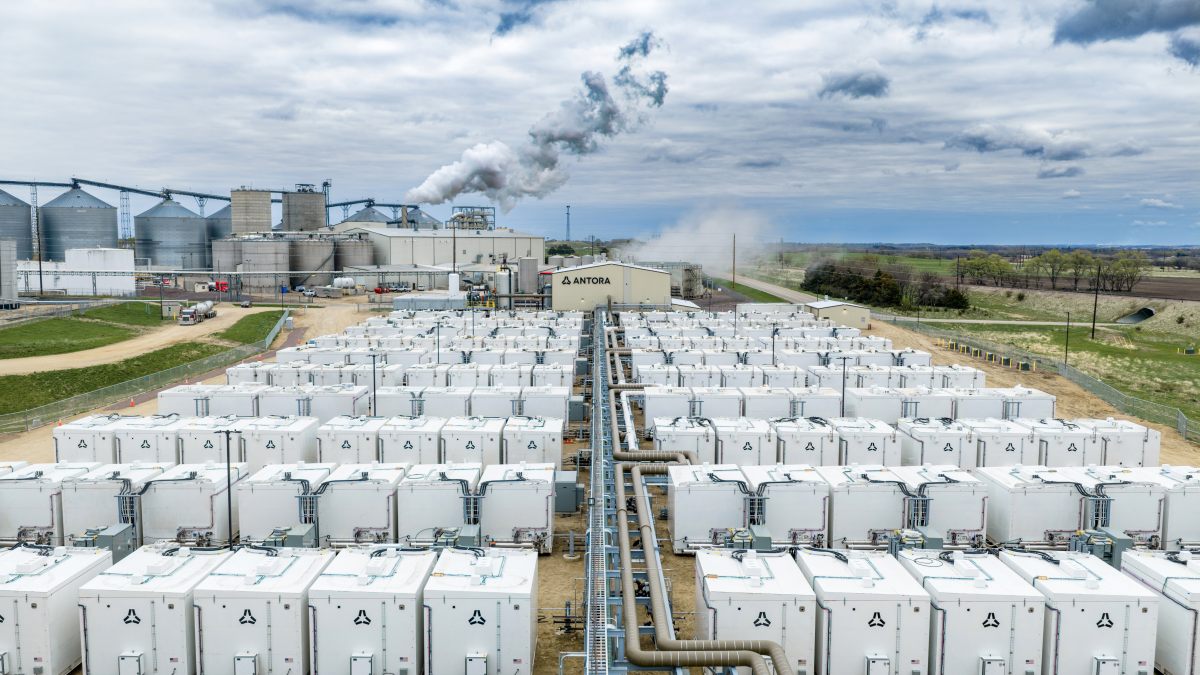
A quiet field in rural Minnesota is filling up with steel enclosures the size of shipping containers, wired together and waiting for winter.
Inside each one sits iron, air and water instead of the usual battery metals.
The project is still under construction.
It will not stop after four or six hours like a normal battery.
It is built to keep going for 100 hours straight.
So what is actually happening inside a battery that runs so much longer than anything else on the grid?
How a battery built from rust keeps pushing power for four straight days
Most grid batteries today use lithium-ion chemistry, the same family of cells found in phones and electric cars. They are fast and efficient, but expensive to scale past a handful of hours, since every extra hour of runtime means buying more of the same costly material.
The iron-air design strips that cost problem out entirely. Instead of lithium, cobalt or nickel, the battery breathes ordinary air and reacts it with cheap iron pellets, letting the metal rust when discharging and un-rust when charging.
Charging strips oxygen from the rust, restoring metallic iron.
So the chemistry that makes a car fender rust in the rain becomes, inside a battery enclosure, a controlled and reversible power source. Because iron is one of the cheapest raw materials on the planet, a developer can pack in far more hours of storage without the price climbing the way it would with lithium.
That tradeoff cuts the other way too. These batteries distinguish the iron-air system from more common short-duration storage technologies, such as lithium-ion batteries, which typically provide between four and eight hours of discharge. The iron-air battery discharges more slowly and loses more energy in the round trip, which is exactly why it exists to do a job lithium cannot.
Picture the actual site and what sits inside those enclosures
The project is called the Cambridge Energy Storage Project, a 1.5 MW/150 MWh multi-day energy storage pilot project between Great River Energy and Form Energy .
That could turn 150 megawatt-hours of stored energy into a multi-day resource for the electricity system. Picture that scale against a familiar four-hour lithium battery of the same power rating.
A 100-hour system storing that much energy would need roughly twenty-five separate four-hour batteries chained together, just to cover the same stretch of time.
Construction is already well along. Great River Energy’s May 2026 integrated resource plan said structures and balance of plant were substantially complete, remaining modules were still awaited, and commercial operation is targeted by the end of 2026.
That timeline matters because Minnesota winters bring exactly the kind of weather this battery is meant for, stretches of gray, windless days when solar and wind generation both sag at once. A four-hour lithium battery empties long before conditions improve, while a multi-day battery is designed to ride out the whole lull.
The company behind it and what the record actually measures
Form Energy, the Massachusetts-based developer of the iron-air chemistry, has described the rating in exact terms. Form Energy’s first commercial product is a rechargeable iron-air battery capable of cost-effectively storing electricity for 100 hours at a time. At full output, that works out to roughly 4.16 days of continuous discharge.
The company is not alone in the space. Various 100-hour multi-day storage batteries have recently been commercialised by Form Energy, Ore Energy and Noon Energy. Noon Energy’s system, which uses a different chemistry built around a reversible solid oxide fuel cell rather than iron, exceeded 200 hours of storage in some tests , though how that holds up at full commercial scale remains to be seen.
Minnesota is only one proving ground. The same chemistry is also drawing far larger commitments elsewhere, including a separate storage deal that is now the largest energy storage project by capacity ever announced .
The demand goes beyond utilities managing weather swings. These systems can help facilities hold critical uptime during multiday lulls, somewhat like how a Buffalo apartment project paired indoor battery storage with a building’s everyday power needs.
Where the 100-hour claim runs into real limits
None of this makes the iron-air battery a universal replacement. Its biggest limit is efficiency, since lithium-ion batteries return about 90% of the electricity you put into them, while Form Energy’s iron-air battery, built from rust, only gives back 40% , because rusting and un-rusting iron simply loses more energy than shuttling lithium ions.
So developers pick the tool for the job. A four-hour lithium battery still wins for evening peak shaving, when power is withdrawn quickly and recharged the next day. Short-duration systems dominate because they hit the sweet spot of the most common revenue streams on the grid today.
A 100-hour battery sits even further out on that curve, built for the rare but costly week when nothing else works. That gap is precisely the opening iron-air developers are chasing, since multi-day storage only has to be cheap enough per hour of runtime to justify a slow-moving reserve.
What a four-day battery means for the grid going forward
If the Cambridge project reaches commercial operation on schedule, it becomes one of the first systems in the country proving out multi-day discharge at real utility scale rather than in a lab. The two companies said groundbreaking has taken place on the Cambridge Energy Storage Project in August 2024 , and grid planners have spent years pricing long-duration storage on paper without many working examples on the ground.
Even so, one small project will not reshape a grid on its own.
Its real value is as a working template, proof that a cooperative serving ordinary Minnesota households can run a battery built on rust rather than rare minerals, sidestepping the kind of supply chain headache that has shadowed lithium and echoed in debates over incentive deadlines like the one in a recent story about a tight December deadline.
None of that guarantees multi-day batteries spread quickly. But the hours on the clock, 100 of them, continuous, on a technology built from one of the most common metals on Earth, give grid planners a genuinely new option heading into the next round of winter planning.
