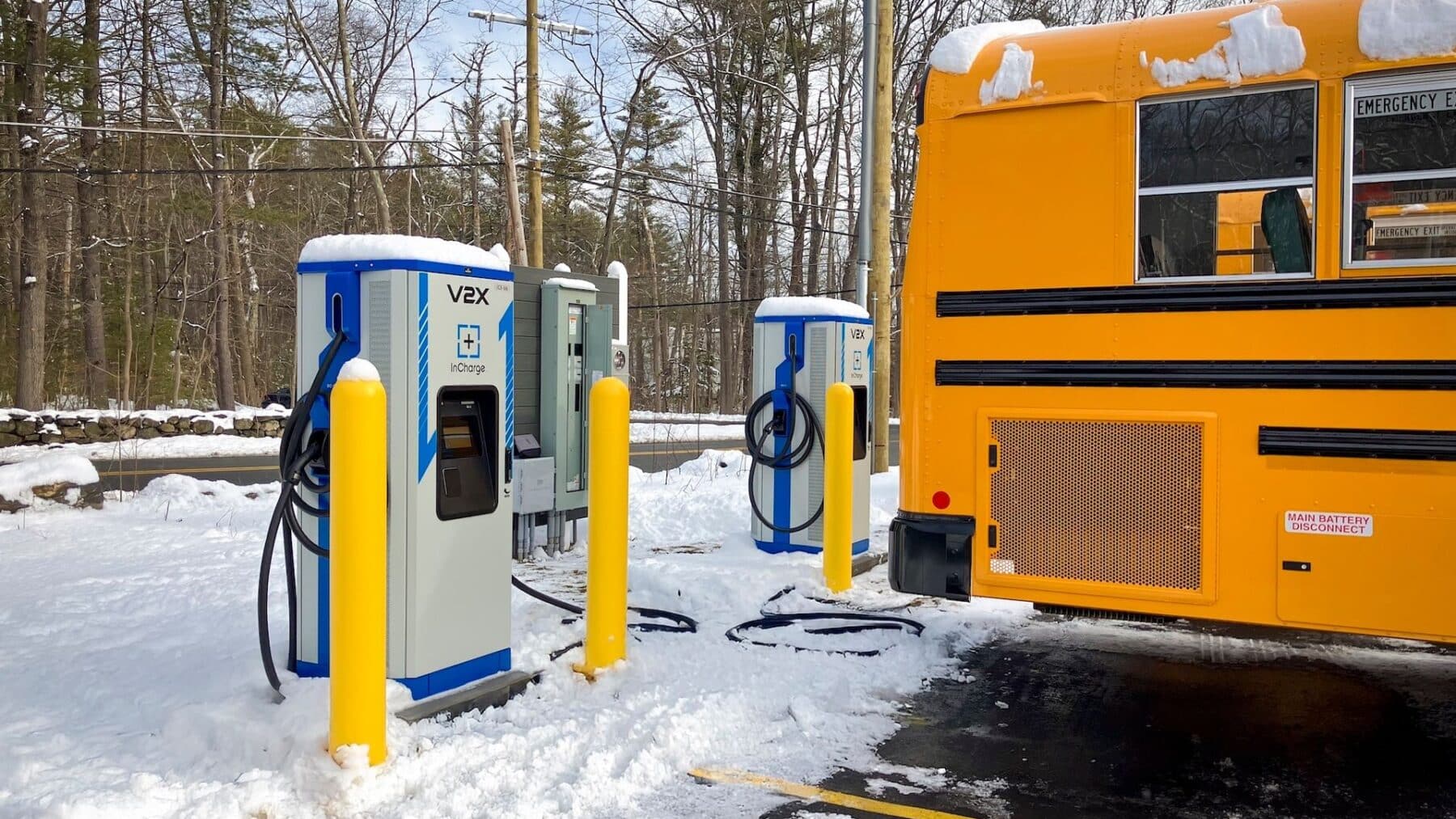
Rows of yellow school buses sit motionless in a fenced lot long after the last student steps off.
Most nights, their batteries just sit there, fully charged and doing nothing.
But on a growing number of these lots, a thick cable snakes from each bus back into the ground.
That cable is not just refilling the battery.
Sometimes, it is draining it on purpose, sending the power somewhere else entirely, and that reversal is where this story starts.
How a parked bus becomes a power plant
The trick is a charger that works in both directions, known in the industry as bidirectional charging hardware. Instead of only pushing electricity into the bus overnight, the same box can pull it back out during the day, when the grid strains under air conditioners and factory loads.
So the bus battery, which might hold somewhere between 150 and 300 kilowatt hours, becomes a kind of mobile energy reservoir parked in a school lot. Utilities call this demand response, and they are willing to pay real money for access to it during a handful of peak summer afternoons each year.
Because school buses mostly sit idle for long stretches, especially in summer when there are no routes to run, they make an unusually convenient battery to borrow from. A Massachusetts utility program called ConnectedSolutions has been paying districts for exactly this kind of access, turning dead time in a parking lot into a revenue line.
Inside the bus lot where the math plays out
Picture a single bus sitting in a depot through a heat wave, plugged in but not going anywhere. That idle time carries real value once a utility agrees to call on it during stress hours, and the value compounds the moment a district stops thinking of one bus and starts thinking of a fleet.
Multiply one bus by twenty, and the numbers scale fast. Guides built for fleet managers now describe a twenty bus program earning thousands of dollars per vehicle every year, enough in some estimates to cover a full-time maintenance position out of parked batteries alone.
None of this requires buses to run differently or routes to change.
The batteries simply sit in the lot doing double duty, charging cheap overnight and selling back expensive during the exact hours utilities need it most. That logic is why manufacturers now build the capability in at the factory instead of bolting it on later; one electric bus maker, Xos, began factory level production of school buses equipped with this technology this April, embedding bidirectional charging directly into the manufacturing stage.
What the pilots actually measured
The Massachusetts numbers come from a specific, documented run. In a pilot tracked by trade press, a single electric school bus discharged about 10.8 MWh into the suburban Boston distribution grid to offset load peaks over two summers, and that idle time was worth nearly $12,000 per season to the district running it.
Other states confirm the pattern. A separate set of pilot tests run across Vermont and Massachusetts discharged over 17 megawatt hours back to local utilities, generating revenue for school districts, according to Highland Electric Fleets, which ran the program.
Industry guides built for school transportation directors now describe two dozen utilities already running some version of the payment structure across multiple states. In Oakland, a deployment tied to a California utility is projected to give back 2.1 gigawatt hours to the grid each year, enough to power hundreds of homes nearby.
Where the battery math gets complicated
Even so, pulling power back out of a battery is not free. Every discharge cycle counts against a manufacturer’s warranty, and fleet operators who skip careful tracking risk a dispute if a pack fails early.
That tension shows up once real dollar figures are run against real fleets. One detailed modeling exercise found a bus fleet’s combined battery capacity could deliver close to 15,000 kilowatt hours to the grid, at a profit of roughly 16 cents per kilowatt hour, but only under favorable assumptions about timing and rates.
So the revenue depends on fine print: how many hours a day a bus actually sits still, how aggressively a utility prices its peak window, and whether a district logs every cycle for warranty purposes. Skip that tracking, and a single denied battery claim can erase a year of grid payments in one stroke, which is why programs increasingly fold this reporting into the same dashboards fleet managers already use, much like the small devices tracking fleet vans daily.
Why this still counts as early days
None of the pilots described here cover a majority of the roughly 500,000 school buses operating nationwide, and most districts running electric buses today have no bidirectional hardware at all. The programs remain concentrated in a handful of states with utilities willing to design the payment structure from scratch.
Even so, the direction is clear, and it shows up on the factory floor. A manufacturer is now building the hardware into every unit coming off the line rather than treating it as a special order, a bet that paid grid service will be what finally pushes more districts to convert.
Fleet operators running electric vans are watching closely too, since the same principle could extend to delivery fleets parked overnight, much like the electric work vans already shipping with fleet tracking built in.
For now, the clearest proof sits in a handful of New England bus lots, where a parked yellow bus quietly turned a summer afternoon into a utility bill credit, and more states are watching to see if the plumbing can scale.
